

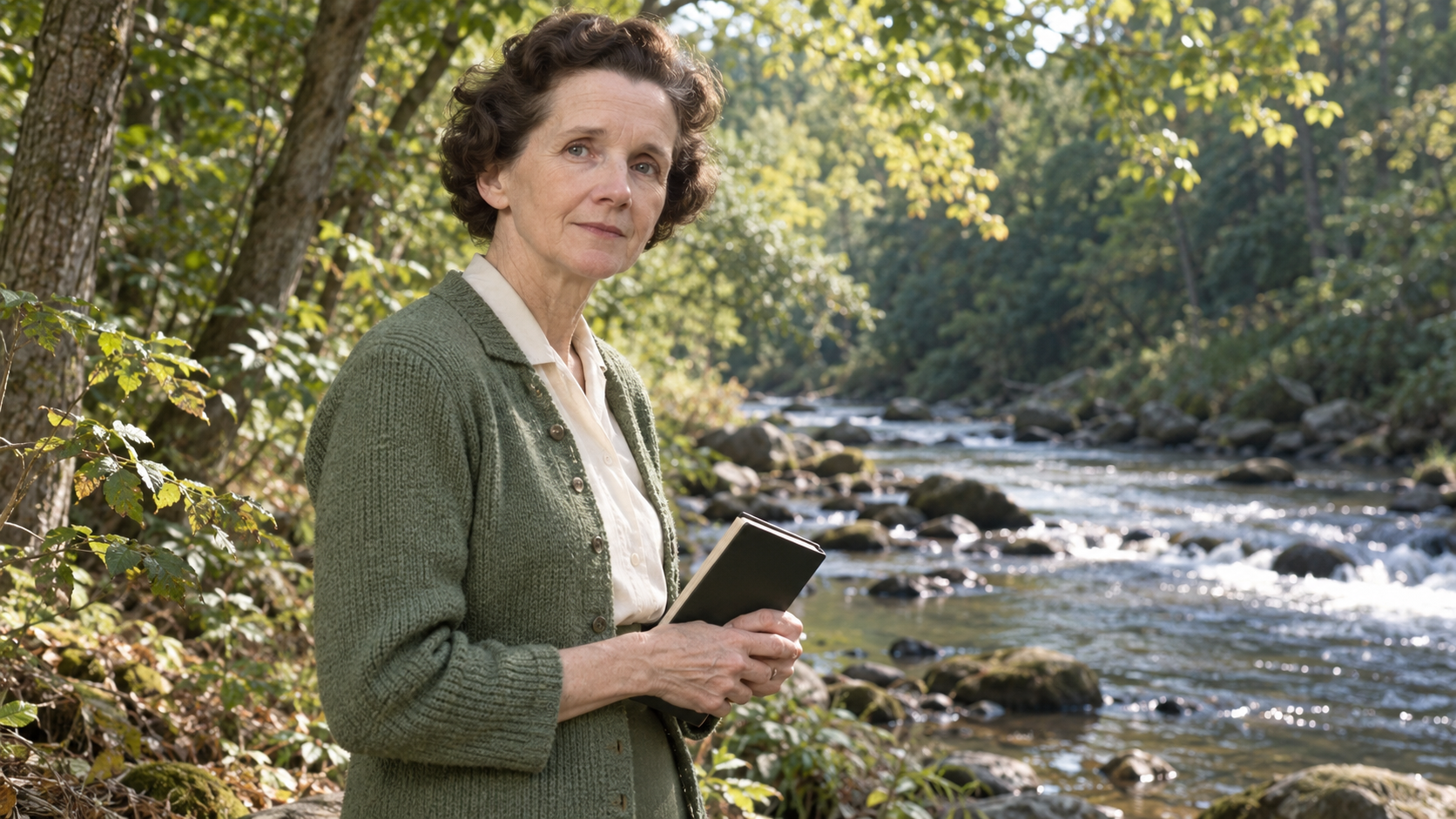
“Here again we are reminded that in nature nothing exists alone.”
Rachel Carson’s sentence closes a passage in Silent Spring about water pollution and leads into a discussion of soil. Published in 1962, the book asked readers to follow environmental consequences beyond the immediate purpose of an action. The full sentence includes “Here again,” words that remind us that she is returning to a relationship already visible elsewhere in her account. Water, ground and living things cannot be understood as entirely separate subjects. This has a clear connection with health: the places where people live are part of the conditions of their lives, even when an environmental change first appears distant from a household. Carson’s thought encourages curiosity about those connections. It also asks for care in tracing them, rather than a quick assumption that every possible link has already been proved.
Picture a family walking beside a stream after heavy rain. From one bend, the water looks like a local feature, belonging to the patch of land immediately around it. Following the path upstream gradually reveals a larger picture: gardens, roads, fields and other homes all lie along its route. The walk offers a simple illustration of how changing the frame can change a question. Instead of asking only what is happening at this one spot, someone begins to ask what lies before it and what comes after. They may still need reliable information before drawing any conclusion about a particular concern. Looking at a connection is the beginning of inquiry, not the end. The same habit can help when a public discussion presents an environmental issue as if its effects stopped neatly at a fence or boundary. A more complete account asks where those effects could travel and who would need to be heard.
This wider perspective can also change the tone of a health conversation. People may experience the same place differently because their daily routines, responsibilities and resources differ. Someone who depends on a nearby waterway for work may notice details that an occasional visitor overlooks. A parent, a local researcher and a person responsible for a public service may each contribute another part of the picture. None of those perspectives automatically settles a scientific question, but excluding them can leave a decision poorly informed. Carson’s sentence gives us a reason to bring observations together and ask for explanations that fit the whole situation. For an ordinary reader, that can mean paying attention to where a claim begins and where it stops. Does it consider the surroundings, the route between cause and consequence, and the people affected? Our health belongs within a living world. Understanding that relationship takes patient observation and a willingness to look beyond the first convenient boundary.
They belong to the complete sentence in Silent Spring. Carson uses it while moving from water pollution toward the subject of soil, returning to the connections discussed in her account.
Shorter quotations often retain only the last six words. This post preserves the full wording and the book’s original publication year, 1962.
The sentence invites attention to the environment surrounding human life. A question about one place can involve relationships with other places and with the people who depend on them.
That perspective helps frame an inquiry. It does not, by itself, establish the cause or health effect of a particular environmental concern.
Look at where an explanation draws its boundaries. Ask whether relevant routes, surroundings and experiences have been included before accepting a simple account.
Listening to people and examining dependable evidence can work together. Following a connection carefully is more useful than assuming that noticing a possible link has already proved it.
Explore more "Quotes of The Day"
Discover more notable quotes from influential voices across politics, science, business, technology, sports, and culture. Each quote offers insight into how ideas, beliefs, and decisions shape the world around us.