

On This Day in Business: August 5, 1914
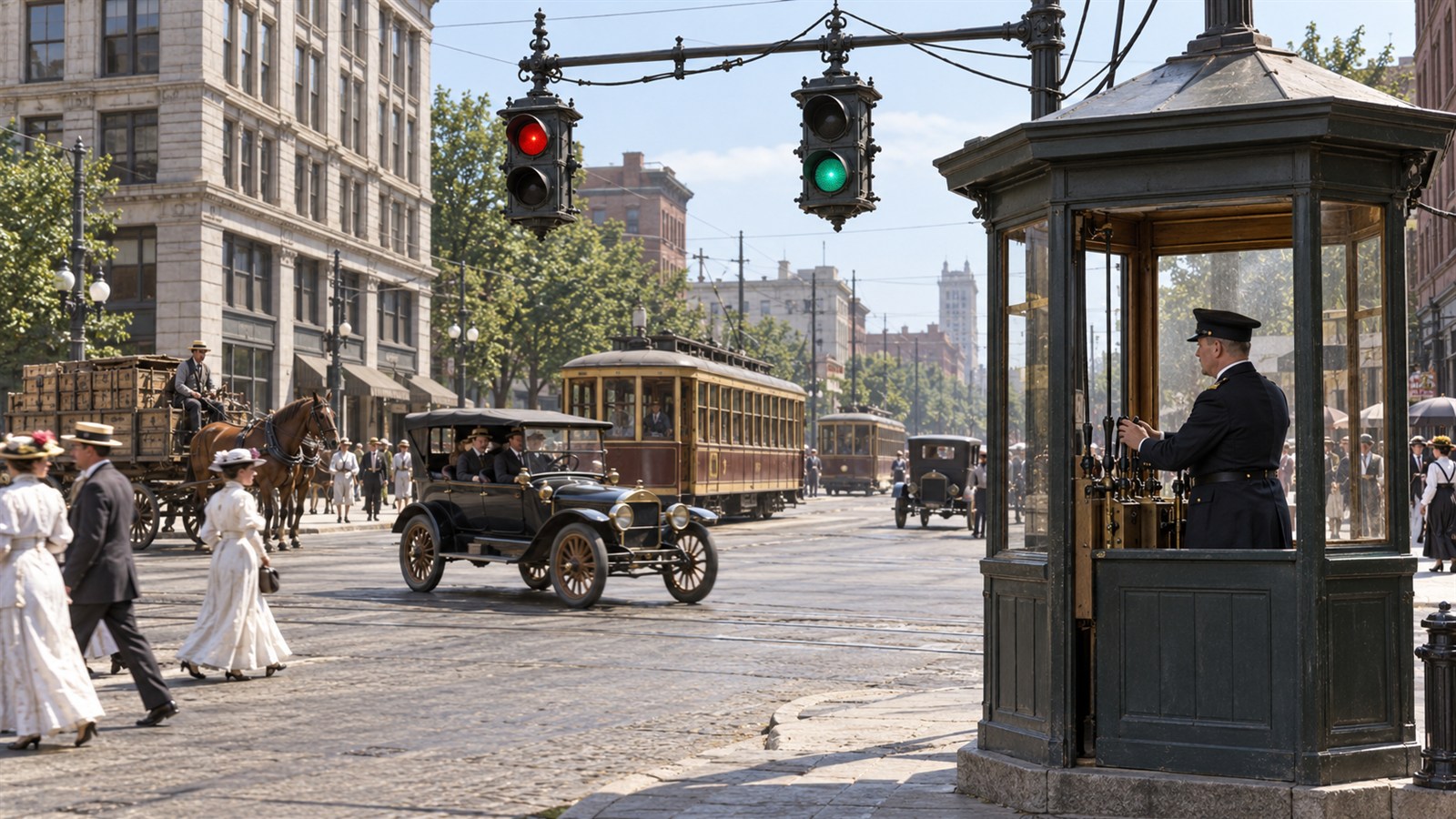
On August 5, 1914, Cleveland safety officials tested an electric traffic signal at Euclid Avenue and East 105th Street. Designed by James Hoge and installed by the American Traffic Signal Company, the system used red and green lights accompanied by stop-and-move directions and audible bells. A police officer controlled the signals from a protected booth rather than standing in the center of the intersection. In an era when automobiles shared streets with streetcars, horse-drawn vehicles, bicycles, and pedestrians, the installation was more than a gadget. It was an operating system for a new and increasingly complicated urban marketplace.
Traffic congestion imposes costs even when no invoice records them. Delays waste fuel and labor, collisions damage property, and uncertainty discourages movement through busy commercial districts. Cleveland's device attempted to standardize the right of way so that different users could predict one another's behavior. The booth also connected the officer with police and fire services, allowing emergency routes to be cleared more quickly. Although the signal still required a human operator, it transferred authority from gestures in the roadway to visible electric commands that could be recognized from several directions.
The business opportunity extended beyond selling signal hardware. Growing cities needed installation, wiring, maintenance, replacement parts, and compatible rules. Automobile ownership created demand for an entire traffic-management industry alongside roads, parking, insurance, repair shops, and fuel stations. Standard signals also increased the useful capacity of existing streets by organizing movement more efficiently. That mattered to retailers, delivery firms, factories, and transit operators whose revenues depended on reliable access. Public safety technology became economic infrastructure, and municipal purchasing helped establish a market for increasingly automated control systems.
Later signals added yellow warning phases, timers, vehicle detection, centralized coordination, and computerized control. The 1914 installation was not the only early traffic-control experiment, but it illustrates the shift from improvised policing toward engineered systems. Its legacy is visible at nearly every modern intersection, where shared signals make high volumes of movement possible without constant negotiation. The commercial lesson is equally durable: when a new technology changes how people use public space, supporting systems can become major industries of their own. Order, reliability, and safety are economic products even when cities provide them as public services. By making rules visible and repeatable, the signal also reduced the transaction cost of every encounter among drivers, pedestrians, transit vehicles, and emergency crews. That small efficiency, multiplied across a city, becomes significant economic capacity. The equipment market grew as cities copied, compared, standardized, and linked these once-isolated signals.
Cleveland tested the electric signal on August 5, 1914, at Euclid Avenue and East 105th Street.
The device used red and green indications with bells to organize traffic movement.
A police officer operated switches from a protected corner booth.
The system reduced the need for an officer to stand in the center of a dangerous intersection.
Signals helped cities increase street capacity and reduce the hidden costs of congestion and collisions.
The installation anticipated a broad traffic-management industry built around equipment, standards, and maintenance.
Explore more of "On This Day ..."
Discover more events from the same date across news, politics, technology, sports, and other fields. Each link highlights significant moments that shaped history on different fronts.