

On This Day in Business: August 7, 1944
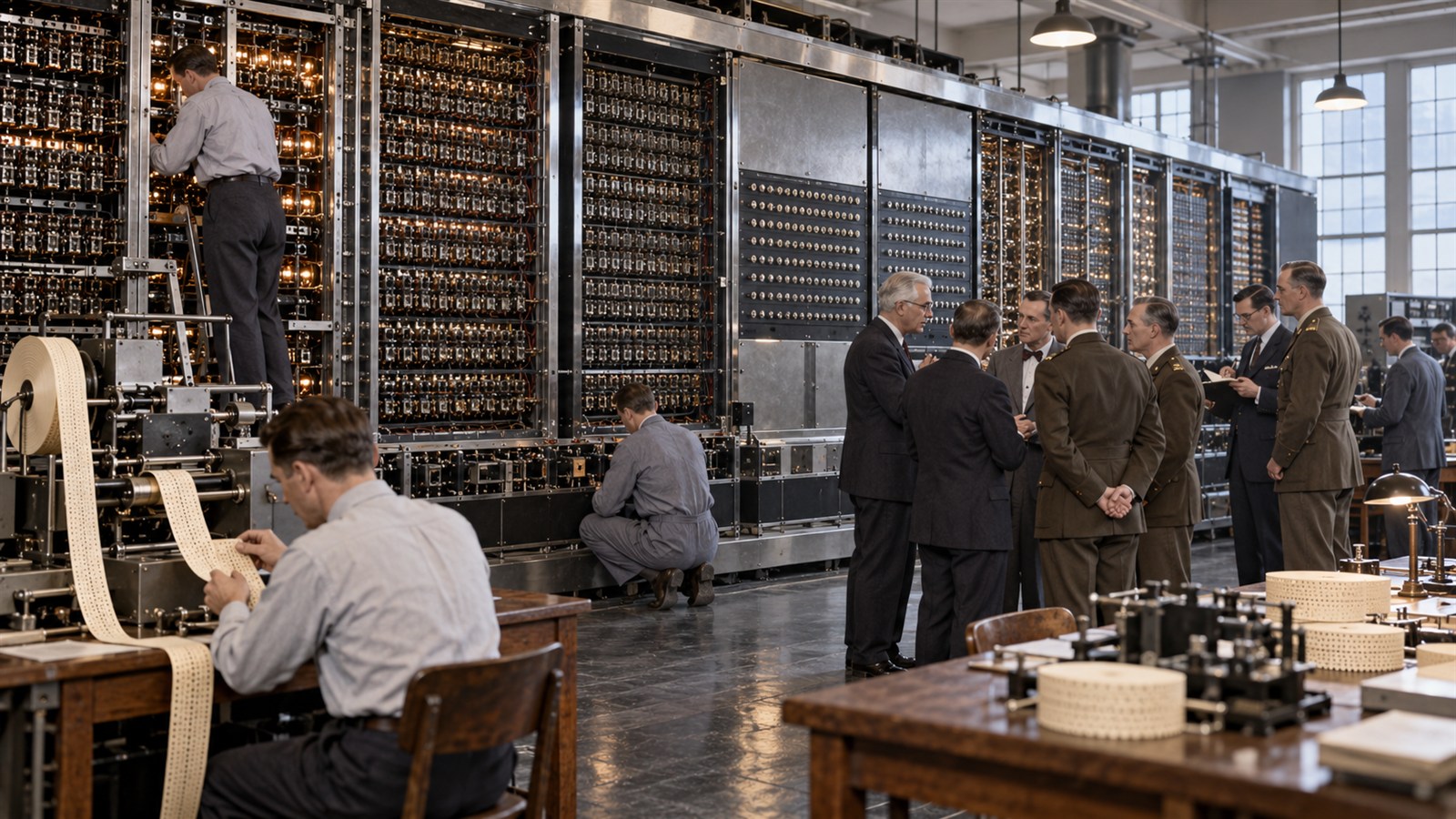
On August 7, 1944, IBM formally presented the Automatic Sequence Controlled Calculator to Harvard University. Better known as the Harvard Mark I, the room-sized electromechanical machine had been conceived by Harvard mathematician Howard Aiken and built by IBM engineers. It used switches, relays, rotating shafts, and paper tape to perform long sequences of calculations automatically. The machine was slow by electronic standards that soon followed, but it could work reliably for hours with far less human intervention than desk calculators required. During wartime, that capability had immediate value for complex mathematical tables and military research.
The Mark I represented a shift from individual calculating devices to organized computing systems. Its size and cost demanded institutional sponsorship, specialized operators, maintenance routines, and carefully prepared instructions. Problems had to be translated into sequences the machine could execute. That process foreshadowed software development even though the machine's program was physically encoded on tape. Businesses and government agencies could see the promise of reducing repetitive numerical labor, but they also encountered a new management challenge: automated computation required new skills and close cooperation among mathematicians, engineers, operators, and decision-makers.
The project also demonstrated a productive, sometimes tense partnership between a university and a corporation. Harvard contributed Aiken's concept and research environment; IBM supplied engineering depth, manufacturing capability, and funding. Public credit became a source of disagreement, a reminder that large innovations often have multiple authors and competing institutional narratives. Even so, the machine strengthened IBM's association with advanced information processing and trained people who would influence later computers. It helped move calculation from a collection of office tools toward a strategic capability supported by dedicated facilities and professional teams.
Electronic machines soon surpassed the Mark I in speed and flexibility, yet its business importance was not erased by rapid obsolescence. Early systems teach organizations what computing can do, create demand for talent, and reveal which tasks are worth automating. The Mark I helped establish that carefully sequenced machines could carry out work too laborious for manual calculation at useful scale. Its dedication marks a stage when computing became visible as infrastructure for science, defense, and eventually commerce. Modern data centers look different, but they inherit the same organizational idea: concentrate expensive machinery and expertise to deliver repeatable information services. The machine's real product was therefore not only answers, but organizational experience in specifying, scheduling, checking, and trusting automated work. That experience became reusable capital for the computer age. It also helped managers recognize that computation needed budgets, schedules, operators, and quality controls of its own.
IBM presented the Automatic Sequence Controlled Calculator to Harvard on August 7, 1944.
The machine became widely known as the Harvard Mark I.
Electromechanical relays, switches, shafts, and paper tape carried out sequenced calculations.
Automatic operation reduced the human effort required for long numerical tables.
The project joined university research with corporate engineering and manufacturing resources.
Its operating model anticipated institutional computing centers and professional programming work.
Explore more of "On This Day ..."
Discover more events from the same date across news, politics, technology, sports, and other fields. Each link highlights significant moments that shaped history on different fronts.