

On This Day in Business: August 11, 1942
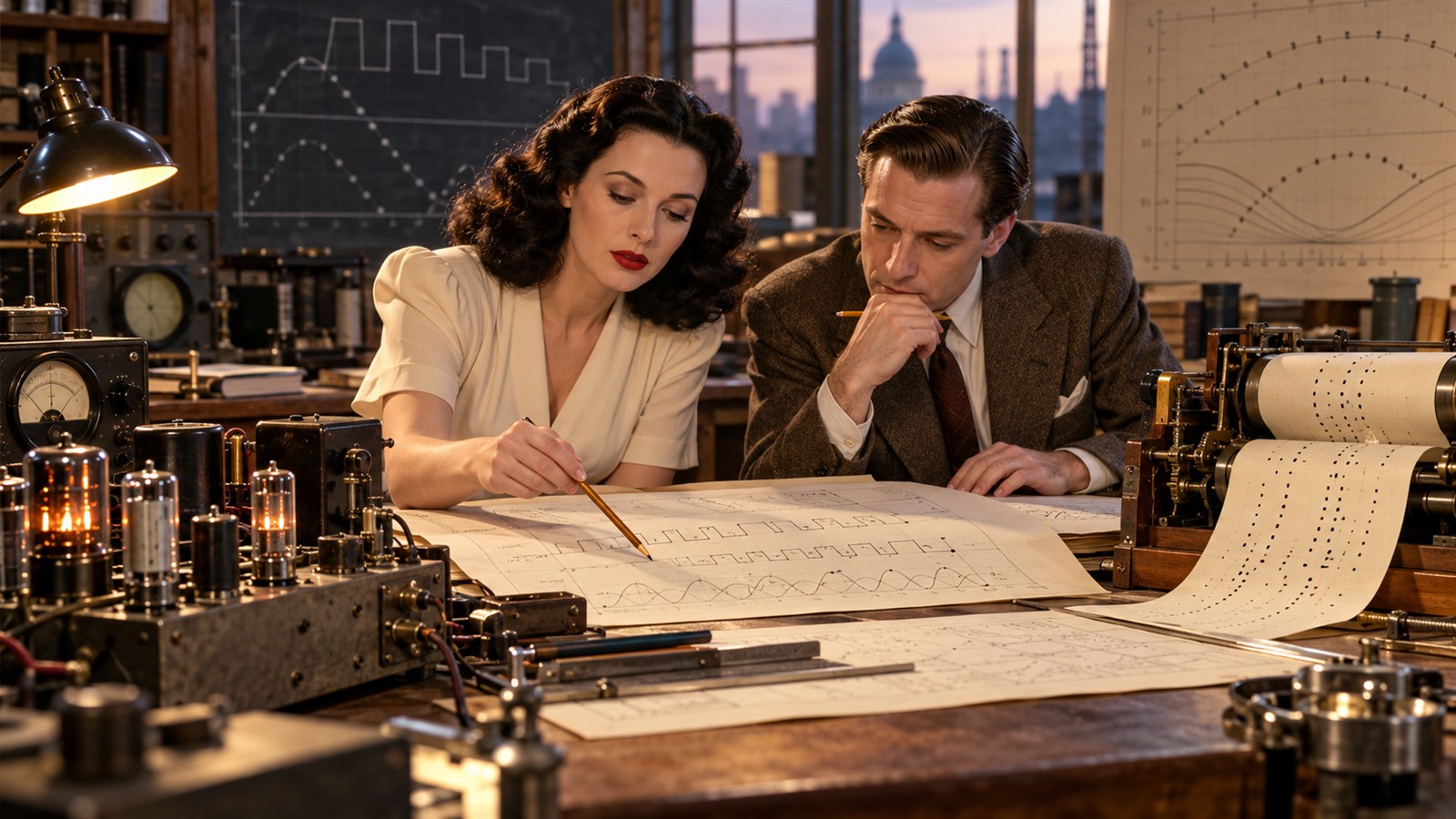
On August 11, 1942, the U.S. Patent Office granted Hedy Kiesler Markey, better known as actress Hedy Lamarr, and composer George Antheil Patent No. 2,292,387 for a secret communication system. Their design proposed switching a radio-controlled torpedo's guidance signal among multiple frequencies in a synchronized pattern. An enemy listening on one frequency would have greater difficulty detecting or jamming the command. The inventors drew inspiration from radio engineering and the coordinated actions of player-piano rolls. The result joined ideas from entertainment, mechanics, and wartime communications in a striking example of cross-disciplinary invention.
Lamarr understood weapons systems through her earlier life in Europe, while Antheil had experience coordinating multiple mechanical pianos. They imagined transmitter and receiver changing frequencies together according to matching sequences. The concept was technically challenging to implement with 1940s equipment, and the Navy did not deploy their design during the war. A patent can secure a claim to an idea, but it does not guarantee manufacturing readiness, institutional adoption, or commercial reward. Moving from concept to market requires components, budgets, users, and an organization willing to change established systems.
The invention received little financial benefit or public recognition for its creators at the time. Decades later, spread-spectrum and frequency-hopping techniques became important in secure military communications and influenced the broader development of wireless systems. Modern technologies do not descend from a single patent in a simple line, yet Lamarr and Antheil's work demonstrated the central value of distributing a signal across frequencies. Their delayed recognition also illustrates how markets and institutions can overlook inventors who do not fit expected professional categories, leaving potentially valuable ideas underdeveloped.
For business, the patent is a lesson in option value. An idea may arrive before the supporting technology or customer is ready, but documenting it can preserve knowledge and expand future choices. It also shows why diverse teams matter: unusual combinations of experience can reveal solutions that specialists miss. Wireless commerce now depends on managing interference, security, and scarce spectrum across billions of devices. The 1942 patent did not create that market by itself, but it anticipated a design principle that became increasingly useful as radio networks grew crowded, mobile, and commercially essential. Recognition came late, yet the story now broadens public understanding of who can invent and where commercially meaningful ideas may originate. The gap between patent and adoption also explains why invention policy cannot end with granting legal rights. Prototypes, procurement pathways, engineering partnerships, and patient capital often determine whether a promising concept becomes practical infrastructure or remains a document in an archive.
Lamarr and Antheil received U.S. Patent No. 2,292,387 on August 11, 1942.
The design synchronized a transmitter and receiver as they moved among multiple radio frequencies.
Its purpose was to make radio-controlled torpedo guidance harder to detect or jam.
Player-piano coordination helped inspire the mechanical sequencing concept.
The system was not adopted during World War II and produced no financial reward for the inventors.
Later spread-spectrum communications made the patent an important symbol of overlooked, cross-disciplinary innovation.
Explore more of "On This Day ..."
Discover more events from the same date across news, politics, technology, sports, and other fields. Each link highlights significant moments that shaped history on different fronts.