

On This Day in Business: August 13, 1889
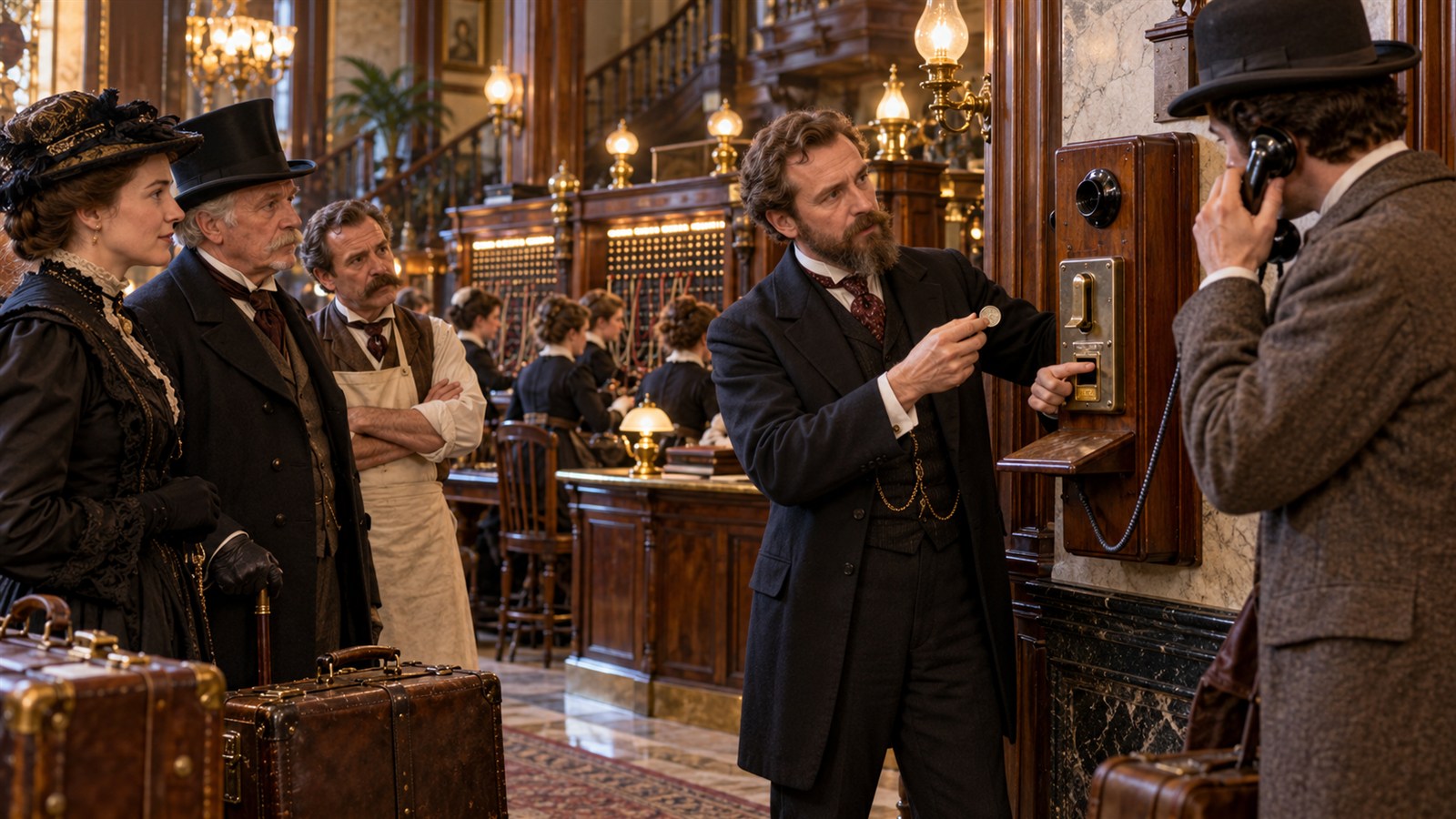
On August 13, 1889, William Gray received U.S. Patent No. 408,709 for a coin-controlled apparatus for telephones. Gray's concept allowed a person without a private subscription to pay for an individual call at a public station. Stories about the invention often trace his motivation to difficulty finding a telephone during a family medical emergency. Whatever the precise path, the commercial insight was powerful: access could be sold in small units at shared locations. The pay telephone turned an expensive network service into something a passerby could purchase only when needed.
The device had to solve both technical and trust problems. A mechanism needed to recognize the coin, connect payment with service, and give an operator or telephone company confidence that the call had been paid for. Early designs evolved from post-payment toward prepayment arrangements and more reliable collection systems. Placement mattered as much as machinery. Hotels, stations, shops, sidewalks, and other high-traffic sites became distribution points. Each phone extended the network's reach without requiring every potential user to install a line at home or maintain a monthly account.
That model created several revenue relationships. Telephone companies gained usage income, property owners could host equipment, manufacturers supplied durable enclosures and mechanisms, and local agents serviced coin boxes and lines. Public phones also increased the value of the wider network because more people could originate calls. The arrangement resembles later shared-access businesses in which customers pay per transaction rather than own the underlying asset. It reduced the cost of trying the service and served travelers, workers, renters, and anyone caught away from a private telephone.
Mobile phones eventually removed much of the payphone's advantage, and public units disappeared from many locations. For nearly a century, however, they were essential communications infrastructure and a visible symbol of connected commerce. Gray's patent illustrates how pricing architecture can unlock demand for a technology that already exists. The telephone network was valuable, but a coin mechanism made that value purchasable in a new context. By matching payment to a single use, the pay telephone widened access and showed that business-model innovation can be embedded directly into a physical product. Its familiar enclosure also functioned as a promise: a working connection would be available in a predictable place whenever a customer needed it. Because the phones were distributed through public and private sites, they also created a physical network of dependable access points. Location strategy, maintenance frequency, vandal resistance, and coin collection became operational disciplines that supported the simple price posted to callers.
William Gray received Patent No. 408,709 on August 13, 1889.
The mechanism connected coin payment with access to a telephone call.
Public placement let people use the network without owning a private telephone line.
High-traffic locations became retail points for communication sold one call at a time.
Telephone companies, site owners, manufacturers, and service agents shared in the expanding market.
The payphone's core innovation was a usage-based business model built into the device.
Explore more of "On This Day ..."
Discover more events from the same date across news, politics, technology, sports, and other fields. Each link highlights significant moments that shaped history on different fronts.