

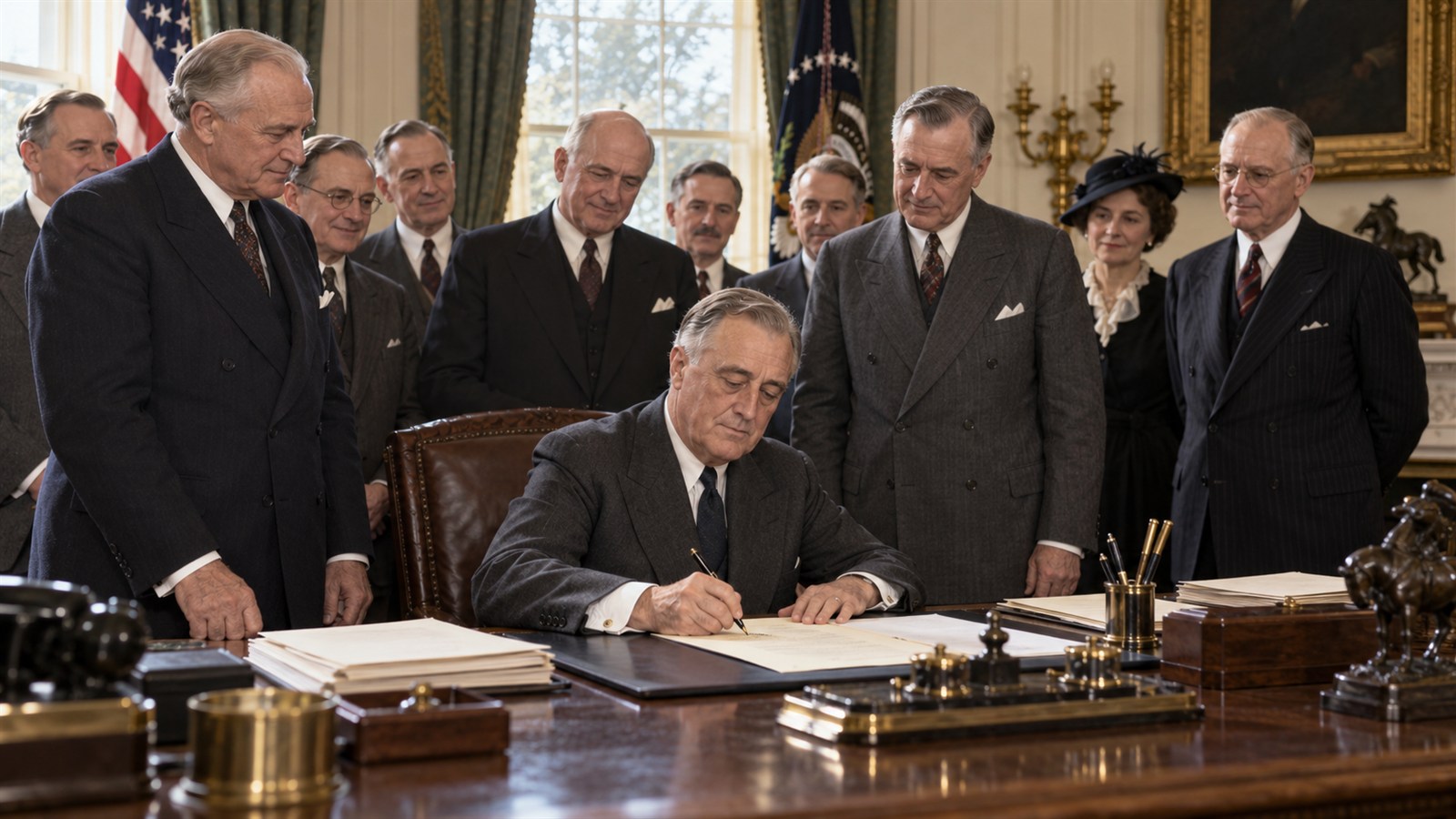
On This Day in Business: August 14, 1935
President Franklin D. Roosevelt signed the Social Security Act on August 14, 1935. The law created a federal old-age benefits program, a federal-state unemployment compensation system, and grants supporting several public-assistance programs. It responded to the economic insecurity exposed by the Great Depression, when unemployment and lost savings left millions of families with little protection. The act did not cover every worker and its benefits were initially narrower than today's system, but it established a national framework linking payroll contributions, employment records, and future income support. That framework changed the financial relationship among workers, employers, and government.
Implementation required an enormous administrative enterprise. Employers had to report wages, workers needed account numbers, and the government had to maintain accurate lifetime records across changing jobs and locations. Payroll systems were redesigned to calculate and transmit taxes. Banks, accountants, insurers, and software providers would later build services around compliance and retirement planning. Social insurance was public policy, yet its operation depended on routine business processes executed at scale. The program demonstrated that administrative capacity can determine whether legislation becomes a functioning economic institution.
The law also influenced consumer demand and labor markets. A predictable retirement benefit gave many older Americans a base of income, while unemployment insurance helped cushion job losses and stabilize household spending. Employers incorporated Social Security taxes into labor costs and benefit planning. The original program excluded many agricultural and domestic workers, disproportionately affecting Black workers and women, and later amendments expanded coverage and added family, survivor, and disability benefits. Its history therefore includes both a durable safety net and continuing debates over inclusion, financing, adequacy, and intergenerational obligations.
For business history, Social Security shows that markets operate within institutions that distribute risk across time. Retirement, unemployment, and disability affect employers, consumers, and communities as well as individuals. By socializing part of those risks, the act altered savings decisions, workforce expectations, and the broader financial-services landscape. The system has changed repeatedly, but the 1935 signature remains the foundation. Its enduring challenge is managerial as well as political: collect contributions fairly, preserve accurate records, pay promised benefits, and adjust a long-term program as demographics and work patterns change. Every paycheck and benefit statement links that national design to an ordinary transaction, making administration the daily face of a vast social contract. The recordkeeping challenge also accelerated demand for data-processing tools. Account numbers, wage reports, and benefit calculations turned public administration into one of the largest recurring information problems of the twentieth century, encouraging investment in tabulation, computers, and secure records management.
Roosevelt signed the Social Security Act on August 14, 1935.
The law created old-age benefits, unemployment compensation, and public-assistance support.
Employers and government agencies built new payroll reporting and recordkeeping systems.
Early coverage excluded many workers, and later amendments broadened participation and benefits.
Retirement and unemployment payments helped stabilize household income and consumer demand.
The act created a lasting institution that links labor costs, public administration, and financial planning.
Explore more of "On This Day ..."
Discover more events from the same date across news, politics, technology, sports, and other fields. Each link highlights significant moments that shaped history on different fronts.