

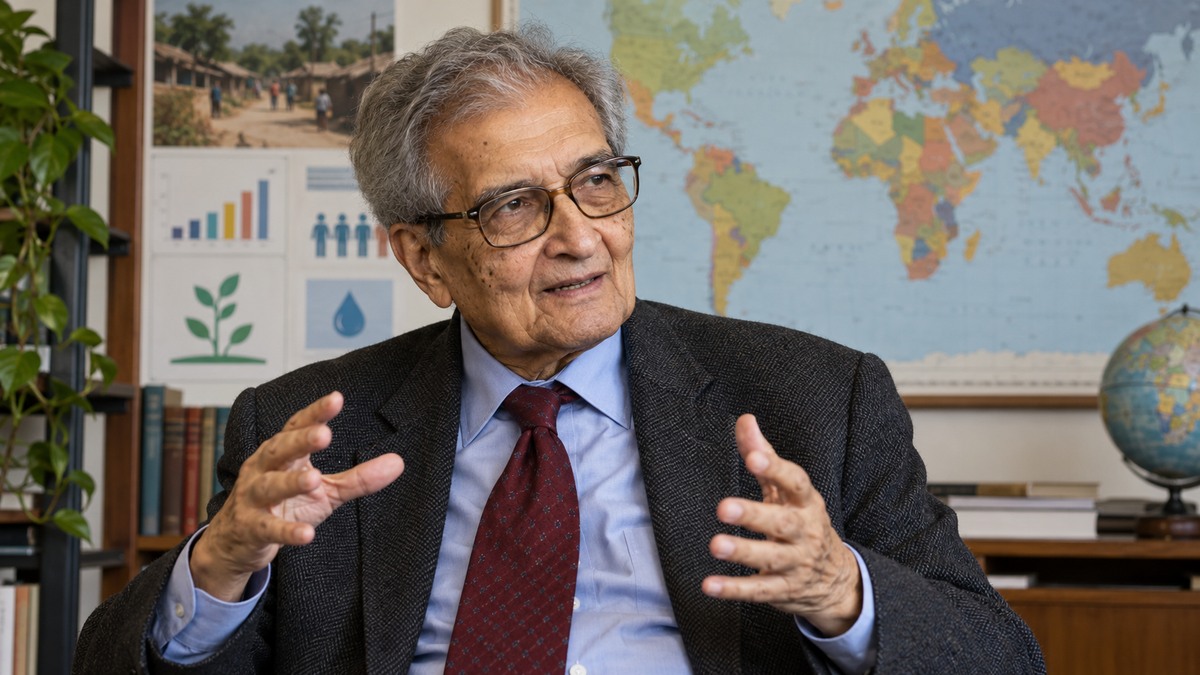
“Development can be seen, it is argued here, as a process of expanding the real freedoms that people enjoy.”
Amartya Sen wrote this sentence at the opening of Development as Freedom. It moves assessment beyond income or output alone and asks what people are genuinely able to be and do, including living healthy lives, learning, participating, working with dignity, and making consequential choices. Resources remain important, but their value depends on conversion into capability. The same income can produce different freedom when health, discrimination, infrastructure, safety, or public services differ. Development therefore includes economic opportunity, political voice, social provision, transparency, and protection from severe deprivation. Behind the concise wording is a claim about how organizations create results. It encourages leaders to look beyond individual effort and examine design, incentives, information, relationships, and the customer context that determine whether a good intention becomes reliable performance.
Organizations can examine a program through the choices it expands, the barriers it removes, and the people it leaves dependent or excluded. Impact measures should combine material results with access, agency, safety, and the ability of affected communities to shape decisions. Managers can translate the claim into a small experiment with a baseline, an owner, a defined customer or employee outcome, and a review date. Specificity protects the work from drifting into broad language that nobody can challenge or verify.
Freedom language can become abstract if institutions ignore power and basic needs. Choice is not meaningful when alternatives are unsafe, unaffordable, inaccessible, or coerced. Leaders should disaggregate outcomes and listen directly to groups whose constraints are easiest to overlook. Responsible use also requires naming the tradeoff. Speed, cost, autonomy, safety, equity, and learning may not all improve at once. People closest to the consequences should have a meaningful voice, and uncertainty should be reported instead of hidden behind confidence.
Digital platforms and AI can expand access to knowledge, finance, and services, yet they can also deepen surveillance, exclusion, and dependence. The central question is whether technology increases people’s practical agency and recourse, not merely whether usage grows. For one initiative, list the real choices available before and after it, identify who cannot convert the offered resource into benefit, and change the design so capability rather than nominal access becomes the outcome. Evidence from the experiment can guide scaling, revision, or stopping. The durable lesson is to join purpose with measurement and human judgment, so the organization becomes better at seeing reality and responding before a local success or failure hardens into mythology. Recording the decision and its limits gives colleagues a foundation they can inspect, challenge, and improve instead of asking them to rely on memory, authority, or an unexplained result.
Amartya Sen wrote this sentence at the opening of Development as Freedom. It moves assessment beyond income or output alone and asks what people are genuinely able to be and do, including living healthy lives, learning, participating, working with dignity, and making consequential choices.
Resources remain important, but their value depends on conversion into capability. The same income can produce different freedom when health, discrimination, infrastructure, safety, or public services differ. Development therefore includes economic opportunity, political voice, social provision, transparency, and protection from severe deprivation.
Organizations can examine a program through the choices it expands, the barriers it removes, and the people it leaves dependent or excluded. Impact measures should combine material results with access, agency, safety, and the ability of affected communities to shape decisions.
Freedom language can become abstract if institutions ignore power and basic needs. Choice is not meaningful when alternatives are unsafe, unaffordable, inaccessible, or coerced. Leaders should disaggregate outcomes and listen directly to groups whose constraints are easiest to overlook.
Digital platforms and AI can expand access to knowledge, finance, and services, yet they can also deepen surveillance, exclusion, and dependence. The central question is whether technology increases people's practical agency and recourse, not merely whether usage grows.
For one initiative, list the real choices available before and after it, identify who cannot convert the offered resource into benefit, and change the design so capability rather than nominal access becomes the outcome.
Explore more "Quotes of The Day"
Discover more notable quotes from influential voices across politics, science, business, technology, sports, and culture. Each quote offers insight into how ideas, beliefs, and decisions shape the world around us.