

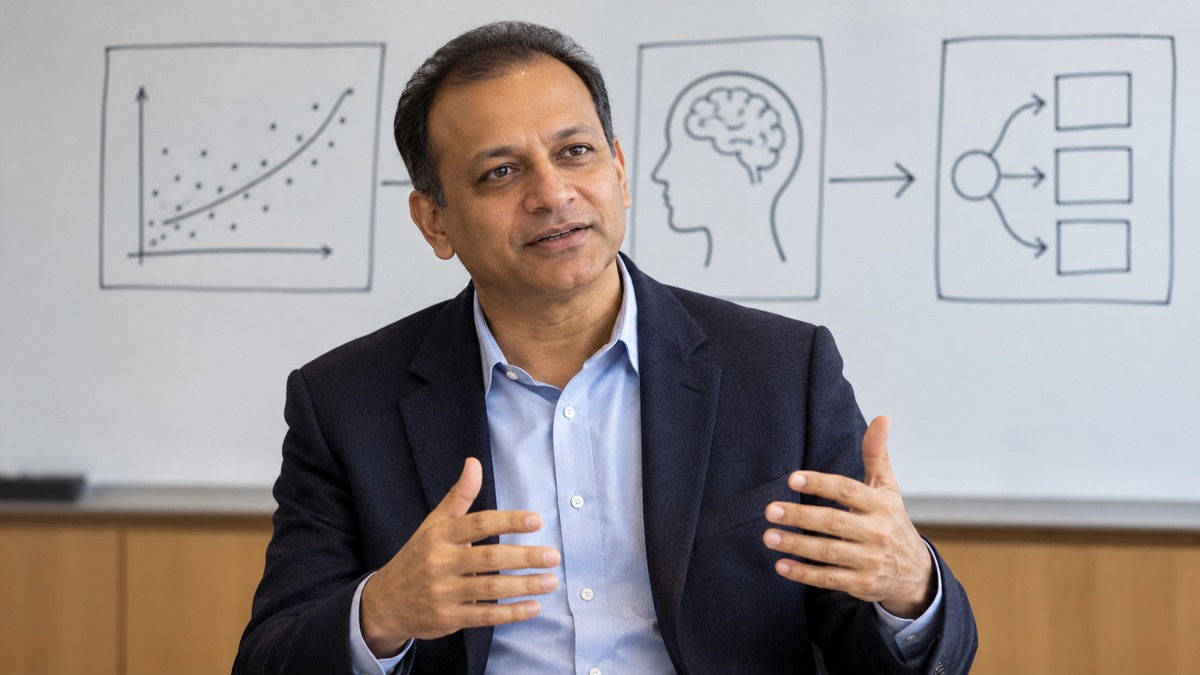
“AI can be recast as causing a drop in the cost of a first-order input into many activities in business and our lives—prediction.”
Ajay Agrawal used this economic framing while discussing Prediction Machines in 2018. Instead of treating AI as a mystical general capability, he described an important part of it as cheaper prediction: using available information to generate information about an uncertain future or missing state. When the cost of an input falls, organizations use more of it and redesign complements around it. Cheaper prediction changes the value of data, judgment, action, and the objectives against which a prediction is used. The business opportunity often lies in workflow redesign, not the model alone. Behind the concise wording is a claim about how organizations create results. It encourages leaders to look beyond individual effort and examine design, incentives, information, relationships, and the customer context that determine whether a good intention becomes reliable performance.
Teams can decompose a decision into prediction, judgment, action, and outcome. They should estimate the value of a more accurate or faster prediction, identify the data and human judgment required, and test whether the redesigned workflow improves the final decision. Managers can translate the claim into a small experiment with a baseline, an owner, a defined customer or employee outcome, and a review date. Specificity protects the work from drifting into broad language that nobody can challenge or verify.
Not every problem is a prediction problem, and cheap predictions can create expensive errors when objectives are wrong or feedback is biased. High accuracy does not justify an action by itself. Accountability, uncertainty, privacy, and the cost of false positives and negatives remain central. Responsible use also requires naming the tradeoff. Speed, cost, autonomy, safety, equity, and learning may not all improve at once. People closest to the consequences should have a meaningful voice, and uncertainty should be reported instead of hidden behind confidence.
Generative models expand what can be predicted or produced from context, but their fluency can obscure uncertainty. The economic lens helps leaders ask where the tool changes a scarce input and what complementary investments, controls, or roles must change with it. Select one decision, label its prediction and judgment components, and calculate whether improving the prediction would change the action enough to create value after data, review, error, and transition costs. Evidence from the experiment can guide scaling, revision, or stopping. The durable lesson is to join purpose with measurement and human judgment, so the organization becomes better at seeing reality and responding before a local success or failure hardens into mythology. Recording the decision and its limits gives colleagues a foundation they can inspect, challenge, and improve instead of asking them to rely on memory, authority, or an unexplained result.
Ajay Agrawal used this economic framing while discussing Prediction Machines in 2018. Instead of treating AI as a mystical general capability, he described an important part of it as cheaper prediction: using available information to generate information about an uncertain future or missing state.
When the cost of an input falls, organizations use more of it and redesign complements around it. Cheaper prediction changes the value of data, judgment, action, and the objectives against which a prediction is used. The business opportunity often lies in workflow redesign, not the model alone.
Teams can decompose a decision into prediction, judgment, action, and outcome. They should estimate the value of a more accurate or faster prediction, identify the data and human judgment required, and test whether the redesigned workflow improves the final decision.
Not every problem is a prediction problem, and cheap predictions can create expensive errors when objectives are wrong or feedback is biased. High accuracy does not justify an action by itself. Accountability, uncertainty, privacy, and the cost of false positives and negatives remain central.
Generative models expand what can be predicted or produced from context, but their fluency can obscure uncertainty. The economic lens helps leaders ask where the tool changes a scarce input and what complementary investments, controls, or roles must change with it.
Select one decision, label its prediction and judgment components, and calculate whether improving the prediction would change the action enough to create value after data, review, error, and transition costs.
Explore more "Quotes of The Day"
Discover more notable quotes from influential voices across politics, science, business, technology, sports, and culture. Each quote offers insight into how ideas, beliefs, and decisions shape the world around us.