

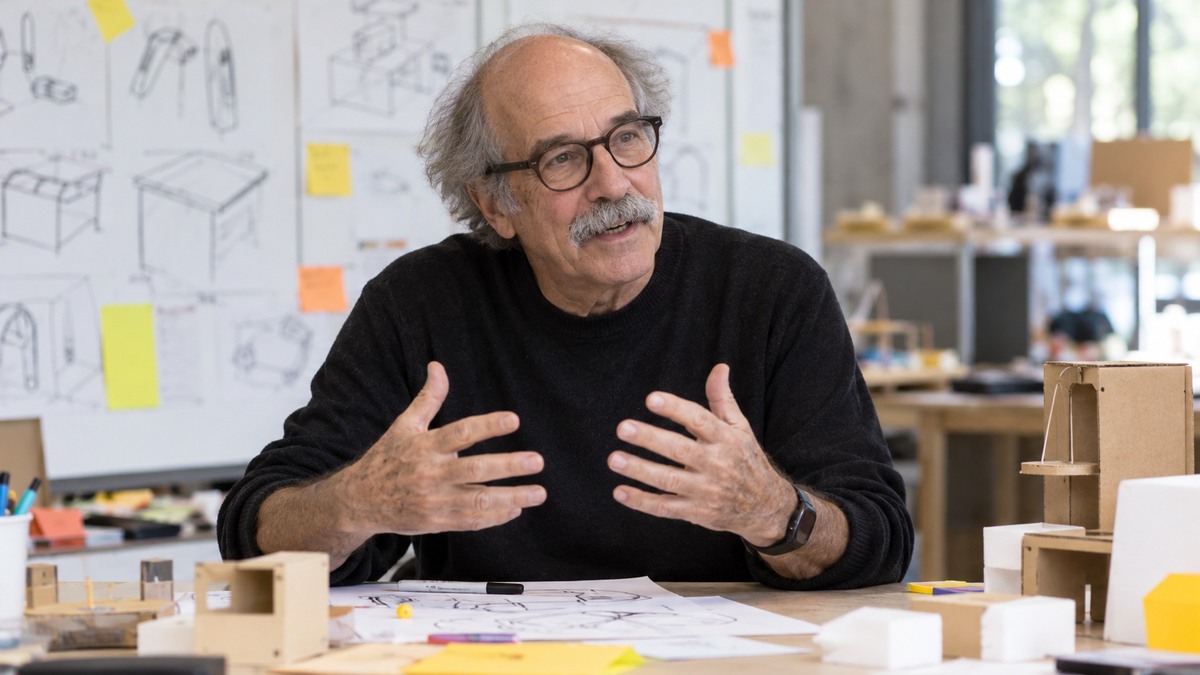
“When people regain that confidence, magic happens.”
David Kelley closed his 2012 TED talk on creative confidence with this observation. Drawing on psychologist Albert Bandura’s work and design projects at Stanford and IDEO, he described creativity not as a gift reserved for a special class but as a capacity people can recover through guided practice. The confidence Kelley names is not bravado or certainty that every idea will succeed. It is self-efficacy: the belief, strengthened by experience, that a person can enter an ambiguous problem, make something, learn from the response, and try again without treating an imperfect result as a verdict on identity. Read closely, the quotation is an operating claim rather than a decorative slogan. It asks leaders to connect an admired principle with the conditions, measures, and behavior through which customers and employees would actually experience it.
Managers can create small, low-cost experiments in which teams interview users, build rough prototypes, and receive feedback before a proposal becomes politically expensive. Leaders should praise the quality of learning and the willingness to expose assumptions, not only the polish of the winning concept. To make that connection visible, decision makers should name the choice the idea is meant to change, the evidence they will review, and the person responsible for follow-through. A principle becomes useful when others can observe its effect on work.
Inviting creativity while punishing dissent or visible failure produces theater rather than confidence. Participation also requires time, tools, access, and psychological safety. A workshop cannot compensate for an operating system in which only senior voices can define the problem or authorize an honest test. The strongest interpretation holds ambition and restraint together. Teams should ask who benefits, who carries risk, what evidence would disconfirm the current belief, and how a person affected by the decision can question it before costs become difficult to reverse.
Generative AI makes producing options easier, which raises the value of human curiosity, empathy, and judgment. Teams still need to decide whose problem matters, observe real behavior, recognize harm, and distinguish a surprising possibility from a fluent but unsupported suggestion. Choose one stalled question and replace the request for a finished answer with a one-week prototype. Name the user, the assumption, the learning target, and the evidence that would justify another iteration. The objective is a safer first step into uncertainty, not immediate perfection. A practical review should compare the promise with outcomes, experience, and unintended effects. The final test is not whether the words sound inspiring, but whether they help the organization learn earlier, act responsibly, and create value that can withstand scrutiny. Results should be shared in plain language, including disappointments, so later decisions begin with accumulated evidence rather than a polished story that hides the conditions under which the earlier choice succeeded.
David Kelley closed his 2012 TED talk on creative confidence with this observation. Drawing on psychologist Albert Bandura’s work and design projects at Stanford and IDEO, he described creativity not as a gift reserved for a special class but as a capacity people can recover through guided practice.
The confidence Kelley names is not bravado or certainty that every idea will succeed. It is self-efficacy: the belief, strengthened by experience, that a person can enter an ambiguous problem, make something, learn from the response, and try again without treating an imperfect result as a verdict on identity.
Managers can create small, low-cost experiments in which teams interview users, build rough prototypes, and receive feedback before a proposal becomes politically expensive. Leaders should praise the quality of learning and the willingness to expose assumptions, not only the polish of the winning concept.
Inviting creativity while punishing dissent or visible failure produces theater rather than confidence. Participation also requires time, tools, access, and psychological safety. A workshop cannot compensate for an operating system in which only senior voices can define the problem or authorize an honest test.
Generative AI makes producing options easier, which raises the value of human curiosity, empathy, and judgment. Teams still need to decide whose problem matters, observe real behavior, recognize harm, and distinguish a surprising possibility from a fluent but unsupported suggestion.
Choose one stalled question and replace the request for a finished answer with a one-week prototype. Name the user, the assumption, the learning target, and the evidence that would justify another iteration. The objective is a safer first step into uncertainty, not immediate perfection.
Explore more "Quotes of The Day"
Discover more notable quotes from influential voices across politics, science, business, technology, sports, and culture. Each quote offers insight into how ideas, beliefs, and decisions shape the world around us.