

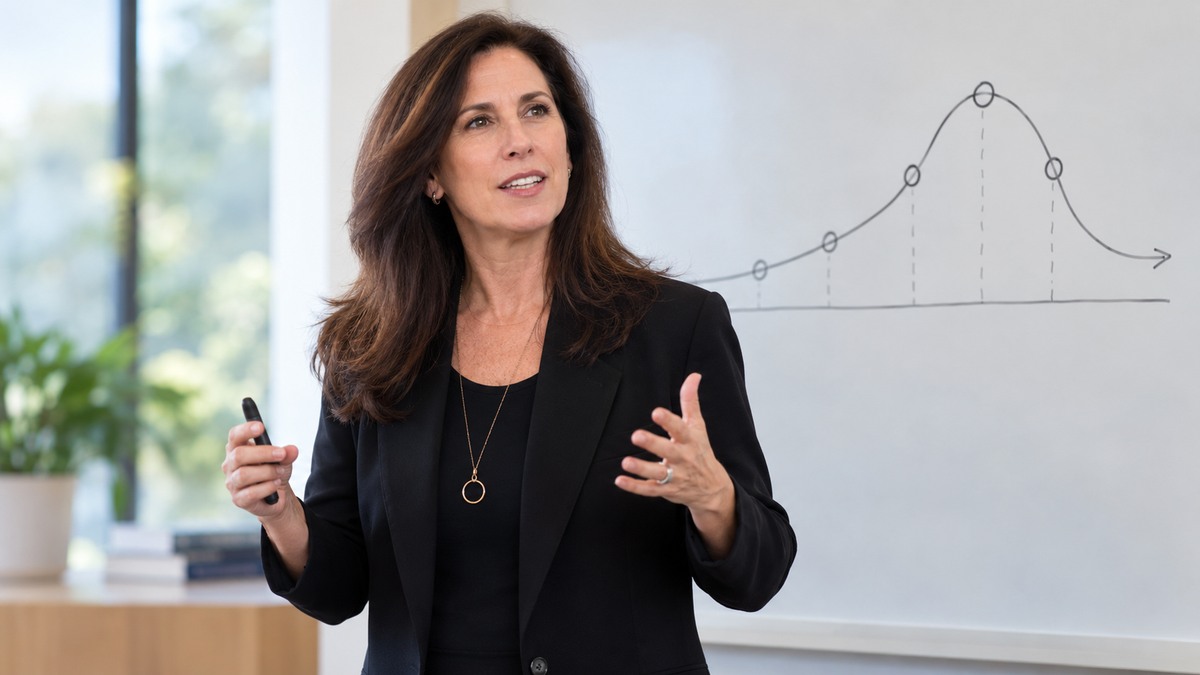
“You have the power to change the world.”
Nancy Duarte ended her 2010 TEDxEast talk on the structure of great presentations with this statement. After comparing influential speeches, she showed how communicators move audiences between present reality and a possible future, creating tension that can support understanding and action. The “power” in the line is not guaranteed by a stage or a polished deck. Communication can help people perceive a problem, imagine an alternative, and understand their role. Its legitimacy depends on truthful evidence, an attainable invitation, and respect for the audience’s agency. Read closely, the quotation is an operating claim rather than a decorative slogan. It asks leaders to connect an admired principle with the conditions, measures, and behavior through which customers and employees would actually experience it.
A leader can structure a proposal around the current condition, the desired change, and the specific obstacles between them. Data should establish the case, stories should make consequences intelligible, and the requested action should be proportionate to what the evidence supports. To make that connection visible, decision makers should name the choice the idea is meant to change, the evidence they will review, and the person responsible for follow-through. A principle becomes useful when others can observe its effect on work.
Narrative techniques can also manipulate, oversimplify, or turn uncertainty into false inevitability. Charisma is not proof. Presenters should disclose assumptions, represent affected people with care, and make room for questions that can alter the decision rather than treating the audience as an obstacle to persuasion. The strongest interpretation holds ambition and restraint together. Teams should ask who benefits, who carries risk, what evidence would disconfirm the current belief, and how a person affected by the decision can question it before costs become difficult to reverse.
AI can draft slides and generate compelling stories at remarkable speed. That raises the burden of verification and authorship. Leaders must ensure that sources are real, images are not misleading, and persuasive fluency does not outrun operational capacity or ethical responsibility. Take one upcoming presentation and write the current reality and desired future in one sentence each. Add the evidence, the cost of inaction, the tradeoff, and one concrete audience choice. Remove any flourish that cannot survive a careful question. A practical review should compare the promise with outcomes, experience, and unintended effects. The final test is not whether the words sound inspiring, but whether they help the organization learn earlier, act responsibly, and create value that can withstand scrutiny. Results should be shared in plain language, including disappointments, so later decisions begin with accumulated evidence rather than a polished story that hides the conditions under which the earlier choice succeeded.
Nancy Duarte ended her 2010 TEDxEast talk on the structure of great presentations with this statement. After comparing influential speeches, she showed how communicators move audiences between present reality and a possible future, creating tension that can support understanding and action.
The “power” in the line is not guaranteed by a stage or a polished deck. Communication can help people perceive a problem, imagine an alternative, and understand their role. Its legitimacy depends on truthful evidence, an attainable invitation, and respect for the audience’s agency.
A leader can structure a proposal around the current condition, the desired change, and the specific obstacles between them. Data should establish the case, stories should make consequences intelligible, and the requested action should be proportionate to what the evidence supports.
Narrative techniques can also manipulate, oversimplify, or turn uncertainty into false inevitability. Charisma is not proof. Presenters should disclose assumptions, represent affected people with care, and make room for questions that can alter the decision rather than treating the audience as an obstacle to persuasion.
AI can draft slides and generate compelling stories at remarkable speed. That raises the burden of verification and authorship. Leaders must ensure that sources are real, images are not misleading, and persuasive fluency does not outrun operational capacity or ethical responsibility.
Take one upcoming presentation and write the current reality and desired future in one sentence each. Add the evidence, the cost of inaction, the tradeoff, and one concrete audience choice. Remove any flourish that cannot survive a careful question.
Explore more "Quotes of The Day"
Discover more notable quotes from influential voices across politics, science, business, technology, sports, and culture. Each quote offers insight into how ideas, beliefs, and decisions shape the world around us.