

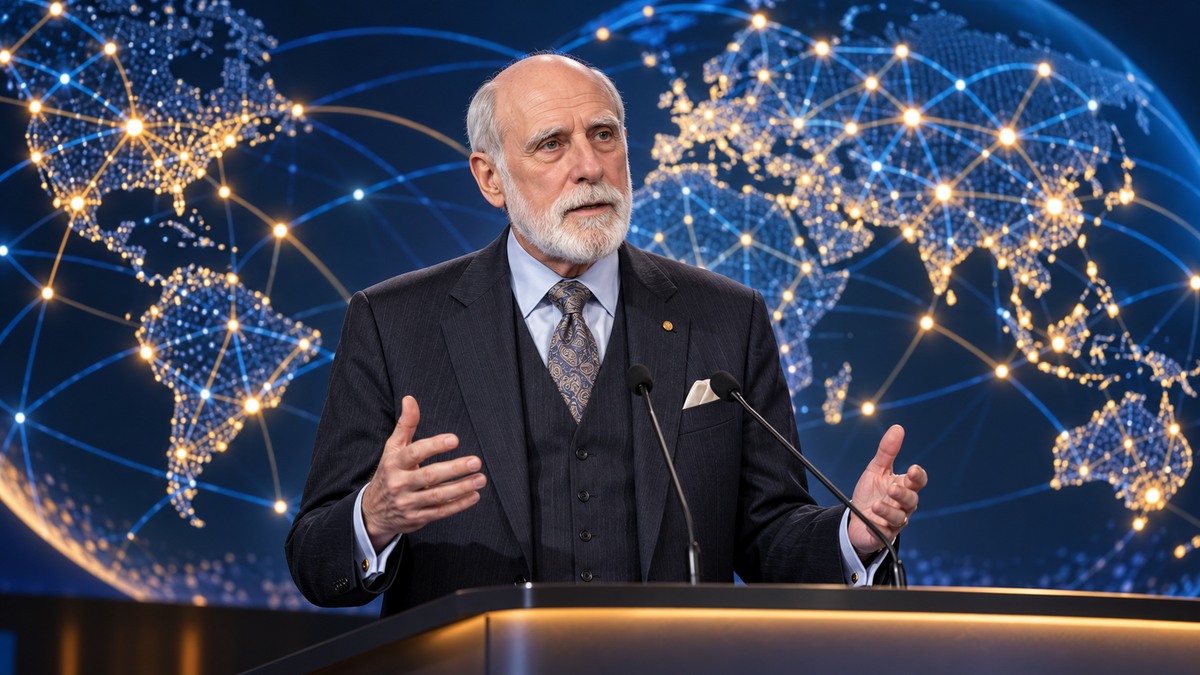
“The Internet is for everyone.”
Vint Cerf used this declaration as the title and central refrain of RFC 3271, published in 2002. The document celebrated the Internet’s open reach while warning that access, affordability, disability, language, security, privacy, and harmful uses could prevent the promise from becoming true. “Everyone” is an architectural and institutional commitment, not a description of equal access already achieved. Networks gain value as participation expands, but markets alone may not serve remote, low-income, or marginalized communities. Standards and policy shape who can connect and on what terms. Behind the concise wording is a claim about how organizations create results. It encourages leaders to look beyond individual effort and examine design, incentives, information, relationships, and the customer context that determine whether a good intention becomes reliable performance.
Technology companies can design for accessibility, low bandwidth, multiple languages, device diversity, and interoperable protocols from the beginning. Metrics should examine meaningful use and reliability across communities, not only aggregate accounts or traffic in well-served markets. Managers can translate the claim into a small experiment with a baseline, an owner, a defined customer or employee outcome, and a review date. Specificity protects the work from drifting into broad language that nobody can challenge or verify.
Universal access does not require unrestricted harmful conduct or the collection of unlimited personal data. Security, privacy, child protection, and due process matter. Governance should be transparent and capable of addressing abuse without turning inclusion into surveillance or arbitrary exclusion. Responsible use also requires naming the tradeoff. Speed, cost, autonomy, safety, equity, and learning may not all improve at once. People closest to the consequences should have a meaningful voice, and uncertainty should be reported instead of hidden behind confidence.
Connectivity increasingly determines access to education, work, finance, health, and public life. Satellite systems, community networks, and lower-cost devices offer new routes, while shutdowns, censorship, and affordability gaps show that technical reach can still be politically or economically withheld. Choose one digital service and test it under low bandwidth, assistive technology, older hardware, and the languages of underserved users. Publish the largest access gap, assign an owner, and prioritize the change that enables meaningful participation rather than a nominal connection. Evidence from the experiment can guide scaling, revision, or stopping. The durable lesson is to join purpose with measurement and human judgment, so the organization becomes better at seeing reality and responding before a local success or failure hardens into mythology. Recording the decision and its limits gives colleagues a foundation they can inspect, challenge, and improve instead of asking them to rely on memory, authority, or an unexplained result.
Vint Cerf used this declaration as the title and central refrain of RFC 3271, published in 2002. The document celebrated the Internet’s open reach while warning that access, affordability, disability, language, security, privacy, and harmful uses could prevent the promise from becoming true.
“Everyone” is an architectural and institutional commitment, not a description of equal access already achieved. Networks gain value as participation expands, but markets alone may not serve remote, low-income, or marginalized communities. Standards and policy shape who can connect and on what terms.
Technology companies can design for accessibility, low bandwidth, multiple languages, device diversity, and interoperable protocols from the beginning. Metrics should examine meaningful use and reliability across communities, not only aggregate accounts or traffic in well-served markets.
Universal access does not require unrestricted harmful conduct or the collection of unlimited personal data. Security, privacy, child protection, and due process matter. Governance should be transparent and capable of addressing abuse without turning inclusion into surveillance or arbitrary exclusion.
Connectivity increasingly determines access to education, work, finance, health, and public life. Satellite systems, community networks, and lower-cost devices offer new routes, while shutdowns, censorship, and affordability gaps show that technical reach can still be politically or economically withheld.
Choose one digital service and test it under low bandwidth, assistive technology, older hardware, and the languages of underserved users. Publish the largest access gap, assign an owner, and prioritize the change that enables meaningful participation rather than a nominal connection.
Explore more "Quotes of The Day"
Discover more notable quotes from influential voices across politics, science, business, technology, sports, and culture. Each quote offers insight into how ideas, beliefs, and decisions shape the world around us.