

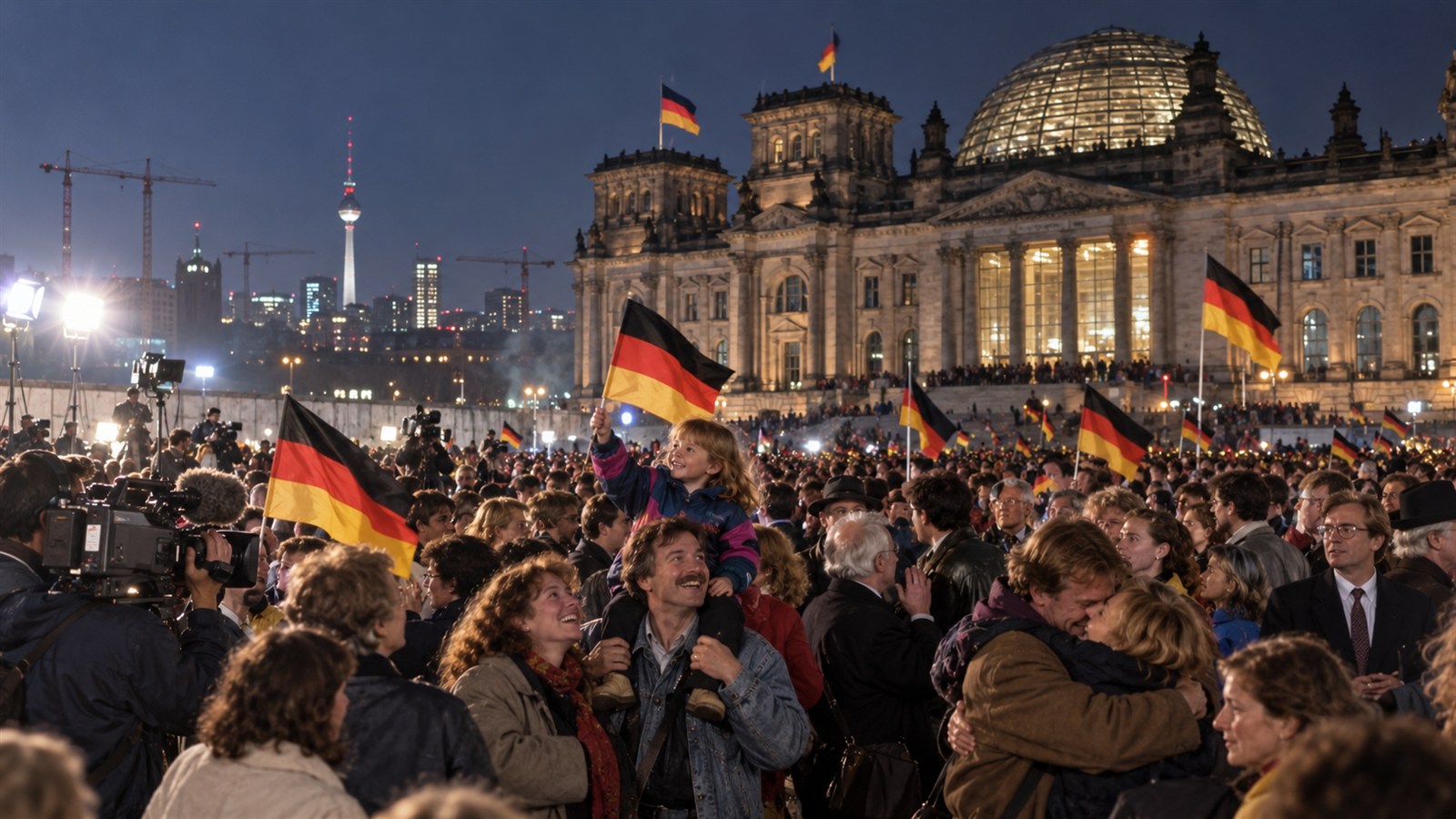
On This Day in Business: October 3, 1990
On October 3, 1990, the German Democratic Republic ceased to exist and its territory joined the Federal Republic of Germany. The legal reunification followed the fall of the Berlin Wall, free East German elections, currency union, and negotiations involving both German states and the four former Allied powers. Politically, it ended four decades of division. Economically, it combined a prosperous social-market economy with an eastern system dominated by state-owned enterprises, administered prices, obsolete equipment, and trading relationships tied to the Soviet bloc. The ceremonial moment therefore began an integration project whose cost, speed, and human consequences extended far beyond a new flag and borderless map.
A currency, economic, and social union had already introduced the West German deutsche mark in the east on July 1. The change protected savings and raised purchasing power, but it also exposed eastern firms to market prices and hard-currency competition almost overnight. The Treuhandanstalt took responsibility for thousands of state-owned enterprises, seeking to privatize, restructure, or close them. Some businesses attracted investment and survived; many did not. Factories lost established customers as Soviet-bloc trade collapsed, while wage expectations and production costs rose. Unemployment and migration followed, making reunification an immediate balance-sheet event for companies and a profound shock for communities.
The federal government directed large transfers toward transport, telecommunications, housing, environmental cleanup, social insurance, and local services. Construction companies, equipment suppliers, banks, retailers, and professional firms entered new markets, while eastern entrepreneurs built private businesses under unfamiliar rules. Infrastructure improved dramatically, but productivity, wealth, and corporate headquarters remained unevenly distributed. Financing included borrowing and a solidarity surcharge, spreading the burden across taxpayers and generations. The process showed that legal unity and currency conversion can happen on a date, while convergence in capital, skills, institutions, and opportunity takes much longer.
Reunified Germany became Europe's largest national economy and a central force in the European Union, yet the experience still informs debates about regional inequality and industrial policy. October 3 matters to business history because it tested how rapidly ownership, money, regulation, and supply chains could be reconstructed across an entire territory. The gains were real: modern networks, cleaner production, broader consumer choice, and access to a larger market. So were the losses, including disrupted careers and the disappearance of familiar enterprises. Reunification demonstrates that markets are not installed by decree alone. They depend on trusted institutions, productive assets, patient investment, and communities able to participate in the transition rather than simply absorb it.
German reunification took legal effect on October 3, 1990.
The event joined West Germany's social-market economy with an eastern economy dominated by state enterprises.
Currency union had already introduced the deutsche mark in the east and exposed firms to immediate competition.
The Treuhandanstalt privatized, restructured, or closed thousands of former state-owned businesses.
Massive public investment modernized transport, communications, housing, and environmental infrastructure.
Persistent regional gaps show that institutional and economic convergence lasts far longer than legal unification.
Explore more of "On This Day ..."
Discover more events from the same date across news, politics, technology, sports, and other fields. Each link highlights significant moments that shaped history on different fronts.