

How Volleyball Rotations Work Explainer
In indoor volleyball, six players occupy six rotational positions. When the receiving team wins a rally and gains the right to serve, its players rotate one position clockwise. The new player in right back serves, and that order continues for the set unless legal substitutions change who fills a position.
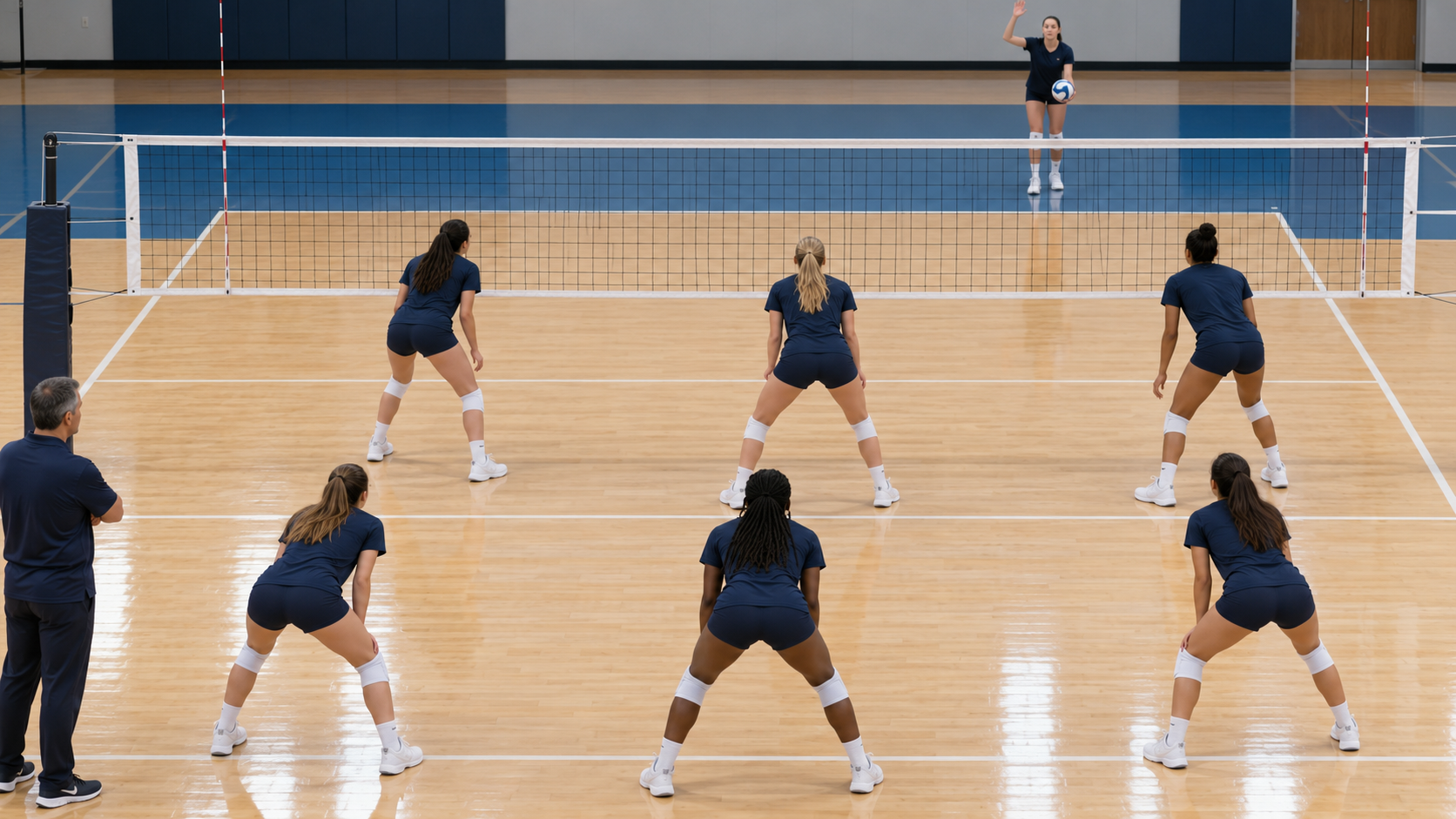
At the instant the server contacts the ball, players must be in the correct relative order. Front-row players must be closer to the center line than their corresponding back-row players, and left or right relationships must also be legal. This is an overlap rule, not a demand that everyone stand on fixed floor dots.
After the serve, players may move into their tactical locations. A setter can run toward the net, attackers can approach their preferred zones, and defenders can spread into coverage. The rotation still matters because a player’s front- or back-row status controls actions such as blocking and attacking a ball above the net from the front zone.
The libero has special replacement and service rules that let the defensive specialist enter for back-row players without ordinary substitutions. Scorekeepers track the service order, and officials can penalize a team that serves out of rotation or overlaps at contact. Rotations create equal turns through the court while allowing complex movement once play begins.
A team rotates only when it wins the right to serve from the opponent. Every player moves one position clockwise.
The player arriving in right back becomes the server, preserving the recorded service order.
At the moment of serve, players must maintain required front-back and left-right relationships with teammates.
They do not need to stand on exact spots. Officials judge relative foot positions and call an overlap when the order is illegal.
Once the ball is served, players may switch into tactical locations for setting, attacking, and defense.
Front- and back-row status still follows the rotation and limits certain blocks and attacks; libero rules add specialized back-row replacements.
Explore more "Explainers"
Discover additional explainers across politics, science, business, technology, and other fields. Each explainer breaks down a complex idea into clear, everyday language—helping you better understand how major concepts, systems, and debates shape the world around us.