

On This Day in Business: December 22, 1882
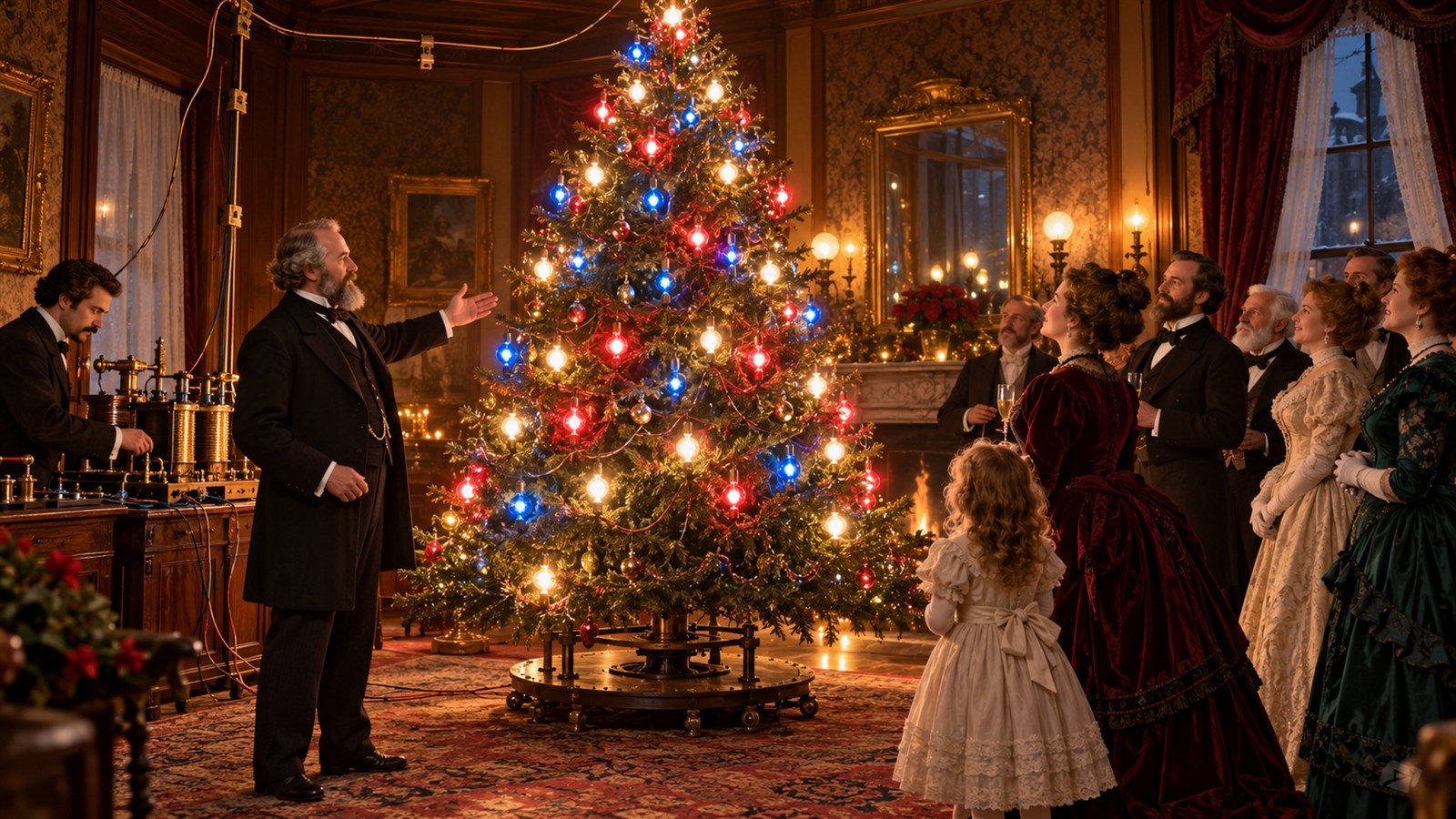
On December 22, 1882, a newspaper account described the electrically illuminated Christmas tree in Edward H. Johnson's New York home. Johnson, an associate of Thomas Edison, used a rotating tree decorated with dozens of red, white, and blue electric bulbs instead of candles. The immediate invention was only one layer of the opportunity. Commercial value depended on interfaces, complementary products, training, support, and confidence that the new system would keep improving. Early adopters were not simply buying hardware or software; they were accepting workflow change and uncertainty about an emerging standard.
The display was both festive and promotional. Electric lighting was still unfamiliar, expensive, and supported by limited central-station networks. Showing small bulbs safely illuminating a domestic ritual helped people imagine electricity inside the home rather than only in streets, factories, or public demonstrations. Adoption required translation between specialists and ordinary users. Performance claims had to become understandable tasks, while cost, reliability, and compatibility determined whether an impressive demonstration could survive outside the laboratory. Documentation and service therefore mattered nearly as much as the breakthrough itself.
Early electric tree lights were not immediately a mass product. Wiring, sockets, household service, manufacturing cost, and installation all limited adoption. As power networks expanded and standardized light strings became easier to buy, a technical spectacle evolved into a broad seasonal market. As more organizations participated, learning and network effects strengthened the proposition. New uses attracted investment, investment improved tools, and better tools brought additional users. That cycle could create durable advantage, but it also made governance important because technical choices by a small group affected a widening market.
Johnson's tree illustrates the value of contextual demonstration. New infrastructure can feel abstract until it improves an experience people already understand. Businesses often accelerate adoption by placing unfamiliar technology inside a trusted ritual, then lowering cost and complexity so the demonstration can become an ordinary purchase. The modern lesson is to design the ecosystem along with the product. Dependable support, open pathways for complements, sensible standards, and clear incentives can turn a clever prototype into infrastructure. Without those surrounding relationships, even remarkable technology may remain isolated or arrive before customers are ready. In practical terms, the advantage came from linking a clear public or customer promise to disciplined execution. Capital and attention had to be committed before demand was certain, partners had to coordinate, and leaders had to keep learning after the first milestone passed into history. The strongest legacy was not the announcement alone, but the repeatable capability, institution, or market that people built around it afterward.
Edward Johnson displayed an electric Christmas tree in 1882.
The rotating tree used red, white, and blue bulbs instead of candles.
The display promoted electricity as a household technology.
Early cost, wiring, and limited power service constrained adoption.
Standardized light strings later created a large seasonal consumer market.
A familiar ritual made an unfamiliar infrastructure easier to understand.
Explore more of "On This Day ..."
Discover more events from the same date across news, politics, technology, sports, and other fields. Each link highlights significant moments that shaped history on different fronts.