

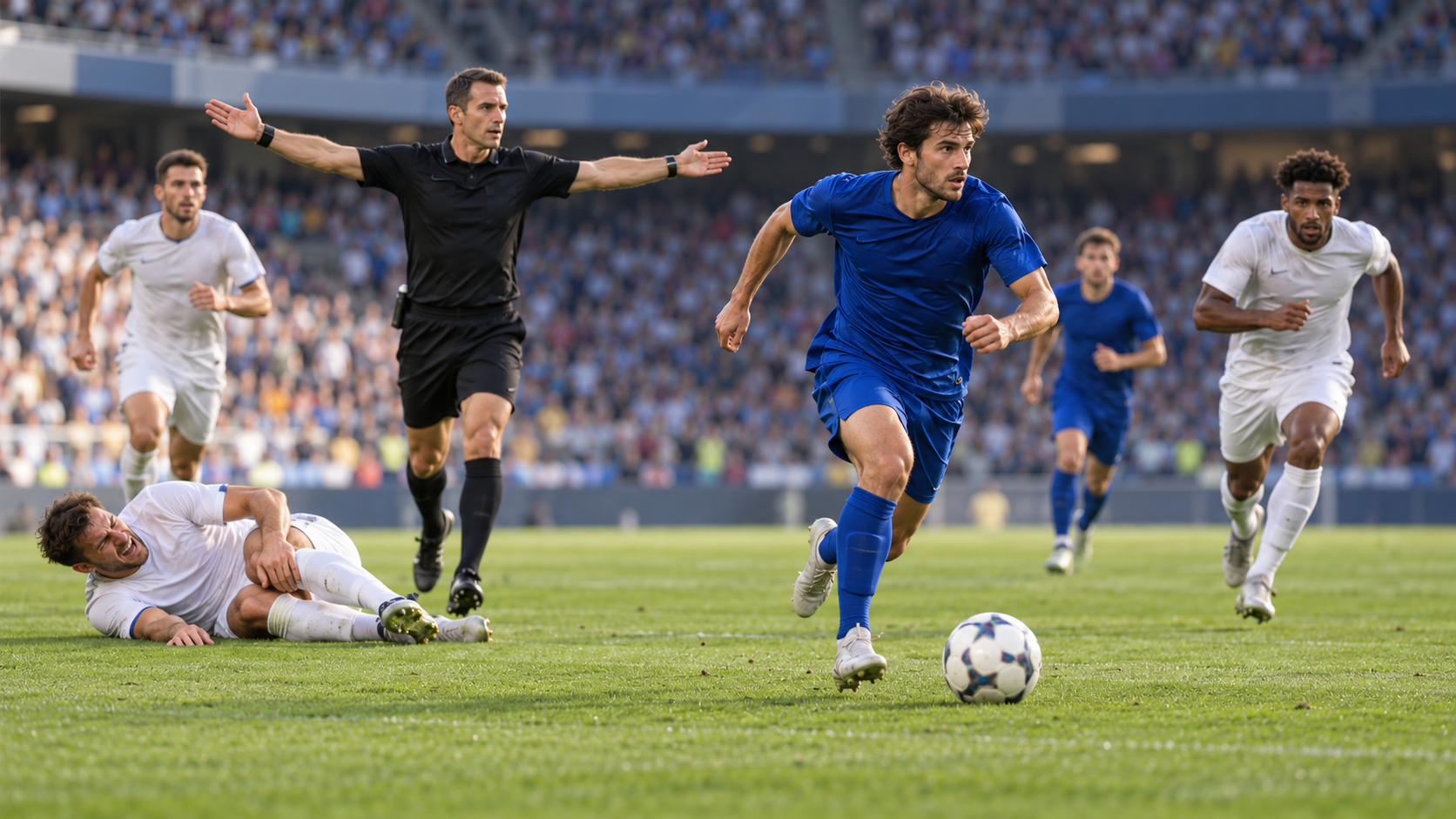
How Soccer’s Advantage Rule Works Explainer
Soccer’s advantage rule lets the referee allow play to continue when stopping for a foul would actually hurt the team that was fouled. Instead of immediately awarding a free kick, the referee waits briefly to see whether the non-offending side keeps a more promising attacking opportunity.
The decision is practical, not automatic. Referees weigh the severity of the offense, the location of the foul, the chances of an immediate attack, and the atmosphere of the match. A foul near the opponent’s goal may create a valuable advantage, while possession deep in a team’s own half may not be better than the free kick.
If the expected benefit does not appear within a few seconds, the referee can return to the original offense and award the free kick. Discipline is separate from the restart: a player may still be cautioned at the next stoppage, while serious misconduct can require play to stop immediately unless there is a clear chance to score.
Watch for the referee’s sweeping arm signal and the attacking team’s next touch. Advantage is not permission to ignore the foul; it is a short evaluation of which outcome better serves the team that suffered it. The best calls feel almost invisible because the attack keeps its rhythm.
Only a few seconds—long enough to judge whether the non-offending team gains a real, immediate benefit.
Yes. The referee can return to caution or send off the offender at the next stoppage when the Laws require it.
The referee has discretion, but serious offenses, dangerous situations, or attacks with little real promise often make an immediate stoppage the better decision.
Explore more "Explainers"
Discover additional explainers across politics, science, business, technology, and other fields. Each explainer breaks down a complex idea into clear, everyday language—helping you better understand how major concepts, systems, and debates shape the world around us.