

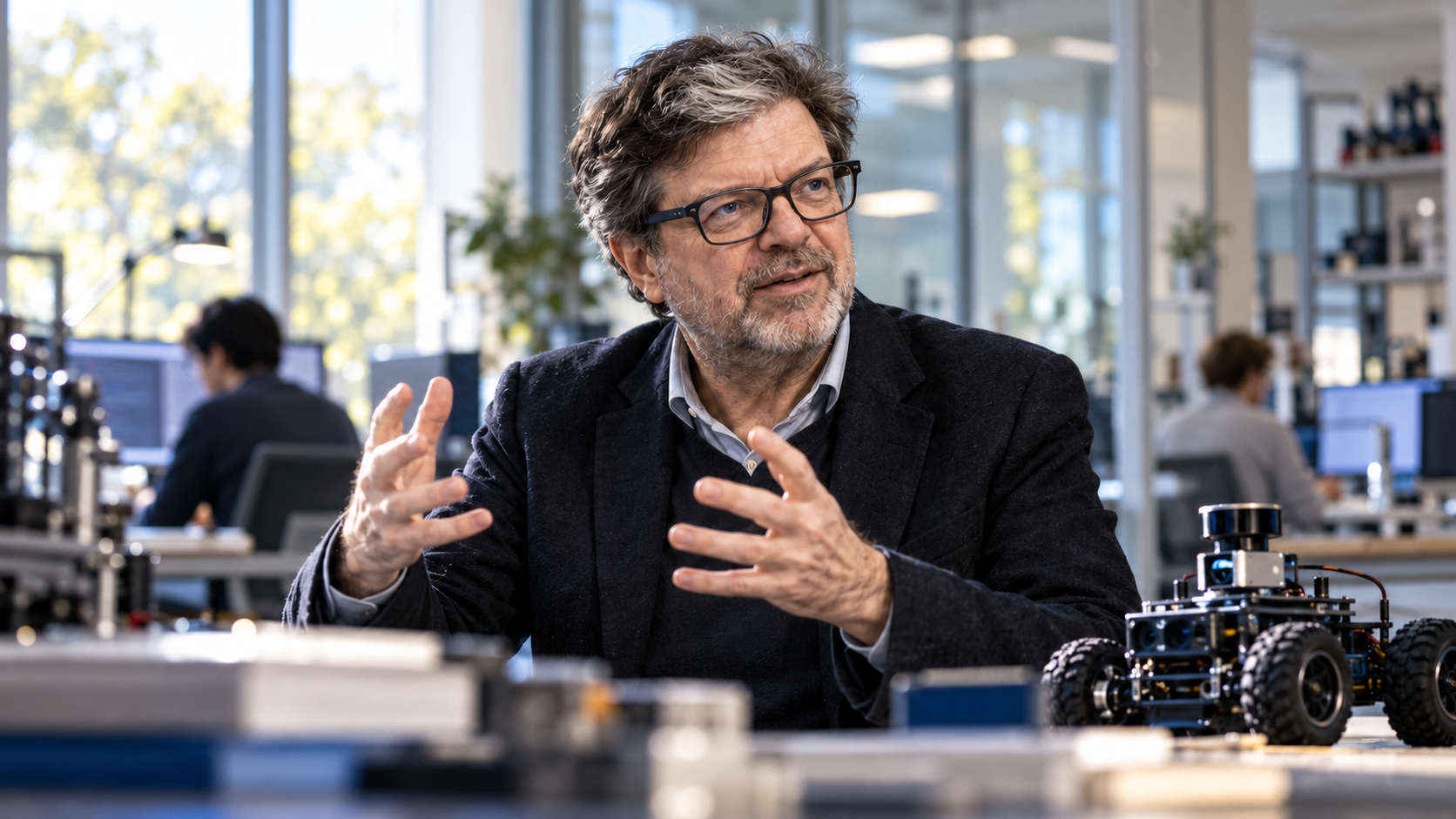
“Our intelligence is what makes us human, and AI is an extension of that quality.”
Yann LeCun’s statement “Our intelligence is what makes us human, and AI is an extension of that quality” places artificial intelligence in a long history of tools that amplify thought. Writing extends memory across time. Mathematics extends the precision of reasoning. Telescopes and microscopes extend perception beyond ordinary senses. Computers extend calculation, simulation, and communication. In this view, AI is not a separate intelligence arriving from nowhere. It is a human-built set of methods that can enlarge our ability to recognize patterns, generate possibilities, and act on information.
The word “extension” is useful because it implies connection. An extension inherits purposes and constraints from the person or institution using it. A model that helps a scientist compare experiments can widen inquiry; the same statistical power used for indiscriminate surveillance can narrow freedom. Capability does not determine purpose. People choose the training material, objective, interface, and deployment, then decide whether to accept the result. Describing AI as an extension therefore does not reduce responsibility. It makes the connection between human decisions and machine effects harder to deny.
Extensions also change the people who rely on them. Navigation tools can free attention while weakening practiced spatial knowledge. Writing assistants can lower barriers while tempting users to skip the work of forming an argument. Decision aids can reveal patterns while creating automation bias. Good design asks what human capacity should be strengthened, what skill must remain practiced, and where friction is protective. The best systems do more than produce an answer; they help users understand alternatives, inspect uncertainty, and improve their own judgment over time.
LeCun’s quote offers an optimistic frame, but optimism becomes credible through design and governance. An extension should remain steerable by the person whose goals it serves and bounded where other people may be harmed. Access should be broad enough that augmentation does not become a privilege reserved for a small group. Institutions should be honest about when an automated recommendation influenced a decision. AI can indeed extend a defining human quality, but the social outcome depends on which capacities are amplified—curiosity or manipulation, care or control, shared knowledge or concentrated power. The extension metaphor should finally preserve reciprocity: tools learn from human culture, and the institutions creating them owe something back to that culture. Credit, consent, accessibility, and shared benefit help ensure that collective knowledge is amplified without being quietly enclosed or narrowly controlled by gatekeepers today.
Writing, mathematics, instruments, and computers have long expanded memory, perception, calculation, and communication.
AI extends this tradition by helping people detect patterns, generate options, and navigate complex information.
The same capability can support discovery, persuasion, surveillance, education, or control depending on its deployment.
Objectives and institutions determine what the extension amplifies and who benefits from it.
Convenient systems may strengthen creativity and access while also reducing practice, attention, or independent judgment.
Responsible design preserves understanding, communicates uncertainty, and helps users remain capable rather than merely dependent.
Explore more "Quotes of The Day"
Continue exploring how writers, thinkers, artists, and advocates have described the choices that shape an everyday life.