

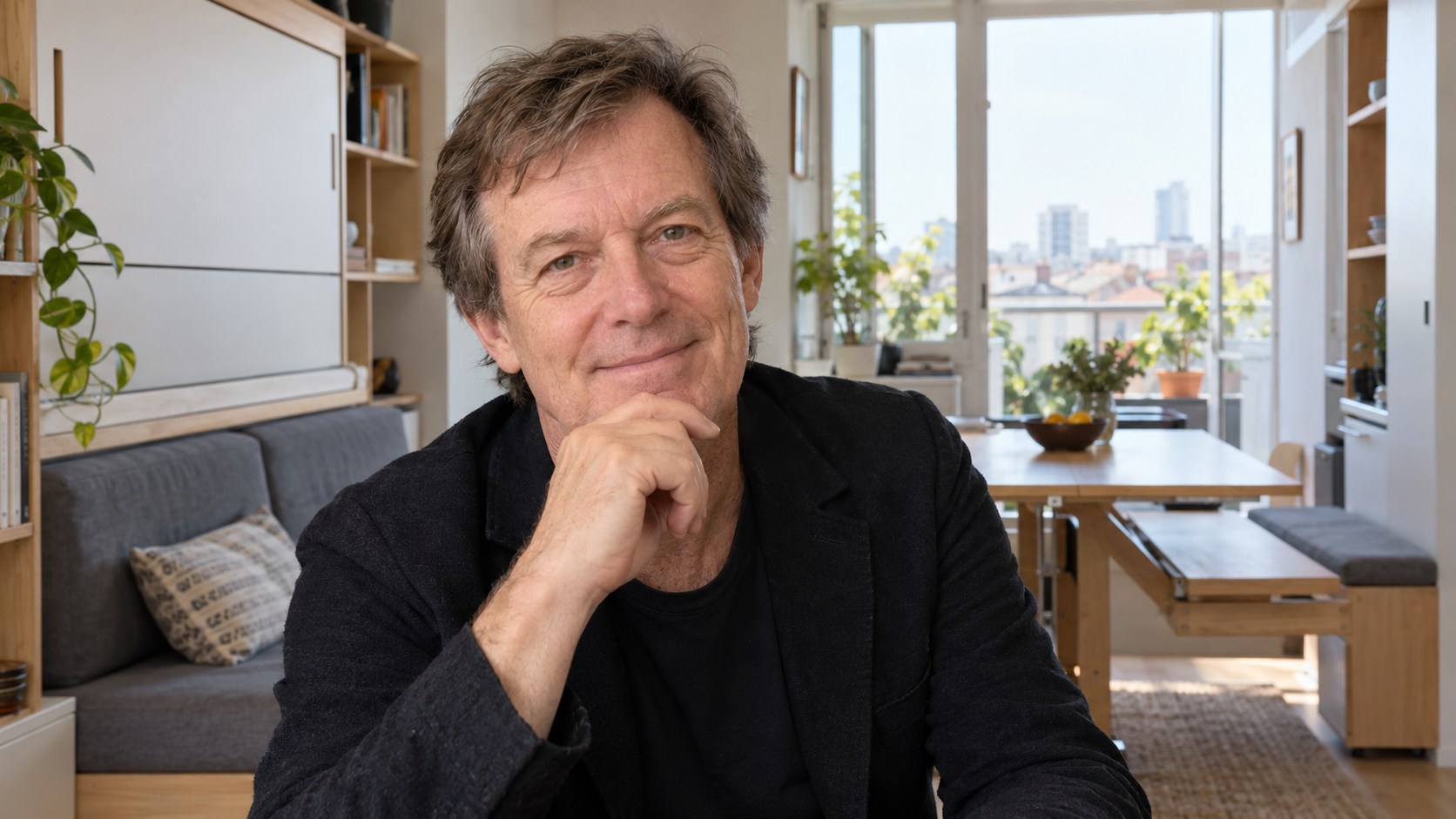
“Living little creates freedom.”
July 25 uses Less Stuff, More Happiness (2011) as Graham Hill's documented setting. Hill describes designing a smaller home and argues that carefully chosen possessions and spaces can reduce expense, maintenance, and environmental demand. Hill connects small-space design with the costs of acquiring, storing, maintaining, and moving possessions. His claim is not that square footage has moral purity. It is that deliberate sufficiency can release resources that accumulation quietly consumes, including money, time, attention, and freedom to relocate. July 25 is NewsStreets placement for Graham Hill; 2011 is Graham Hill's date for Less Stuff, More Happiness.
Having less can return time, mobility, attention, and money when possessions no longer require as much storage, care, or mental management. The featured wording—“Living little creates freedom.”—compresses that distinction for Graham Hill. “Living little” works as a design question: what must a space and its contents enable? When an object earns its place through use or deep value, fewer things can support more flexible living. The freedom comes from reducing obligations, not from achieving a particular minimalist appearance.
Minimalism is not the same as involuntary scarcity, and adequate housing, accessibility, family needs, culture, and sentimental value change what enough means. For Graham Hill, the boundary guards Less Stuff, More Happiness from overreach. Voluntary simplicity is distinct from scarcity. Families, disabled people, renters, cultural traditions, and people preserving essential supplies may need more space or different possessions. Discarding usable goods carelessly can also shift environmental and financial costs onto others.
Low-cost purchasing and targeted advertising make accumulation easy while the long-term costs of space and upkeep remain less visible. Test the proposition in one crowded category rather than staging a total purge. Keep what works or carries real meaning, transfer usable excess responsibly, and observe whether finding, cleaning, spending, or decision-making becomes easier. The result should be functional relief, not a photograph of emptiness. Sufficiency is easier to judge when the question is concrete: does this possession support the life taking place here? The answer may be yes for tools, archives, adaptive equipment, children's materials, or objects carrying family history. Deliberate ownership is not visual austerity. It is alignment between resources, obligations, available space, and the activities a household values. For Graham Hill, a practical July 25 trial is this: Choose one crowded category, keep what is useful or deeply valued, pass on usable excess responsibly, and observe whether daily friction changes. On July 25, readers can test Less Stuff, More Happiness through Graham Hill's guidance.
Graham Hill used the line in Less Stuff, More Happiness, associated with 2011. Hill describes designing a smaller home and argues that carefully chosen possessions and spaces can reduce expense, maintenance, and environmental demand.
The source year identifies the documented work; July 25 is only this Quote of the Day series position, not the date when the words were first spoken or published.
Having less can return time, mobility, attention, and money when possessions no longer require as much storage, care, or mental management.
Minimalism is not the same as involuntary scarcity, and adequate housing, accessibility, family needs, culture, and sentimental value change what enough means.
Low-cost purchasing and targeted advertising make accumulation easy while the long-term costs of space and upkeep remain less visible.
Choose one crowded category, keep what is useful or deeply valued, pass on usable excess responsibly, and observe whether daily friction changes.
Explore more "Quotes of The Day"
Continue exploring how writers, thinkers, artists, and advocates have described the choices that shape an everyday life.