

Game Engines Explainer
A game engine is a reusable software framework for creating and running interactive experiences. Rather than write every low-level system from the beginning, developers use an engine to coordinate graphics, input, audio, physics, animation, user interfaces, assets, scenes, scripting, and deployment. The engine is not the finished game and does not supply its story or art automatically. It is closer to a working environment and set of connected subsystems. Teams build game-specific rules and content on top of that foundation, then package the project so it can run on target hardware such as computers, consoles, phones, or headsets.
Rendering turns scene data into images by processing geometry, materials, lights, cameras, effects, and postproduction. Physics simulates motion, collisions, cloth, vehicles, destruction, or other behavior under defined rules. Audio systems play and position music, dialogue, and effects. Animation tools blend poses and connect them to gameplay states. Input systems translate controllers, keyboards, touch, and accessibility devices into actions. None of these parts operates alone: opening a door can trigger animation, collision changes, sound, particles, artificial intelligence, and a saved gameplay state, all while the renderer produces a new frame within a strict time budget.
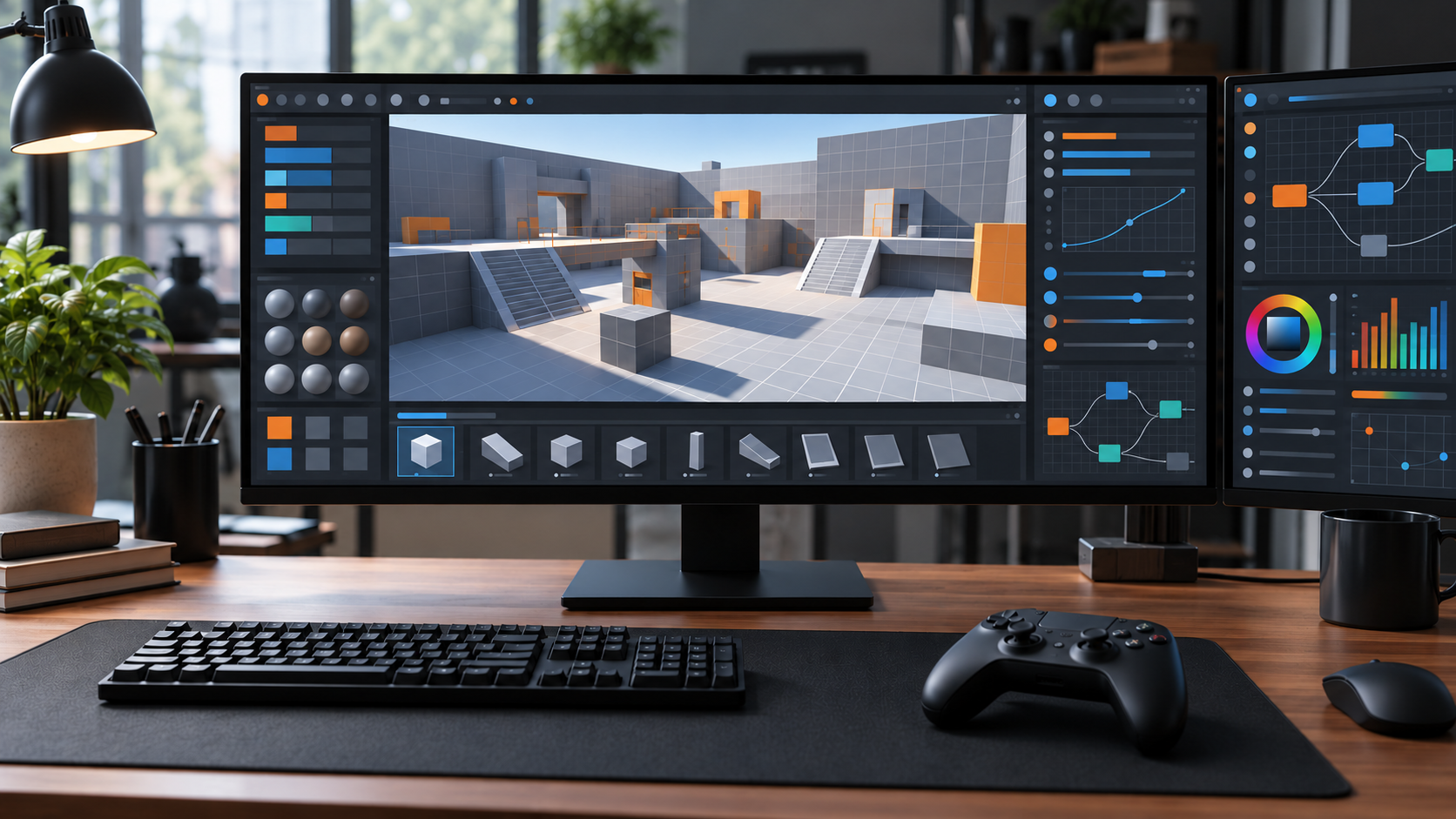
Editors make those systems usable to artists and designers. A scene or level editor places objects in space, a content browser organizes assets, an inspector exposes properties, and visual scripting can express logic without writing every behavior in text code. Programmers still extend engines in languages such as C++, C#, or scripting languages, and teams build custom tools for their pipeline. Version control, automated builds, profiling, debugging, localization, and testing connect the engine to production. A feature that looks impressive in a demo must also fit memory, performance, team expertise, licensing terms, and the platforms the project intends to support.
Studios can license a commercial engine, use an open-source one, or maintain proprietary technology. Commercial tools may offer mature documentation, asset marketplaces, and broad platform support, while custom engines can focus tightly on a studio's genre and workflow. Switching engines is rarely like changing an ordinary application because project code, assets, shaders, tools, and staff knowledge become deeply connected to the chosen architecture. Licensing can involve royalties, subscription tiers, source access, or service fees. The right choice depends on the project and organization, not on which engine produces the most photorealistic public demonstration. An engine does not guarantee a particular visual style or performance level. Artists can build stylized work in a high-end 3D engine, and poor optimization can make simple scenes run badly. Many engines also support architecture, film production, simulation, and other real-time uses beyond games. What defines the engine is the way it manages a repeating loop of input, simulation, and output while providing tools to create the content inside that loop. Understanding that structure clarifies why games with very different appearances can share technology, and why apparently minor engine changes can affect every department from animation and audio to testing and release engineering. A practical way to read or discuss Game Engines is to separate the basic definition from the choices made in a particular example. A game engine coordinates reusable systems for rendering, input, audio, physics, animation, scenes, interfaces, and deployment. Then identify who sets the relevant rules, which parts are creative decisions, and which parts follow from law, contracts, technology, or production limits. Examples that look similar on the surface can operate differently because their purpose, audience, timing, and surrounding agreements are different. Performance profiling matters because all active systems must fit frame-time, memory, storage, and hardware constraints. It is also useful to check whether a source is describing a formal industry category, an informal critical label, or one organization's current practice. Those distinctions prevent a memorable anecdote from becoming a false universal rule. Finally, compare the visible result with the less visible work that produced it. An engine is a framework, not a finished style; the same technology can produce visually and mechanically different projects. That approach keeps the explanation grounded while leaving room for reasonable disagreement about borderline cases.
A game engine coordinates reusable systems for rendering, input, audio, physics, animation, scenes, interfaces, and deployment.
Editors and content browsers let artists and designers assemble experiences without manipulating every low-level system directly.
Visual scripting and text programming can coexist, with teams extending the engine through custom code and production tools.
Performance profiling matters because all active systems must fit frame-time, memory, storage, and hardware constraints.
Commercial, open-source, and proprietary engines trade licensing, flexibility, documentation, platform support, and team expertise.
An engine is a framework, not a finished style; the same technology can produce visually and mechanically different projects.
Explore more "Explainers"
Discover additional explainers across politics, science, business, technology, and other fields. Each explainer breaks down a complex idea into clear, everyday language—helping you better understand how major concepts, systems, and debates shape the world around us.