

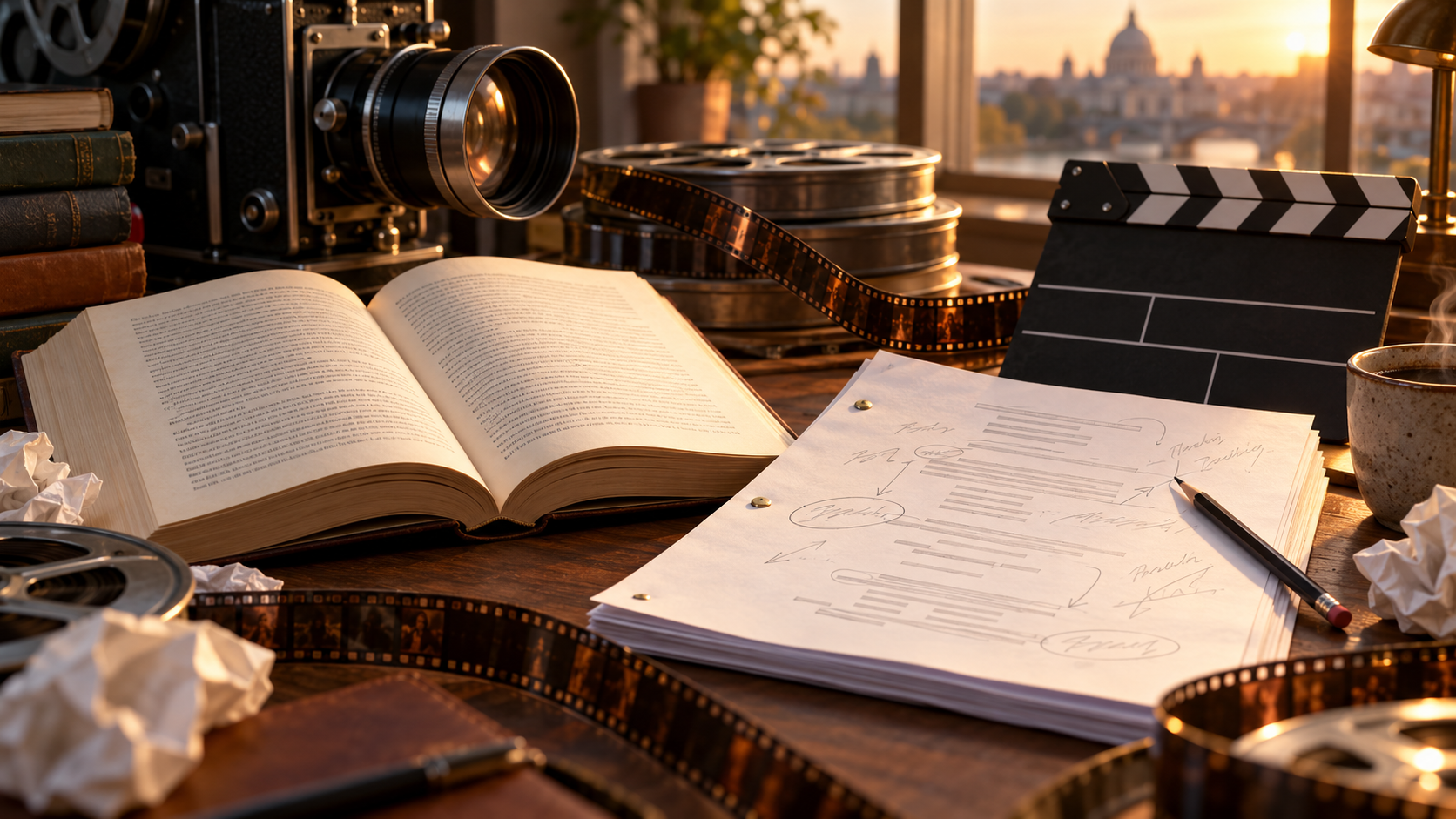
Film Adaptations Explainer
A film adaptation is a motion picture that recasts material from an earlier work, such as a novel, play, article, comic, game, or previous film. U.S. copyright law treats a motion-picture version of protected material as a derivative work, so permission is ordinarily part of the production process unless the source is in the public domain or another exception applies. Adaptation is also an artistic act: the filmmakers create new performances, images, sounds, pacing, and structure rather than simply transferring words from one container to another.
Development often begins with a producer or studio obtaining an option, license, or assignment of relevant rights. A screenwriter then identifies the source's dramatic spine and decides what can survive within a film's running time. Internal narration may become dialogue, visual behavior, or sound design. Several characters may be combined, chronology may be compressed, and subplots may disappear. These choices are not automatically betrayals; they respond to the different ways prose, theater, interactive media, and cinema communicate information and hold attention.
The screenplay passes through further interpretation by directors, actors, designers, editors, composers, and other departments. A location described in one sentence may require extensive visual planning, while a long chapter can sometimes become a silent glance. Budget, casting, audience expectations, ratings, and technical feasibility place additional limits on what reaches the screen. The finished film is therefore one reading of the source, shaped by many collaborators and by practical conditions that may not exist in the original medium.
Debates about fidelity usually mix several questions. Viewers may care about literal events, the tone of the source, the treatment of a beloved character, or the preservation of a theme. A film can change plot details yet feel faithful to the source's emotional logic, while a scene-by-scene reproduction can still miss its voice. Comparing versions is most useful when the standards are stated clearly. The question is not only what changed, but what the filmmakers gained, lost, or reinterpreted by making that change. Adaptations also have independent copyrightable authorship in the new material they add, although that protection does not erase ownership of the underlying work. Public-domain stories can support many unrelated versions because no single adapter controls the source. For audiences, the practical takeaway is that an adaptation is neither a replacement for the original nor a neutral illustration. It is a new work in conversation with an older one, and its differences reveal how creators understood both the source and the possibilities of film. A practical way to read or discuss Film Adaptations is to separate the basic definition from the choices made in a particular example. An adaptation uses preexisting material as a foundation, then expresses it through filmed performance, composition, editing, sound, and duration. Then identify who sets the relevant rules, which parts are creative decisions, and which parts follow from law, contracts, technology, or production limits. Examples that look similar on the surface can operate differently because their purpose, audience, timing, and surrounding agreements are different. Fidelity can refer to plot, character, theme, tone, setting, or spirit; disagreements often arise because viewers prioritize different kinds of faithfulness. It is also useful to check whether a source is describing a formal industry category, an informal critical label, or one organization's current practice. Those distinctions prevent a memorable anecdote from becoming a false universal rule. The date and market matter too: tools, distribution systems, and standard agreements change, while older examples can preserve assumptions that no longer apply everywhere. When a claim sounds absolute, compare it with a second type of source and look for the conditions under which it is actually true. Finally, compare the visible result with the less visible work that produced it. Comparing the source and film works best when each is judged as a complete work in its own medium, then examined for purposeful changes. That approach keeps the explanation grounded while leaving room for reasonable disagreement about borderline cases.
An adaptation uses preexisting material as a foundation, then expresses it through filmed performance, composition, editing, sound, and duration.
Producers generally need the relevant adaptation rights when the underlying work remains protected, often securing them before substantial development begins.
Screenwriters select and restructure because a feature cannot reproduce every event, thought, branch, or descriptive passage from another medium.
Fidelity can refer to plot, character, theme, tone, setting, or spirit; disagreements often arise because viewers prioritize different kinds of faithfulness.
Public-domain material may be adapted without licensing its original text, although a later adaptation can contain separately protected additions.
Comparing the source and film works best when each is judged as a complete work in its own medium, then examined for purposeful changes.
Explore more "Explainers"
Discover additional explainers across politics, science, business, technology, and other fields. Each explainer breaks down a complex idea into clear, everyday language—helping you better understand how major concepts, systems, and debates shape the world around us.