

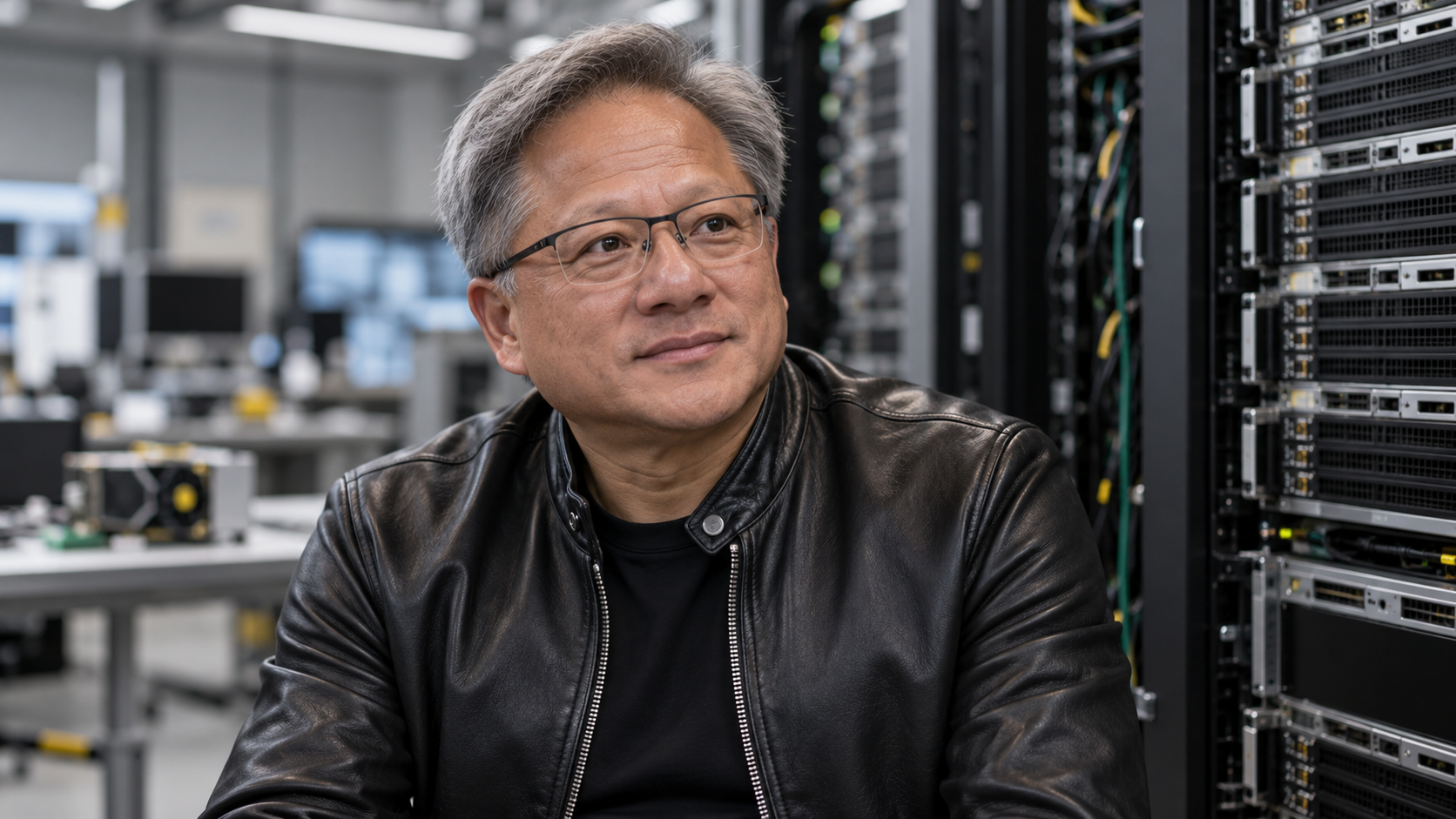
“Generative AI is the defining technology of our time.”
NVIDIA founder and chief executive Jensen Huang made this statement in March 2024 while introducing the Blackwell computing platform. The setting explains the scale of the claim. Generative AI is not only a family of models that produces text, images, audio, or code. It is also an infrastructure project involving specialized chips, high-speed networks, data centers, software libraries, training data, and vast amounts of electricity. Huang’s company supplies crucial parts of that stack, so his words are both a technological judgment and a declaration from an industry with a direct stake in the platform shift.
The description “defining” reflects how quickly generative models moved from research demonstrations into office software, search, design, programming, customer service, and scientific work. A general interface built around language can make advanced computation accessible to people who never write conventional code. That reach creates opportunities for faster prototyping, translation, accessibility, and analysis. It also changes expectations: once a tool can produce a plausible answer instantly, users may overlook the difference between fluency and accuracy. The interface lowers friction, but it does not eliminate the need for expertise.
Infrastructure places limits on the story. Training and serving large models require capital, hardware, energy, and technical talent that are concentrated among a small number of firms and countries. Bottlenecks can shape competition and determine which researchers or communities can participate. Environmental costs vary with power sources, model design, and utilization, so a simple claim about efficiency can hide total growth in demand. Security also becomes systemic when many organizations rely on the same chips, clouds, models, or software. A defining technology creates dependencies as well as capabilities.
Huang’s statement is best read as a challenge to examine what the era is being defined by. Is generative AI broadening creative and scientific capacity, or primarily increasing the leverage of organizations that control compute? Are models becoming more reliable and efficient, or only larger? Are workers gaining better tools and stronger roles, or being asked to validate automated output at an unsustainable pace? The answers differ by application. A platform shift becomes durable when it solves real problems under realistic constraints, earns trust through evidence, and gives customers alternatives rather than forcing them into a single technical path. Calling a technology defining should raise the standard applied to it. The more deeply AI enters essential systems, the more important reliability, energy use, security, competition, and public accountability become. Scale is not only evidence of success; it is also a measure of responsibility.
Huang’s line accompanied the launch of a new accelerated-computing platform aimed at large-scale generative AI.
The context joins a broad technological claim with the hardware and infrastructure needed to pursue it.
Natural-language systems let more people use complex computational capabilities without traditional programming.
That convenience can expand access while also making fluent errors easier to accept.
Generative AI depends on chips, networks, data centers, energy, software, and concentrated pools of capital and talent.
Governance must consider those dependencies alongside the visible behavior of the model.
Explore more "Quotes of The Day"
Continue exploring how writers, thinkers, artists, and advocates have described the choices that shape an everyday life.