

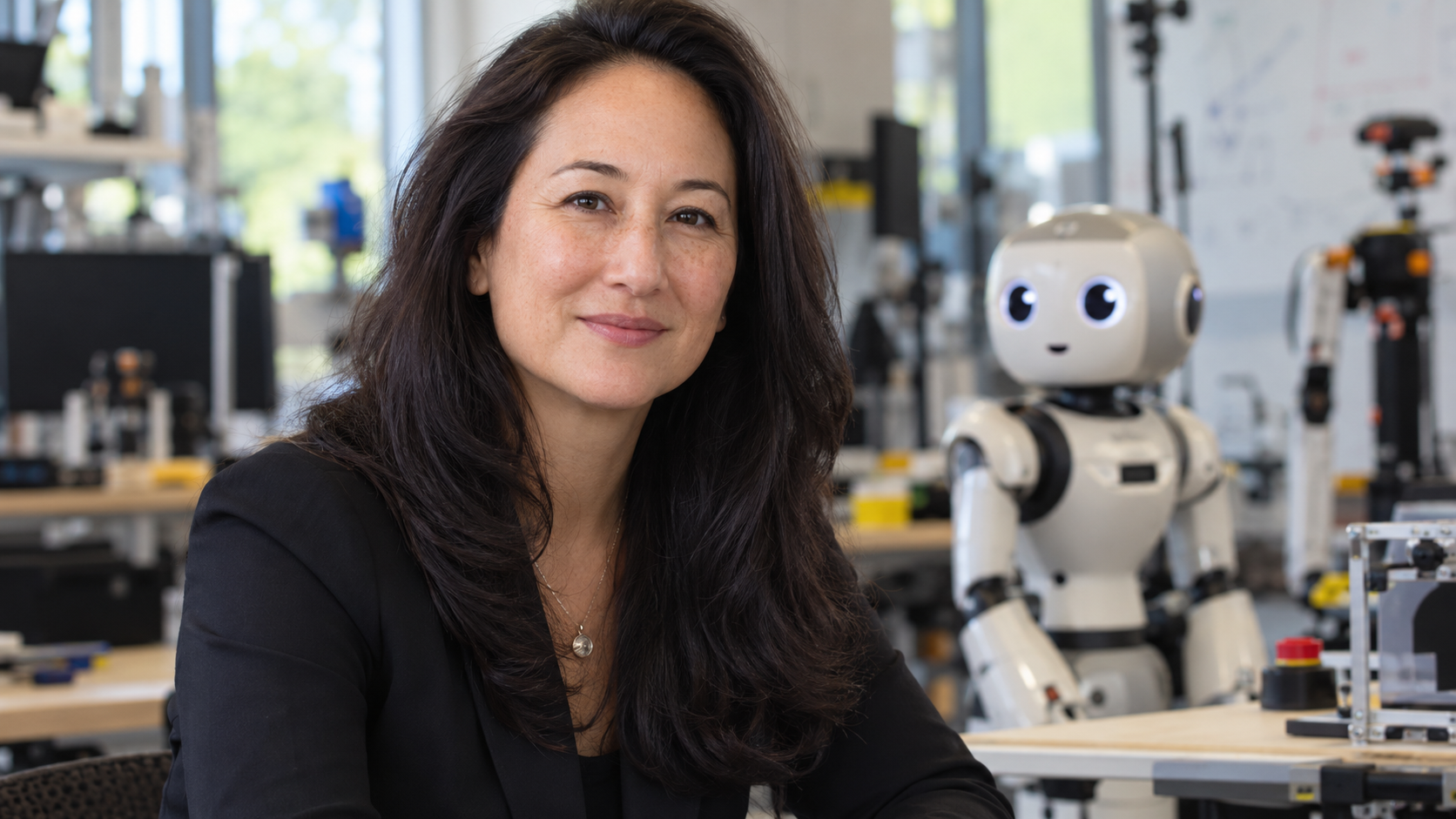
“The goal is to build a socially intelligent machine that learns things as we learn them, through social interactions.”
MIT roboticist Cynthia Breazeal made this statement while discussing Kismet, an early expressive social robot. Kismet used a face, gaze, vocal patterns, and simple emotional signals to sustain interactions with people. Its importance was not that it possessed human feelings. The project treated communication itself as part of intelligence. Infants learn through attention, imitation, feedback, and shared routines; Breazeal asked what a machine might gain from comparable exchanges. The quote describes a research direction in which a robot develops within a social environment instead of receiving every useful behavior as a fixed instruction.
That shift changes both the learner and the teacher. People naturally adjust their speech, timing, gestures, and expectations when another participant appears attentive. A robot that can signal confusion, interest, or readiness gives its partner cues for effective instruction. Learning becomes a loop rather than a one-way command. The machine observes a person, acts, receives a response, and updates its behavior. The person also adapts. This reciprocity can make technology easier to use, especially when users cannot be expected to write code or translate ordinary goals into precise machine instructions.
Social design also creates ethical obligations. Humanlike signals can invite trust that a system has not earned. A warm voice or expressive face may cause a child, patient, or older adult to assume empathy, memory, or confidentiality that is not really present. Designers must distinguish useful communication from manipulation. They should disclose automation, limit data collection, test behavior across cultures and abilities, and provide straightforward ways to stop or override the system. Social intelligence cannot mean becoming better at exploiting social cues; it should mean participating in ways that protect the person.
Today the idea appears in home robots, educational tools, virtual assistants, and collaborative machines on factory floors. The best applications do not merely imitate conversation. They use interaction to clarify goals, recognize uncertainty, and share control. A robot working near a person might signal its intended path before moving. A learning companion might notice confusion and offer a different explanation without pretending to replace a teacher. Breazeal’s quote points toward technology whose intelligence is measured partly by the quality of the relationship it supports. Breazeal’s goal remains demanding because it joins technical performance to human experience. A successful social machine must learn with people while respecting their autonomy, expectations, vulnerabilities, and right to understand what the machine can actually do. Trust should follow evidence, not appearance.
A social robot can learn from gaze, timing, expression, demonstration, correction, and shared routines.
The human partner also adapts, making learning a reciprocal process rather than a sequence of commands.
Signals of attention or uncertainty can help people understand when to speak, teach, wait, or intervene.
Those cues should communicate real system states instead of manufacturing a false impression of human feeling.
Humanlike behavior can encourage people to overestimate empathy, memory, privacy, or competence.
Responsible social robotics requires disclosure, consent, data limits, inclusive testing, and accessible human control.
Explore more "Quotes of The Day"
Continue exploring how writers, thinkers, artists, and advocates have described the choices that shape an everyday life.