

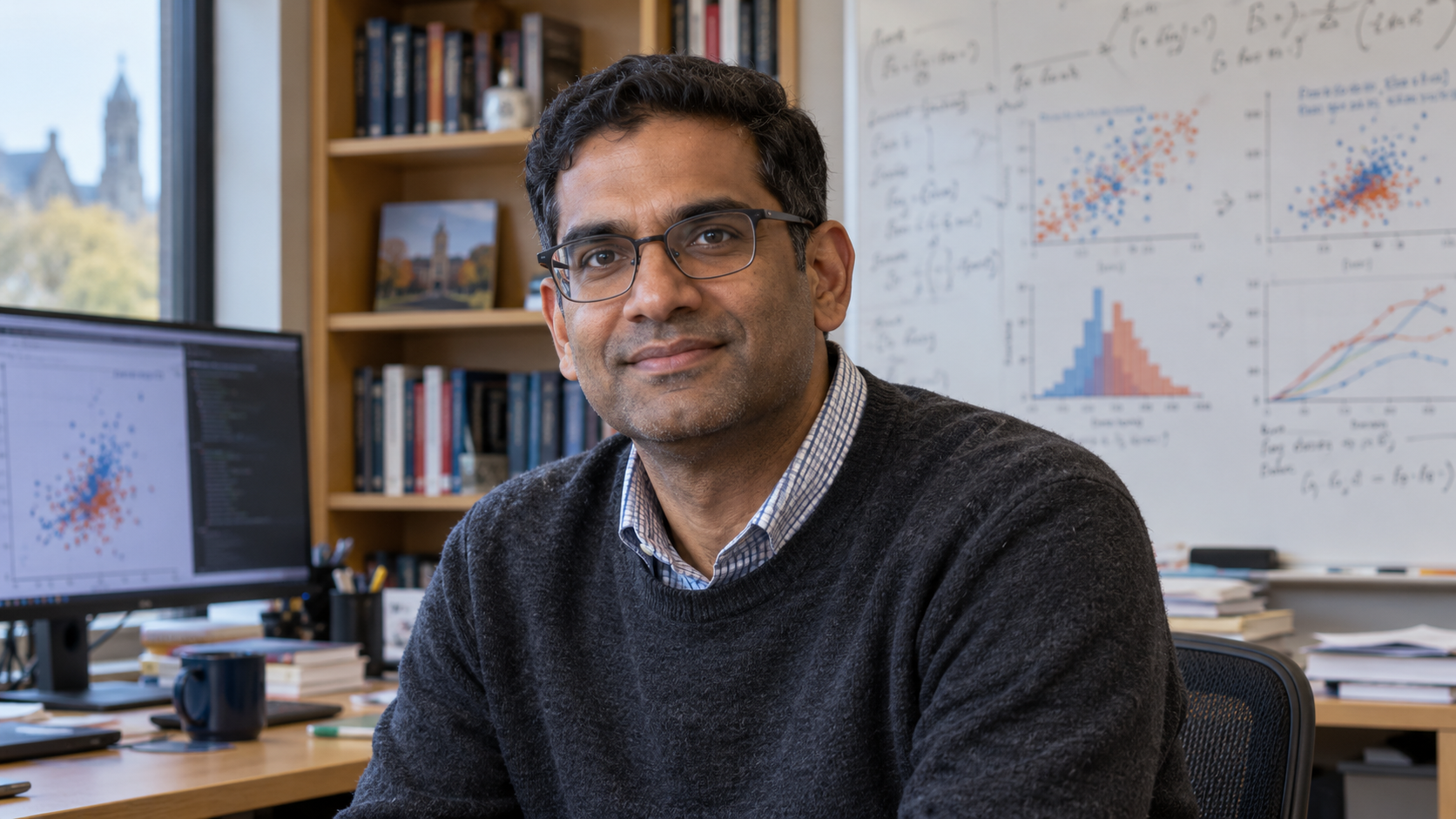
“The fact is that it is hard to predict the future using AI, and its ability to do that is not improving.”
Princeton computer scientist Arvind Narayanan made this point while separating realistic uses of artificial intelligence from what he and Sayash Kapoor call AI snake oil. Some tasks have clear labels, stable relationships, and immediate feedback. A model can improve image recognition, transcription, or certain kinds of forecasting when the environment is sufficiently regular. Other tasks ask for predictions about people’s future job performance, criminal behavior, academic success, or risk of harm. Those outcomes are shaped by changing circumstances, institutions, choices, and labels that may be subjective or incomplete.
Prediction has limits even when a model finds a pattern in historical data. The people, policies, economy, or incentives in the future may differ from the past. Deploying the model can itself change behavior. A risk score may affect who receives attention, producing records that seem to confirm the score. Measurement error compounds the problem: an arrest is not the same as an offense, health spending is not the same as health need, and a manager’s rating is not a complete measure of performance. More sophisticated algorithms cannot repair a target that fails to represent the claimed outcome.
Strong evidence should therefore match the deployment. A vendor may report high accuracy on a curated test set while the real system serves a different population, faces missing data, or influences the outcome being measured. Independent evaluation should compare the model with simple baselines and with the existing human process. It should report uncertainty, error distribution, and performance over time. Most importantly, organizations should measure downstream consequences: whether assistance reaches people, whether decisions improve, and whether errors can be corrected before causing lasting harm.
The quote is not an argument that forecasting is useless. Weather, demand, equipment failures, and many other phenomena can be modeled with meaningful skill. It is a warning against transferring confidence from one domain to another because both products use AI. Complex human futures often contain irreducible uncertainty. Pretending otherwise can give an opaque score more authority than the evidence supports. Humility becomes a technical virtue: acknowledge what cannot be known, preserve discretion, and design policies that remain fair when prediction fails. Narayanan’s warning favors evidence over technological prestige. Before a prediction affects a life, decision-makers should ask whether the outcome is predictable at all, whether the evaluation resembles reality, and whether a simpler process would be more honest. Restraint is a valid technical conclusion when evidence stays weak. Uncertainty should remain explicit.
Stable labels, regular environments, abundant examples, and timely feedback can support useful machine predictions.
Complex human outcomes often depend on changing institutions, choices, and measurements that do not meet those conditions.
Arrests, spending, grades, or ratings may be imperfect proxies for the outcome an organization claims to predict.
Optimization against a distorted label can improve a benchmark while making real decisions less fair or useful.
Testing should use the intended population, compare simple baselines, track changes, and measure downstream consequences.
Uncertainty and appeal routes matter because prediction errors can shape the very future the system later observes.
Explore more "Quotes of The Day"
Continue exploring how writers, thinkers, artists, and advocates have described the choices that shape an everyday life.