

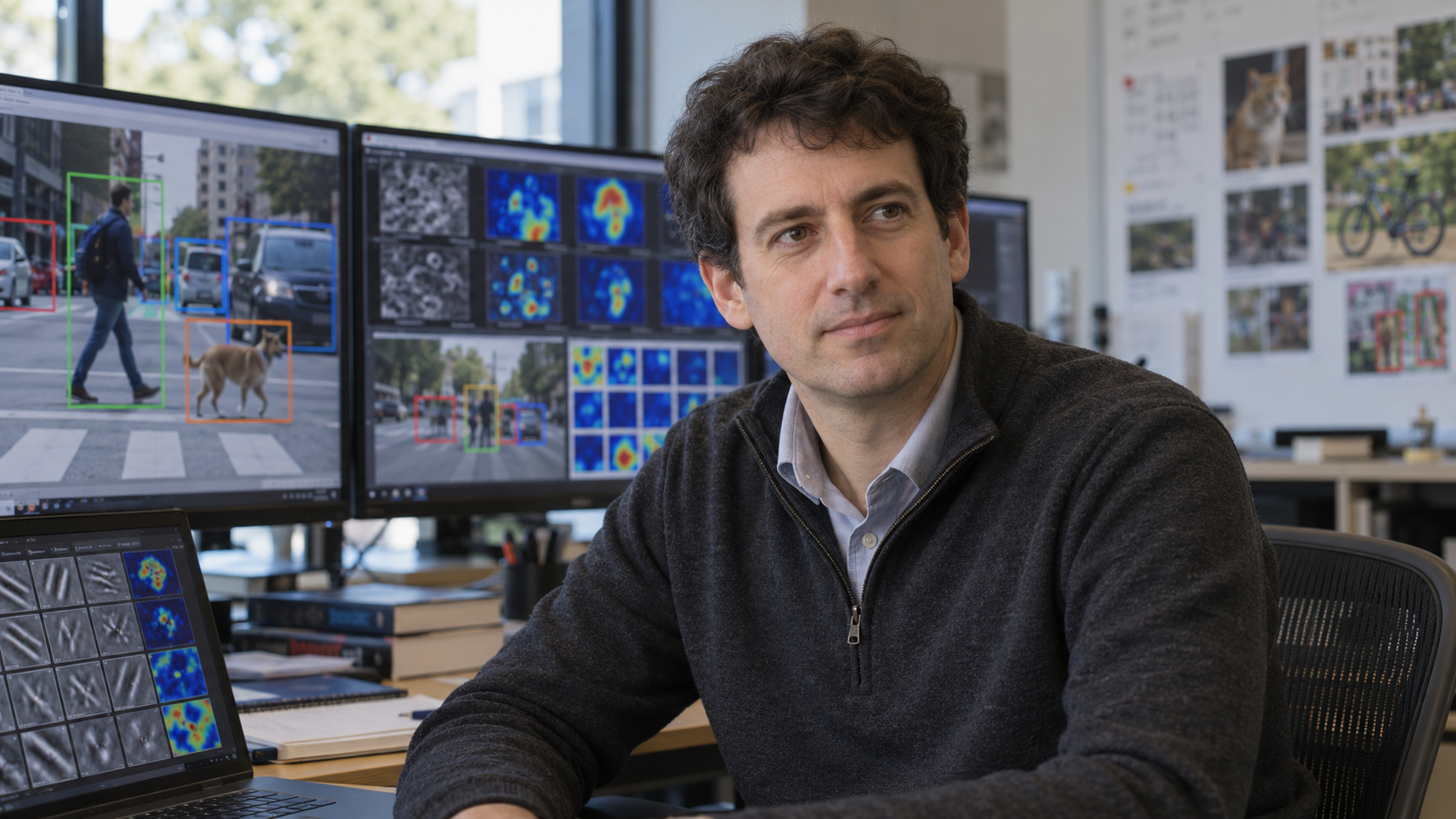
“Since we combine region proposals with CNNs, we call our method R-CNN: Regions with CNN features.”
Ross Girshick and colleagues created R-CNN by combining bottom-up region proposals with features learned by a convolutional neural network. Each proposed area of an image was transformed to a standard size, passed through a CNN, and classified. The approach dramatically improved object detection on established benchmarks and demonstrated that deep features learned for classification could transfer to the harder task of locating objects. Its historical importance comes from the bridge it built between an abstract idea and evidence that other researchers could inspect, challenge, and extend.
R-CNN separated the problem into candidate generation, representation, and classification. That modular design made the contribution understandable and let the team reuse a pretrained network, but it was computationally expensive because thousands of regions were processed separately. The strengths and inefficiencies sparked rapid follow-up work—Fast R-CNN, Faster R-CNN, and related systems—that integrated more of the pipeline and shared computation. A responsible interpretation therefore asks what the system represents, what it ignores, and how its objective changes behavior once it leaves the laboratory.
Region-based detectors remain influential when accurate localization matters, including medical imaging, inspection, mapping, and scientific observation. The R-CNN lineage also shows how research advances through successive bottlenecks: a method proves capability, measurement reveals cost, and later systems redesign the pipeline. Teams should preserve that habit by profiling latency, memory, annotation burden, and failure modes rather than optimizing one benchmark in isolation. Current AI systems operate inside social and technical networks, so evaluation must include workflows, incentives, maintenance costs, and the behavior of people adapting to the tool.
Object regions inherit the ambiguity of labels and the limitations of the proposal process. Systems may miss objects outside the training distribution, produce different error rates across environments, or encourage surveillance when applied to people. High-stakes uses require task-specific annotation standards, uncertainty handling, data governance, and review by the communities and professionals who understand what a detection means in context. The quotation ultimately rewards intellectual humility: state what is known, invite scrutiny, and change course when evidence from the real world contradicts the model. R-CNN connected reusable deep representations with explicit localization and opened a productive line of improvement. Its story demonstrates the value of making both capability and bottleneck visible. The enduring question is therefore practical as well as scientific: what would count as success, and who gets to decide when the answer changes? That habit of precise comparison keeps innovation open to correction and makes it easier to distinguish a durable contribution from confidence produced mainly by scale or novelty.
R-CNN generates candidate image regions and extracts convolutional features from each proposal.
Classifiers then determine which object category, if any, the region contains.
The original pipeline repeated expensive network computation for many overlapping regions.
Successors shared feature computation and learned region proposals more directly inside the model.
A bounding box can be technically accurate while the label or use remains inappropriate for the setting.
Data governance, domain review, uncertainty, and explicit limits matter whenever detection affects people or safety.
Explore more "Quotes of The Day"
Continue exploring how writers, thinkers, artists, and advocates have described the choices that shape an everyday life.