

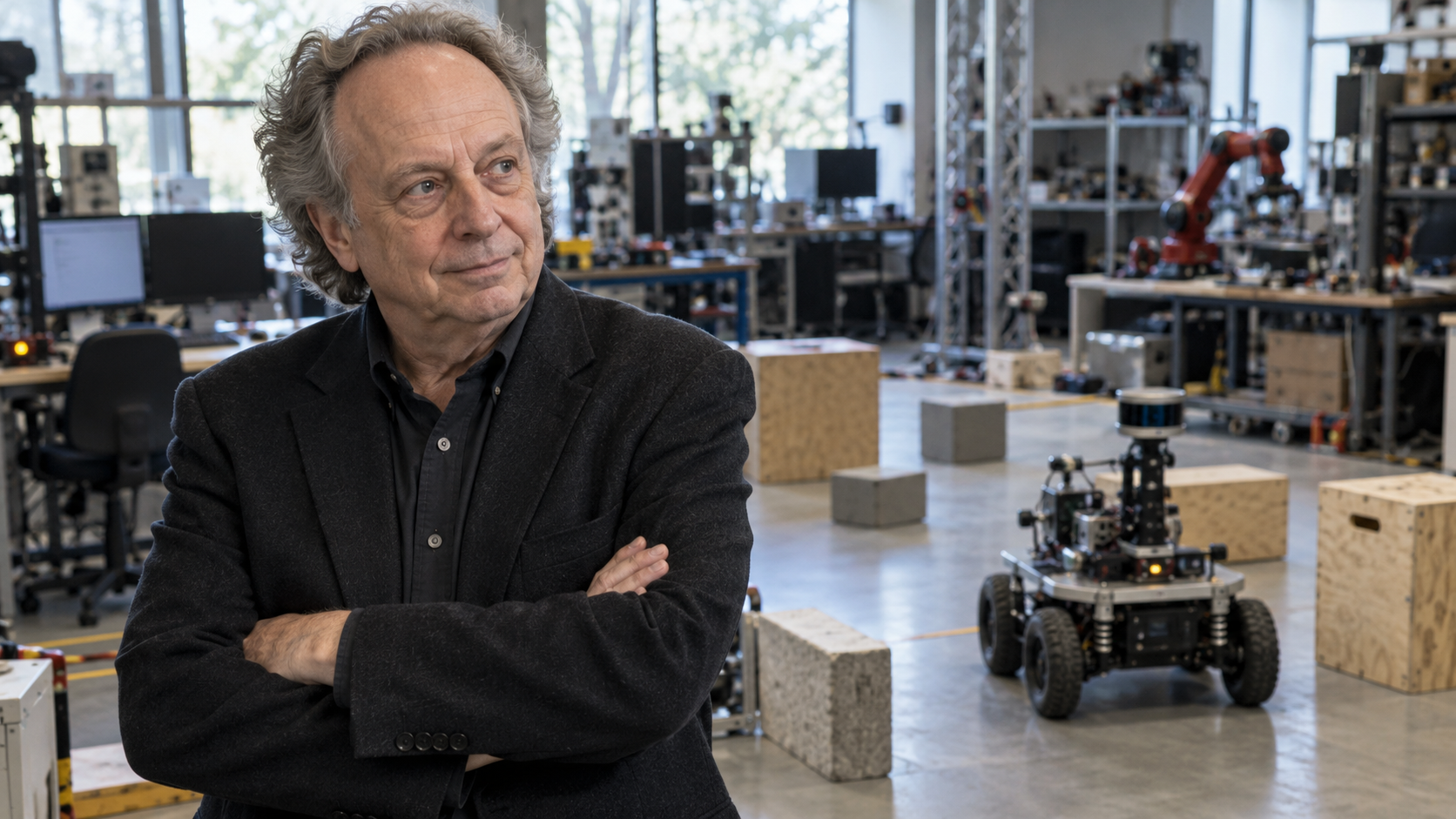
“The world is its own best model.”
Rodney Brooks’s essay Elephants Don’t Play Chess argued for physically grounded intelligence built through direct interaction with a complex environment. Instead of requiring a complete internal symbolic model before acting, behavior-based robots used layered control systems that sensed and responded in real time. The world supplied continuing information, reducing the need to reconstruct every relevant detail inside the machine. Read carefully, the quote records an engineering choice and an invitation to reproduce the result, rather than a universal claim about intelligence.
The aphorism does not mean internal state is useless. It challenges the assumption that intelligence begins with an exhaustive representation separated from action. A robot can exploit the stability and feedback of its environment, using perception as needed rather than storing a perfect copy. Intelligence becomes situated: what the system can do depends on its body, sensors, timing, and opportunities to act. The distinction is useful today: a mechanism may be powerful without being appropriate for every task, institution, or group of people affected by it.
Embodied AI, autonomous vehicles, drones, warehouse robots, and interactive agents all confront the gap between simulation and the physical world. Real environments offer rich feedback but also noise, wear, people, and unexpected events. Teams should test progressively in representative settings, use simulation without confusing it for reality, and design fallback behavior for sensor failure or conditions outside the training envelope. Modern practitioners can carry the idea forward through staged testing, independent evaluation, representative data, and direct feedback from people who experience the system’s consequences.
Direct action can create immediate harm. A physically grounded system needs conservative safety constraints, emergency stops, human awareness, cybersecurity, and clear responsibility for maintenance. The world may be the best model, but it is not a risk-free training ground. Experiments must protect bystanders, property, and ecosystems and should not shift the costs of learning onto people who did not consent. The best response is disciplined adoption: verify the benefit, disclose the limitation, protect the people carrying the risk, and preserve a path for correction. Brooks’s line made embodiment and real-time interaction central to an alternative vision of AI. Its modern responsibility is to learn from the world without treating the world or its inhabitants as disposable test data. Returning to the source helps keep the achievement precise—and precision is the beginning of trustworthy engineering, communication, and governance. Keeping method, evidence, and consequence together gives the quote lasting value while protecting it from claims that exceed what the original work was designed to establish.
Behavior-based robotics links perception and action closely so a machine can respond to its current environment.
Capability emerges through interaction rather than from one complete symbolic description of the world.
Simulation enables repeatable, low-risk training, but physical environments add noise, wear, latency, people, and unmodeled events.
Progressive real-world testing is necessary to reveal where simplified models break.
A software error in a moving machine can affect bodies, property, and public space immediately.
Safety constraints, emergency stops, security, maintenance, consent, and accountable ownership must surround deployment.
Explore more "Quotes of The Day"
Continue exploring how writers, thinkers, artists, and advocates have described the choices that shape an everyday life.