

On This Day in AI: April 1, 2017
On April 1, 2017, OpenAI described a robotic perception system trained entirely with simulated images and then transferred to a physical robot. The team used domain randomization to vary colors, textures, lighting, camera position, and other visual details until the real world appeared to the model as just another variation of its synthetic training environment. Robotics researchers had long struggled with the gap between clean simulations and messy reality. Collecting and labeling enough real images for every object, angle, and lighting condition was expensive, while a system trained only in simulation often failed as soon as it encountered a real camera. The date matters because it turned a fast-moving technical or policy development into a visible milestone that people, institutions, and researchers could evaluate.
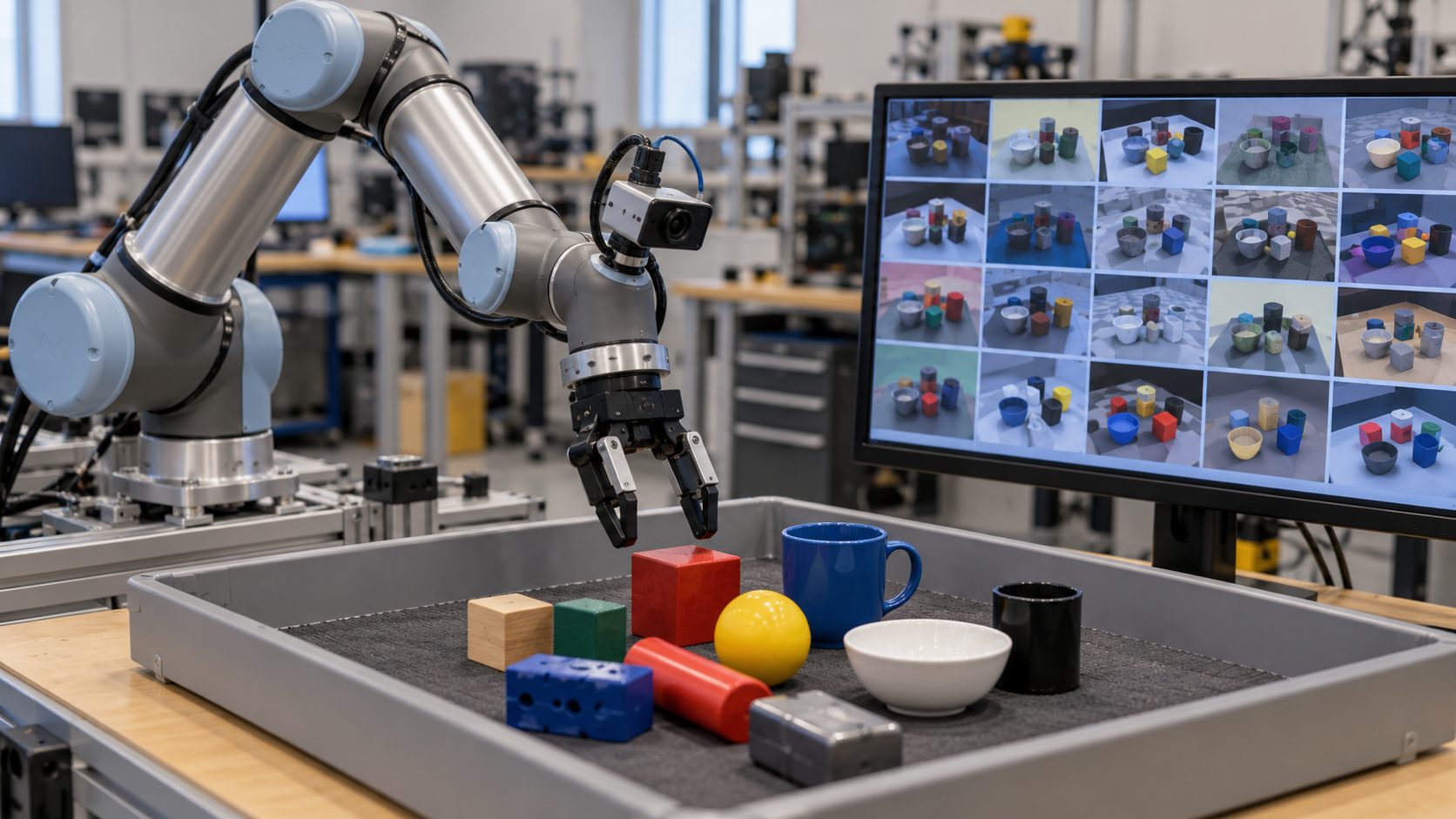
The substance of OpenAI’s sim-to-real robot experiment was as important as the headline. The demonstration used a camera-equipped robot arm to locate objects in a cluttered tray. Instead of making one simulator perfectly realistic, the researchers made thousands of deliberately different simulated scenes. That diversity taught the detector to focus on stable features and transfer without retraining on real photographs. Those choices reveal what the people behind the milestone believed was necessary at the time. AI history rarely advances through one breakthrough alone; research, product design, infrastructure, governance, and access all shape what a system can become.
The immediate consequences reached beyond the organization at the center of the event. The experiment made domain randomization a widely discussed strategy for sim-to-real learning. It offered a practical route to generating large training sets safely and cheaply, especially for robots that would otherwise need many hours of physical practice and human supervision. The moment also invited scrutiny, because new capabilities create new dependencies. Reliability, safety, cost, privacy, and human control determine whether an impressive demonstration becomes a trustworthy part of everyday life. Those practical limits are essential to understanding both the achievement and the response it received.
In retrospect, Sim-to-real transfer became a central theme in modern robotics, autonomous systems, and reinforcement learning. The work showed that useful reality can emerge from intentionally imperfect simulation when variation is designed well enough to cover the uncertainty of the physical world. Looking back from today’s rapidly changing AI landscape, this event belongs to a larger transition from specialized machine-learning experiments to systems embedded in ordinary products, workplaces, institutions, and public decisions. Its enduring lesson is that technical progress becomes historically significant when it changes what people can do and what society expects next. That connection between capability and consequence gives the milestone its lasting relevance. The anniversary therefore records a turning point, not simply an announcement.
OpenAI described a robotic perception system trained entirely with simulated images and then transferred to a physical robot. The team used domain randomization to vary colors, textures, lighting, camera position, and other visual details until the real world appeared to the model as just another variation of its synthetic training environment.
The demonstration used a camera-equipped robot arm to locate objects in a cluttered tray. Instead of making one simulator perfectly realistic, the researchers made thousands of deliberately different simulated scenes. That diversity taught the detector to focus on stable features and transfer without retraining on real photographs.
The experiment made domain randomization a widely discussed strategy for sim-to-real learning. It offered a practical route to generating large training sets safely and cheaply, especially for robots that would otherwise need many hours of physical practice and human supervision.
The event connected a concrete technical, commercial, or policy decision with the wider development of artificial intelligence.
Sim-to-real transfer became a central theme in modern robotics, autonomous systems, and reinforcement learning. The work showed that useful reality can emerge from intentionally imperfect simulation when variation is designed well enough to cover the uncertainty of the physical world.
Its influence can be traced through later products, research, governance, or industry practice.
Explore more of "On This Day ..."
Discover more events from the same date across news, politics, technology, sports, and other fields. Each link highlights significant moments that shaped history on different fronts.