

Film Scoring Explainer
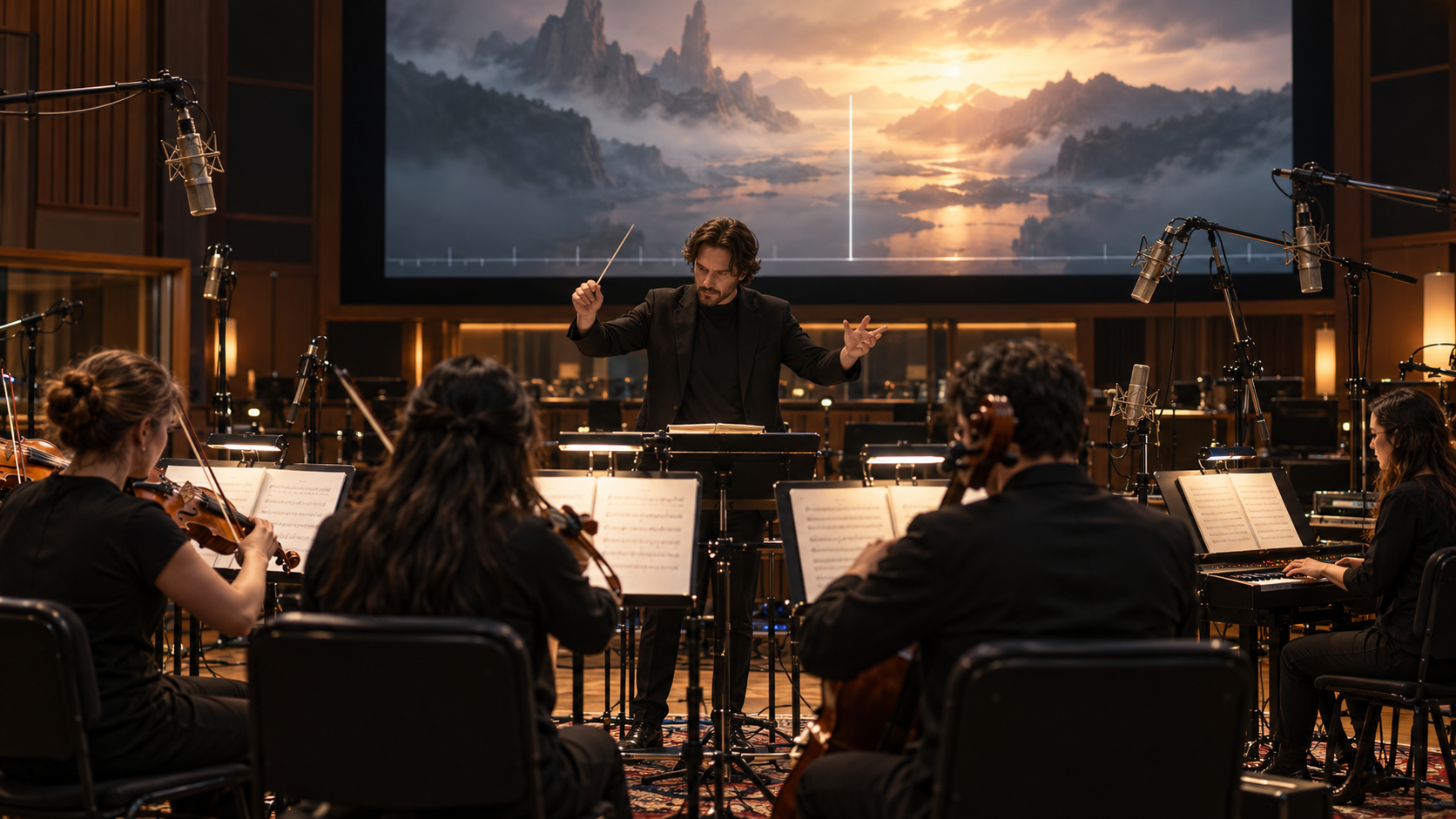
Film scoring is the creation of original music designed to work with moving images. A score can establish a world, connect ideas across scenes, reveal a character's inner state, control expectation, or deliberately resist the apparent emotion on screen. It differs from a collection of licensed songs, although a film can use both. The composer serves the story under fixed durations, dialogue, effects, editorial rhythm, deadlines, and approval processes, so musical form must often bend around picture without losing coherence.
The process commonly begins with a spotting session in which the director, composer, music editor, and sometimes producers watch the cut and decide where music should begin, end, and change. They discuss dramatic purpose rather than only style. Notes identify cue lengths, transitions, important actions, dialogue to protect, and temporary music already used by the edit. A locked picture is ideal, but schedules often require composers to work while scenes are still changing, which creates revisions and careful version control.
Composers develop themes, textures, harmonic language, rhythm, and instrumentation suited to the film. Mockups let collaborators hear an approximation before recording, but they are not always the final sound. Sync points align musical changes with a cut, gesture, reveal, or line; some need frame-level precision, while others can breathe across a range. Effective scoring does not hit every action. Space, silence, and continuity can be more powerful than constant emphasis.
Depending on the production, a score may be performed by an orchestra, chamber players, soloists, electronic instruments, sampled libraries, or a hybrid ensemble. Orchestrators, copyists, music editors, contractors, engineers, and performers translate the composition into recordable material. Sessions are planned around cue priorities and budget. Editors conform music to picture changes, and mixers balance stems so dialogue and effects remain clear while the score retains shape and impact. A memorable score can stand alone, but its primary success in the film comes from dramatic function. Loudness or melody is not the same as effectiveness. Viewers can listen for when music enters, whose perspective it seems to support, what changes when a theme returns, and whether the cue predicts, confirms, or complicates the scene. Those questions expose the collaboration among composer, director, editor, sound team, and musicians that makes screen music feel inseparable from the story. A practical way to read or discuss Film Scoring is to begin with the basic definition and then identify the choices made in a particular example. A film score is original music shaped for picture; licensed songs and preexisting tracks can share the soundtrack but follow different workflows. Next, ask who sets the relevant rules, who performs the work, and which results follow from creative judgment, law, contracts, technology, budget, or production limits. Similar-looking examples can operate differently because their audience, market, format, timing, and agreements are different. Sync points connect musical events to picture, but effective scoring usually avoids mechanically accenting every visible action. It also helps to distinguish a formal industry category from an informal critical label or one organization's current practice. That separation keeps a memorable anecdote from becoming a false universal rule. Dates and territories matter: tools, distribution systems, audience behavior, and standard agreements change, while older examples can preserve assumptions that no longer apply everywhere. When a claim sounds absolute, compare it with a second kind of source and look for the conditions under which the claim is true. Then trace the process from the visible result back through the less visible decisions, handoffs, and quality checks that produced it. The most useful analysis asks what the music changes in the scene rather than whether the score is noticeable on its own. Finally, compare the example with a contrasting case and note which part of the definition still holds. This method keeps the explanation grounded, highlights the people and systems behind the outcome, and leaves room for reasonable disagreement about hybrid or borderline cases.
A film score is original music shaped for picture; licensed songs and preexisting tracks can share the soundtrack but follow different workflows.
Spotting sessions decide where cues belong, what they should accomplish, and which dialogue, actions, or transitions they must respect.
Themes, harmony, rhythm, texture, instrumentation, and silence can organize character and story across scenes.
Sync points connect musical events to picture, but effective scoring usually avoids mechanically accenting every visible action.
Orchestrators, copyists, players, music editors, engineers, and mixers help turn a composition into flexible deliverable stems.
The most useful analysis asks what the music changes in the scene rather than whether the score is noticeable on its own.
Explore more "Explainers"
Discover additional explainers across politics, science, business, technology, and other fields. Each explainer breaks down a complex idea into clear, everyday language—helping you better understand how major concepts, systems, and debates shape the world around us.