

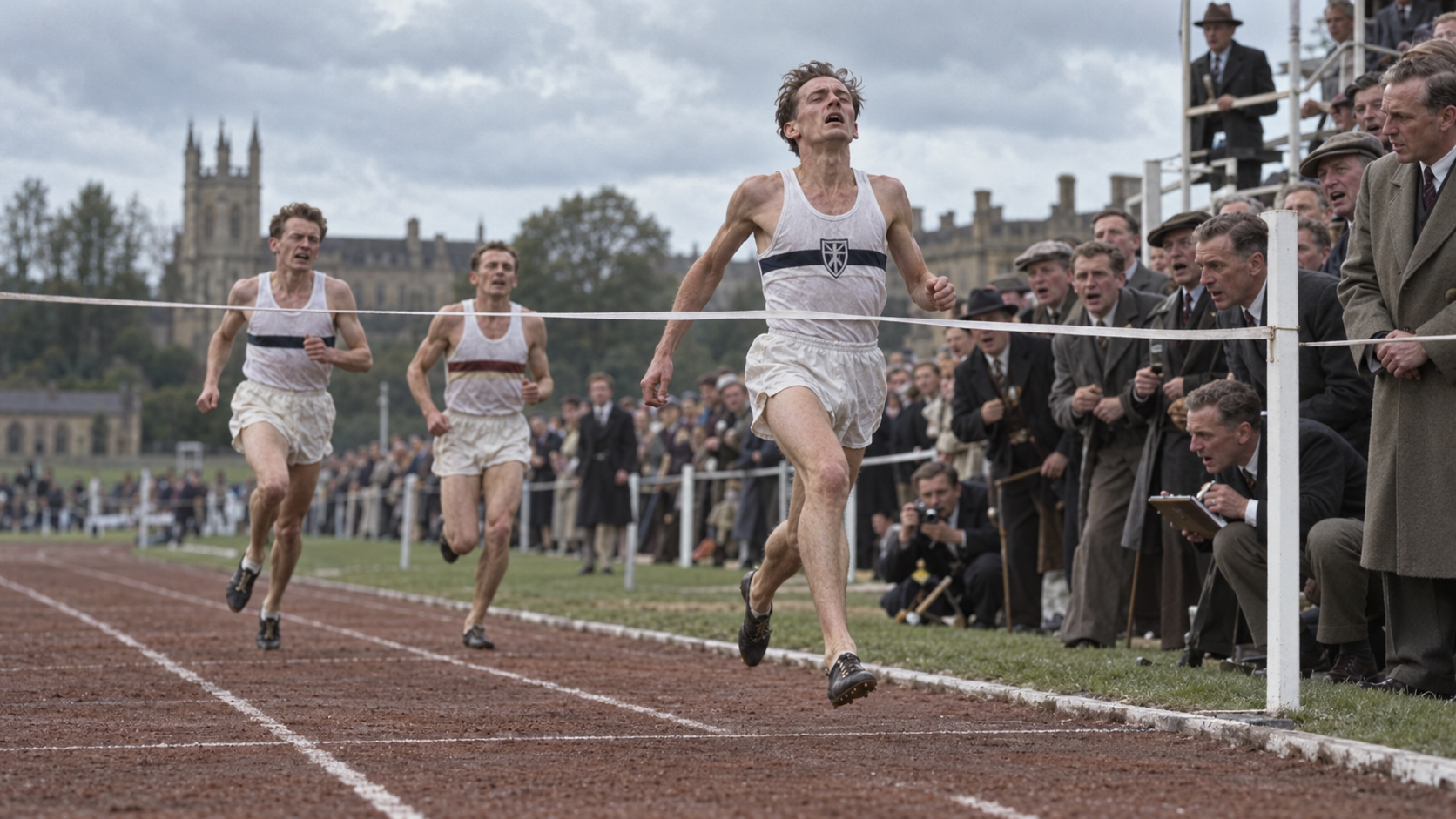
On This Day in Sports: May 6, 1954
On May 6, 1954, Roger Bannister ran one mile in 3 minutes 59.4 seconds at Oxford’s Iffley Road track, becoming the first athlete to break four minutes. The attempt unfolded in cool, gusting conditions before a modest crowd at a university meet. When the public-address announcer began reading the time with the word “three,” the rest disappeared beneath a roar from spectators who understood that a long-imagined barrier had fallen. The public record fixes the central details with unusual clarity: Bannister ran 3:59.4. The race took place at Oxford’s Iffley Road track. Together, those facts explain why May 6, 1954 stands apart from the ordinary flow of a season and deserves to be remembered as a distinct historical moment.
The performance depended on precise teamwork. Chris Brasher led the early laps and Chris Chataway carried the pace into the final circuit, shielding Bannister from the wind and keeping the schedule within reach. Bannister then drove past Chataway, strained down the backstretch and produced a final surge that left him collapsing into waiting arms just beyond the finish. The clock stopped six-tenths of a second inside history. Two further details help reconstruct how the achievement unfolded: Chris Brasher and Chris Chataway served as pacemakers. Windy conditions nearly caused the attempt to be canceled. They move the story beyond a headline by showing the pressure, setting and competitive choices that shaped the decisive action in real time.
Bannister was a medical student who trained around hospital duties and approached the mile as a problem in physiology, pace and will. He had narrowly missed the target the previous year. His preparation rejected the idea that only enormous training volume could produce the breakthrough, emphasizing carefully timed intervals and an exacting understanding of how much effort the final lap would require. The wider context is equally important. Bannister was training while studying medicine. John Landy broke the record weeks later. Those points connect one day’s performance to a longer career, institution or rivalry and clarify why the event continued to matter after the immediate celebration had ended.
The barrier proved psychological as well as physical. John Landy broke Bannister’s record only weeks later, and the two met in the celebrated “Mile of the Century” that summer. Thousands of runners have since gone below four minutes, but the first remains singular. Bannister’s 3:59.4 turned a round number from a boundary into a benchmark and permanently changed how athletes imagined the possible. Seen from today, the milestone remains compelling because it joins a measurable result with the uncertainty of live competition. Nothing about the outcome was guaranteed beforehand. That combination of preparation, opportunity and execution is what transformed the date from another entry on the schedule into lasting sports history.
Bannister ran 3:59.4.
The race took place at Oxford’s Iffley Road track.
Chris Brasher and Chris Chataway served as pacemakers.
Windy conditions nearly caused the attempt to be canceled.
Bannister was training while studying medicine.
John Landy broke the record weeks later.
Explore more "On This Day in Sports"
Discover more landmark games, records, championships, and turning points from sports history. Each day revisits the athletes, teams, and moments that shaped competition and culture.