

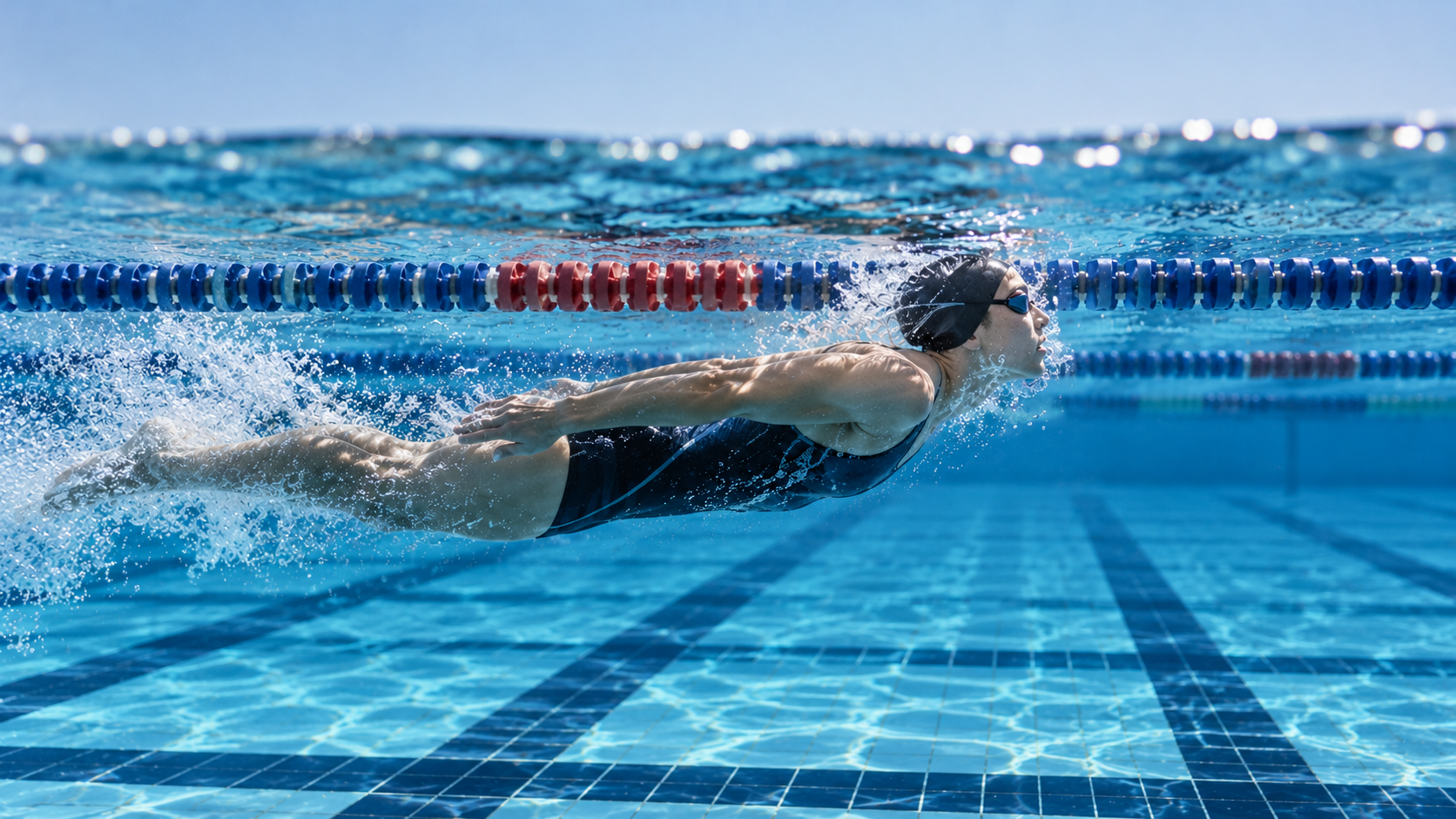
How Swimming's 15-Metre Underwater Limit Works Explainer
In freestyle, backstroke, and butterfly, a swimmer may remain fully underwater for no more than 15 metres after the start and after each turn. By that point, some part of the swimmer's head must break the surface. The rule preserves underwater skill without letting an entire race become a submerged event.
Pool markings help officials judge the distance. The 15-metre line is measured from the starting end after the dive and from each wall after a turn. Swimmers typically plan a sequence of dolphin kicks, then begin the breakout early enough that the head reaches air before the limit.
Backstroke has the same distance restriction even though the swimmer starts in the water. Butterfly also requires the body to remain on the breast and uses its own kick and arm-cycle rules. Freestyle allows any stroke, but the underwater-distance provision still applies in a freestyle race.
Breaststroke follows a different pullout rule rather than the general 15-metre allowance. A breaststroker may complete the permitted underwater cycle and must break the surface by the required point in that cycle. Confusing the two systems is a common mistake because both regulate the period immediately after starts and turns.
Freestyle, backstroke, and butterfly.
Some part of the swimmer's head must have broken the surface.
No. Breaststroke has a separate underwater pullout and surfacing requirement.
Explore more "Explainers"
Discover additional explainers across politics, science, business, technology, and other fields. Each explainer breaks down a complex idea into clear, everyday language—helping you better understand how major concepts, systems, and debates shape the world around us.