

On This Day in Pop: May 22, 1980
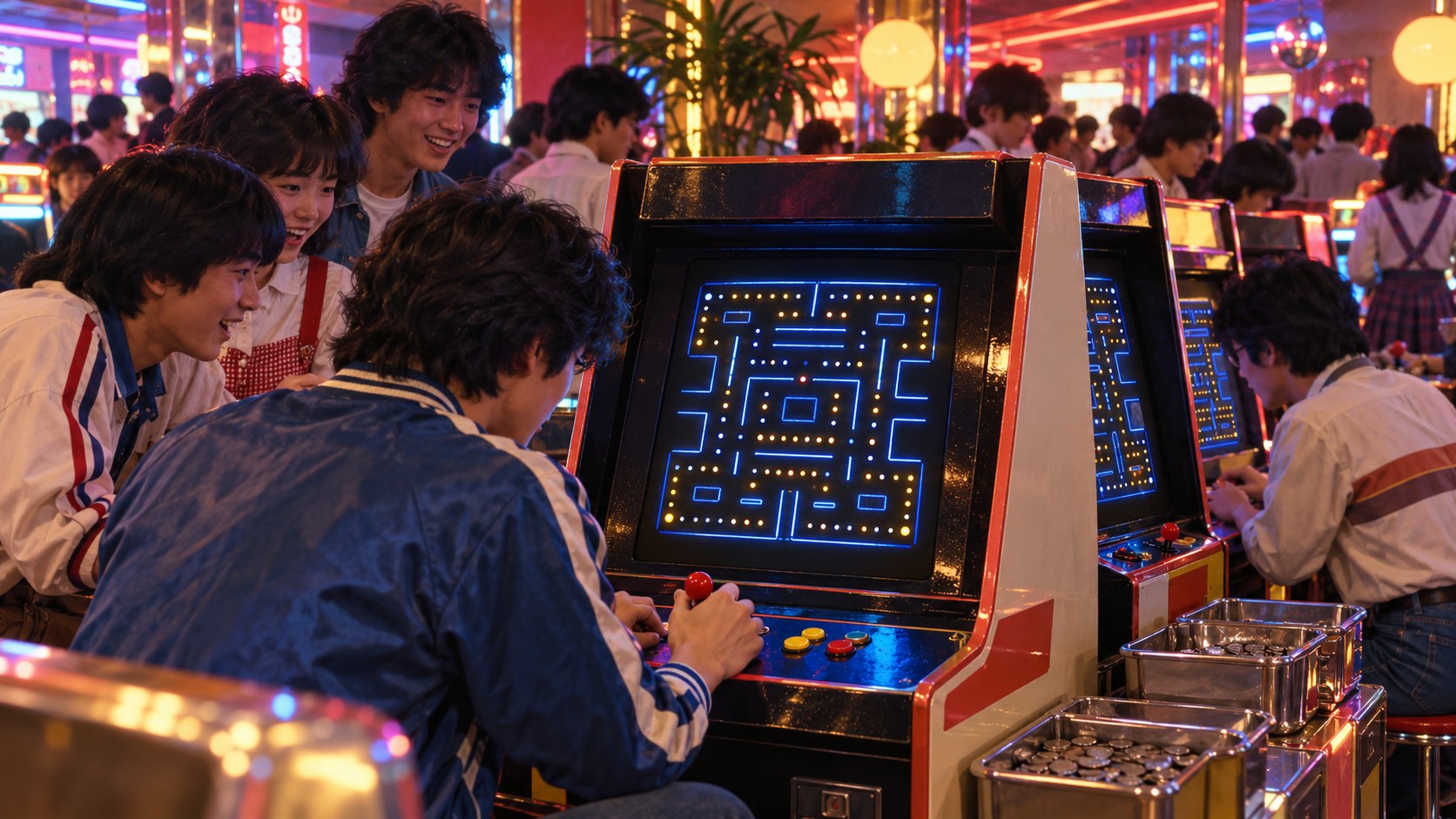
On May 22, 1980, Namco introduced the arcade game later known worldwide as Pac-Man in Japan. Designer Toru Iwatani led a team seeking an alternative to the shooting games that dominated arcades. Players guided a round yellow character through a maze, eating dots while avoiding four differently colored ghosts. Power pellets temporarily reversed the chase, creating a simple rhythm of vulnerability and pursuit. The Japanese title Puck Man was changed for the North American market, where Pac-Man reduced the risk of vandals altering the first letter on cabinets. Its abstract characters, readable rules and bright colors made the game inviting to a broader audience without making it easy. Each maze looked the same, but faster movement and ghost behavior created escalating pressure.
Iwatani’s design used limited hardware with unusual clarity. The four ghosts were not interchangeable: their movement rules produced distinct personalities and patterns, encouraging players to learn rather than rely only on reflex. Intermissions between rounds gave the characters brief comic scenes, strengthening the sense that the machine contained a cast rather than anonymous targets. The eating theme also made the central action immediately understandable across language barriers. Pac-Man reached North America through Midway and became a phenomenon, though the huge demand generated unofficial copies as well as authorized machines. The game’s appeal to women is often emphasized in histories, but its importance is broader: it helped demonstrate that arcade audiences were not a single masculine market defined only by space combat.
Pac-Man expanded into merchandise, an animated television series and the hit novelty song Pac-Man Fever, making its central figure one of video games’ first global pop characters. Sequels changed the mazes and cast, while the original remained playable across new hardware generations. Its influence can be seen in character branding, maze design, artificial-intelligence study and the idea that a game mascot can live beyond one set of mechanics. Bandai Namco continues to celebrate May 22 as Pac-Man’s birthday. The anniversary marks a release whose technical modesty became an advantage: every shape, sound and rule had to communicate quickly in a noisy arcade. Four decades later, a yellow circle missing a wedge still reads as a complete personality because play, design and repetition taught the world how to see it. The cabinet’s sounds worked with the shapes: the opening tune, steady eating pulse and warning siren communicated state changes in a crowded room. That economy made play understandable even when spectators could barely hear instructions.
Bandai Namco identifies May 22, 1980 as Pac-Man's birthday.
Toru Iwatani led a team that wanted to broaden arcade play beyond shooting games.
Power pellets reverse the normal predator-and-prey relationship for a short time.
The ghosts follow different movement rules that create recognizable behavior.
The North American name avoided the vandalism risk associated with Puck Man.
Merchandise, television and music made Pac-Man an early global game mascot.
Explore more of "On This Day ..."
Discover more events from the same date across news, politics, technology, sports, and other fields. Each link highlights significant moments that shaped history on different fronts.