

On This Day in Pop: May 24, 1956
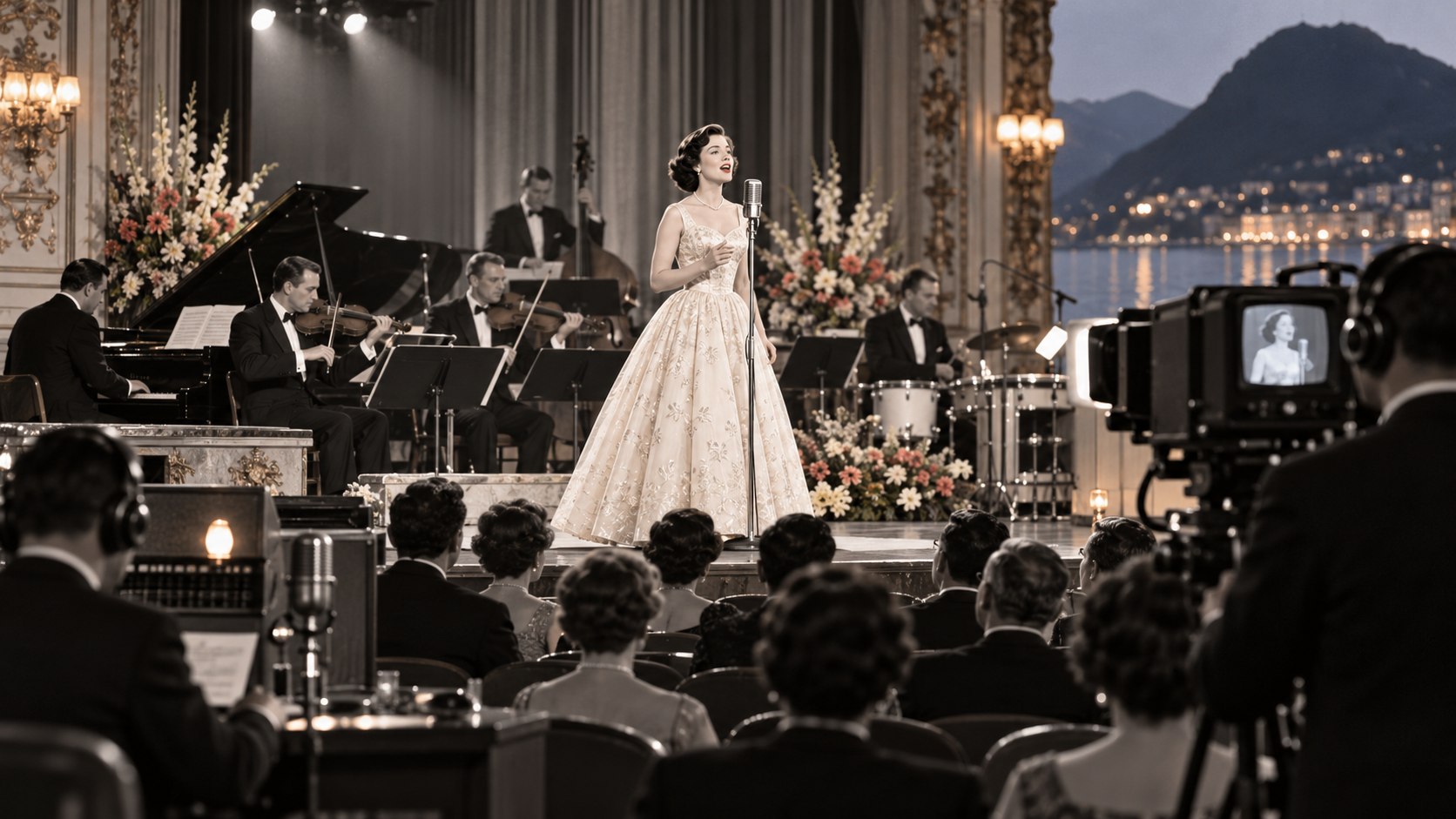
On May 24, 1956, the first Eurovision Song Contest was held at the Teatro Kursaal in Lugano, Switzerland. Seven national broadcasters—Belgium, France, West Germany, Italy, Luxembourg, the Netherlands and Switzerland—each submitted two songs, giving the evening fourteen entries. Swiss singer Lys Assia won with Refrain, though the complete voting totals were not publicly preserved. The program grew from the European Broadcasting Union’s interest in a shared live television event that could test and demonstrate cross-border transmission. Modeled in part on Italy’s Sanremo festival, the first contest was closer to a formal radio concert than the arena spectacle later viewers recognize. A small orchestra accompanied solo singers, and only a limited television audience could receive the broadcast.
Postwar European broadcasting networks were building technical and institutional connections across national boundaries. A live music competition offered a positive, repeatable format while forcing stations to coordinate timing, signals, rules and presentation. Marcel Bezençon of the EBU played a central role in developing the idea. The 1956 voting procedure allowed jurors to support songs from their own countries and kept detailed results secret, practices changed in later years. Two songs per country also disappeared after the inaugural edition. These differences matter because Eurovision did not begin with a finished formula. Languages, orchestras, scoring, staging and eligibility were repeatedly renegotiated as more broadcasters joined and television technology improved.
Eurovision became one of the world’s largest live entertainment broadcasts and launched or accelerated careers including ABBA and Céline Dion. Its songs range from conventional ballads to performances that use costume, choreography, lighting and national humor as part of the competition. The event has also reflected political tensions despite rules that define it as nonpolitical; voting patterns, participation and public debate regularly carry meanings beyond music. May 24 marks the modest start of a durable media ritual. What began with seven countries in a small theater developed into a yearly production connecting tens of millions of viewers, fan communities and national broadcasters. The continuity is not a fixed sound or style but the original technical promise: people in different places can watch the same live performance, compare choices and experience television as a shared transnational event. The contest’s archive is incomplete—the first program was not preserved in full—but the format survived through institutional repetition. Each annual production became another test of how a shared broadcast could accommodate different languages, tastes and national expectations. The annual uncertainty became one of the tradition’s most recognizable pleasures.
The first contest took place in Lugano on May 24, 1956.
Seven countries participated and each entered two songs.
Lys Assia won for Switzerland with Refrain.
Detailed voting totals from the first contest were not made public.
The EBU developed the program partly to test coordinated live television across borders.
Rules, scoring and staging changed repeatedly as Eurovision expanded.
Explore more of "On This Day ..."
Discover more events from the same date across news, politics, technology, sports, and other fields. Each link highlights significant moments that shaped history on different fronts.