

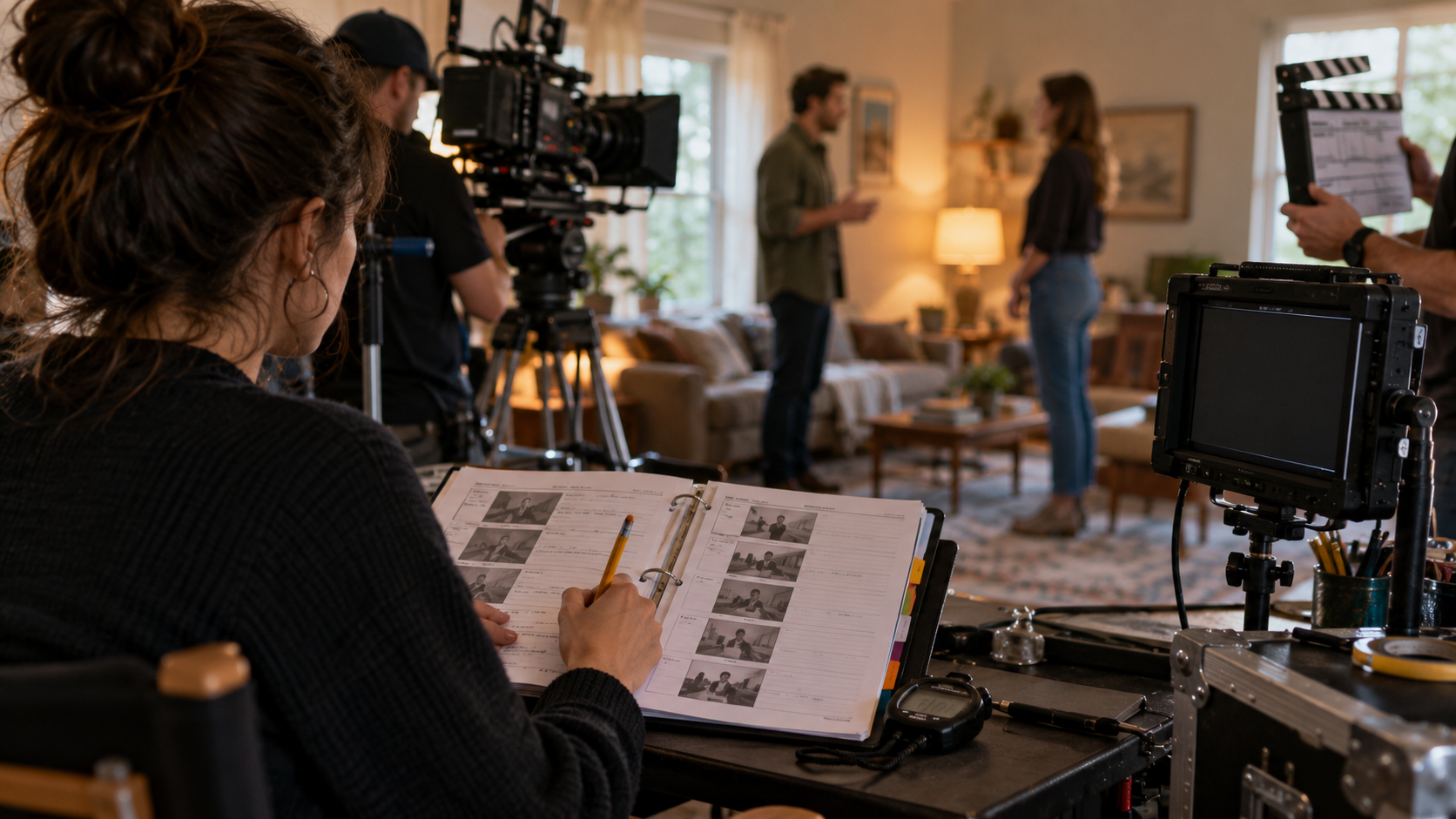
Script Supervisors Explainer
A script supervisor maintains the production record that helps separately filmed shots become a coherent screen sequence. Film and television scenes are rarely photographed in story order, and each setup may repeat action from a new angle hours or days later. The supervisor tracks dialogue, movement, props, wardrobe details, screen direction, timing, camera coverage, and approved changes. This work supports continuity, but it also gives editors reliable information about what was filmed and how each take relates to the script.
Before and during a shoot, the supervisor breaks the script into practical units and notes details that must remain consistent. On set, they observe rehearsals and takes, compare performance and action, and flag mismatches that could make an edit distracting or impossible. They may time scenes, record lens or slate information supplied by other departments, mark the printed script to show coverage, and document line changes. The aim is not mechanical sameness; it is to preserve choices that the finished sequence depends on.
Continuity requires collaboration. The camera department manages image capture, sound records audio details, costume and makeup track appearance, props control objects, and assistant directors manage the schedule. The script supervisor connects these observations to story order and editorial needs. If an actor lifts a cup with one hand in a wide shot and the other in a close-up, the supervisor can identify the difference, but the director decides whether performance, time, or another priority outweighs it.
The role also guards against missing coverage. A scene may need a wide master, close views, reactions, inserts, or clean dialogue options, depending on the planned edit. The supervisor notes which lines and actions each setup covers and can warn when the schedule is about to move on without a needed piece. Their daily reports help production track completed script pages and help post-production locate preferred takes, variations, and departures from the written draft. Viewers often notice script supervision only when continuity breaks, yet perfect visual matching is not the sole measure of good work. Editors may intentionally choose a stronger performance despite a small mismatch, and directors may design discontinuity for expressive reasons. The supervisor's value lies in making those choices informed. By preserving an accurate map of filmed material, the role reduces guesswork, protects story logic, and allows creative teams to understand the consequences of each departure. A practical way to read or discuss Script Supervisors is to begin with the basic definition and then identify the choices made in a particular example. Script supervisors track story continuity and create a detailed bridge between the set, the screenplay, production management, and the editing room. Next, ask who sets the relevant rules, who performs the work, and which results follow from creative judgment, law, contracts, technology, budget, or production limits. Similar-looking examples can operate differently because their audience, market, format, timing, and agreements are different. Continuity is shared across departments, while the director can deliberately accept a mismatch for performance or another creative priority. It also helps to distinguish a formal industry category from an informal critical label or one organization's current practice. That separation keeps a memorable anecdote from becoming a false universal rule. Dates and territories matter: tools, distribution systems, audience behavior, and standard agreements change, while older examples can preserve assumptions that no longer apply everywhere. When a claim sounds absolute, compare it with a second kind of source and look for the conditions under which the claim is true. Then trace the process from the visible result back through the less visible decisions, handoffs, and quality checks that produced it. The job is best understood as informed editorial continuity, not as policing every visual detail for perfect sameness. Finally, compare the example with a contrasting case and note which part of the definition still holds. This method keeps the explanation grounded, highlights the people and systems behind the outcome, and leaves room for reasonable disagreement about hybrid or borderline cases.
Script supervisors track story continuity and create a detailed bridge between the set, the screenplay, production management, and the editing room.
Their notes cover dialogue, action, timing, props, wardrobe, screen direction, camera setups, takes, and approved script changes.
A lined script and daily reports show what material was filmed and which portions of a scene each setup covers.
Continuity is shared across departments, while the director can deliberately accept a mismatch for performance or another creative priority.
The supervisor can flag missing coverage before a set is struck or a location is left, when a correction is still possible.
The job is best understood as informed editorial continuity, not as policing every visual detail for perfect sameness.
Explore more "Explainers"
Discover additional explainers across politics, science, business, technology, and other fields. Each explainer breaks down a complex idea into clear, everyday language—helping you better understand how major concepts, systems, and debates shape the world around us.