

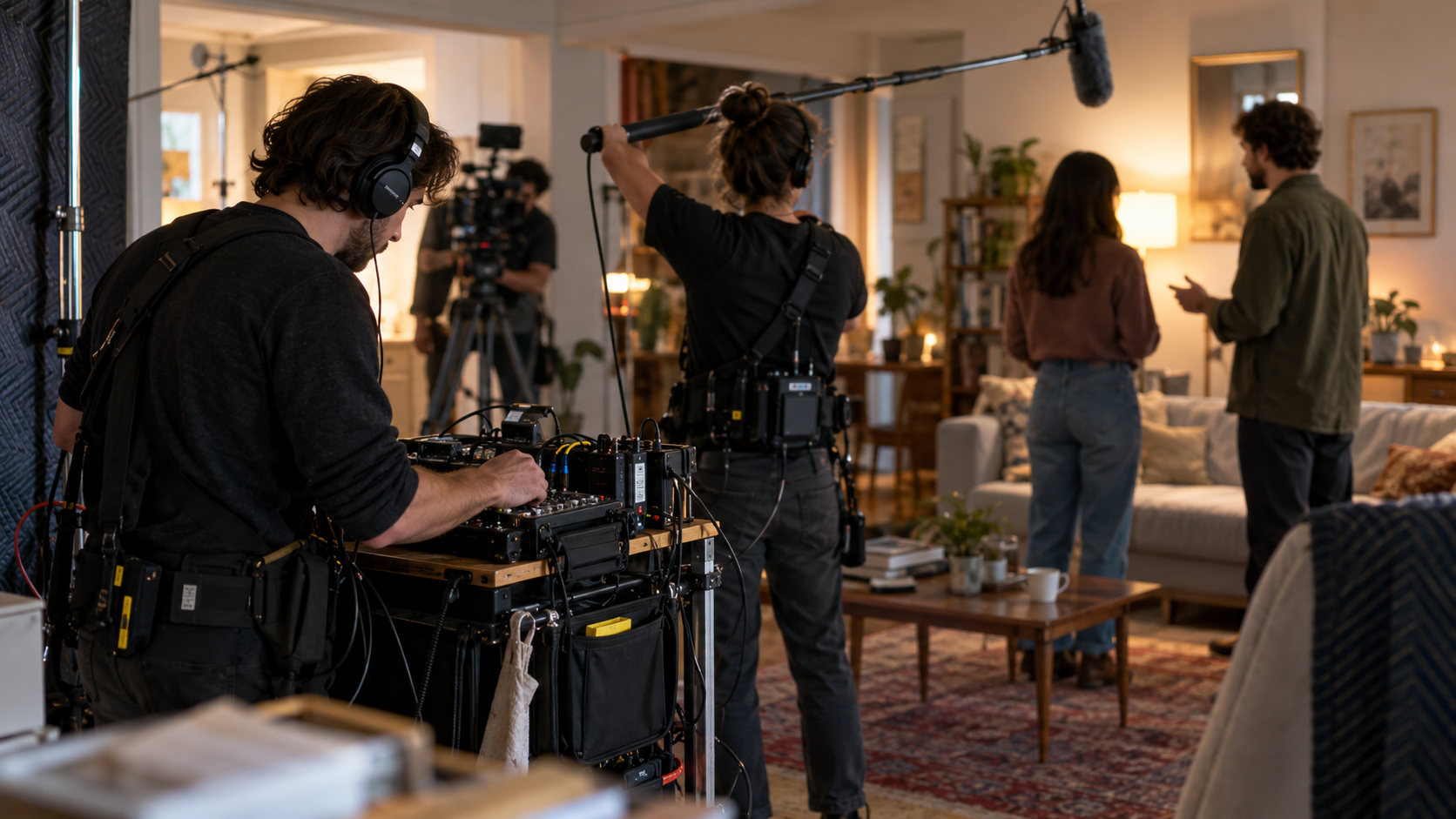
Production Sound Recording Explainer
Production sound recording is the capture of dialogue and useful ambient audio while a film or television scene is being photographed. The sound team typically plans microphone placement, records multiple isolated tracks, monitors noise, labels files, and reports technical details for post-production. Their goal is not merely to hear the words. They seek clean, synchronized recordings that preserve performance, perspective, and the acoustic character of the location while remaining compatible with camera movement and visual composition.
A boom microphone can follow performers from above or below the frame, often delivering natural perspective and consistent tone. Small radio microphones hidden in clothing provide close isolation when a boom cannot approach, but fabric movement, wireless interference, and body placement can affect them. Plant microphones may be concealed in scenery or vehicles. A production mixer balances these sources while also recording separate tracks, giving dialogue editors options instead of forcing one irreversible blend on set.
Set conditions shape every choice. Generators, traffic, ventilation, rain machines, costumes, props, crowd noise, and camera equipment can mask dialogue or create sounds that do not match across takes. The sound team identifies problems and proposes practical changes, such as quieting a machine, adjusting a costume, moving a microphone, or recording room tone. Some noise is unavoidable, and the director or assistant director decides whether the take should continue, be repeated, or be addressed later.
Post-production can repair, replace, and reshape audio, but it cannot make every compromised recording identical to a clean original performance. Automated dialogue replacement asks actors to recreate lines later in synchronization with the picture. Noise reduction may introduce artifacts, and replacing location sound can require added ambience and effects to rebuild a believable space. Good production audio reduces that work and preserves subtle timing, breath, overlap, and emotional detail created in the moment. The role is collaborative rather than separate from cinematography. A microphone must stay outside the visible frame, radio packs must respect wardrobe and performer comfort, and recording plans must follow blocking. The best result often comes from early communication about wide shots, reflective rooms, effects, vehicles, or costume materials. When viewers accept dialogue as naturally belonging to the image, that apparent simplicity usually reflects careful production sound decisions and extensive coordination. A practical way to read or discuss Production Sound Recording is to begin with the basic definition and then identify the choices made in a particular example. Production sound crews record synchronized dialogue, ambience, and reference audio while the camera unit photographs a scene. Next, ask who sets the relevant rules, who performs the work, and which results follow from creative judgment, law, contracts, technology, budget, or production limits. Similar-looking examples can operate differently because their audience, market, format, timing, and agreements are different. Noise from locations, costumes, props, weather effects, vehicles, and equipment may require changes or a conscious production tradeoff. It also helps to distinguish a formal industry category from an informal critical label or one organization's current practice. That separation keeps a memorable anecdote from becoming a false universal rule. Dates and territories matter: tools, distribution systems, audience behavior, and standard agreements change, while older examples can preserve assumptions that no longer apply everywhere. When a claim sounds absolute, compare it with a second kind of source and look for the conditions under which the claim is true. Then trace the process from the visible result back through the less visible decisions, handoffs, and quality checks that produced it. Early coordination among sound, camera, wardrobe, locations, performers, and directing teams prevents many avoidable recording problems. Finally, compare the example with a contrasting case and note which part of the definition still holds. This method keeps the explanation grounded, highlights the people and systems behind the outcome, and leaves room for reasonable disagreement about hybrid or borderline cases.
Production sound crews record synchronized dialogue, ambience, and reference audio while the camera unit photographs a scene.
Boom, radio, and planted microphones offer different balances of natural perspective, isolation, mobility, and concealment.
Mixers commonly preserve separate tracks so dialogue editors can choose or combine sources during post-production.
Noise from locations, costumes, props, weather effects, vehicles, and equipment may require changes or a conscious production tradeoff.
Dialogue replacement and noise reduction are useful tools, but they add work and may not preserve every quality of the original performance.
Early coordination among sound, camera, wardrobe, locations, performers, and directing teams prevents many avoidable recording problems.
Explore more "Explainers"
Discover additional explainers across politics, science, business, technology, and other fields. Each explainer breaks down a complex idea into clear, everyday language—helping you better understand how major concepts, systems, and debates shape the world around us.