

Co-Viewing Measurement Explainer
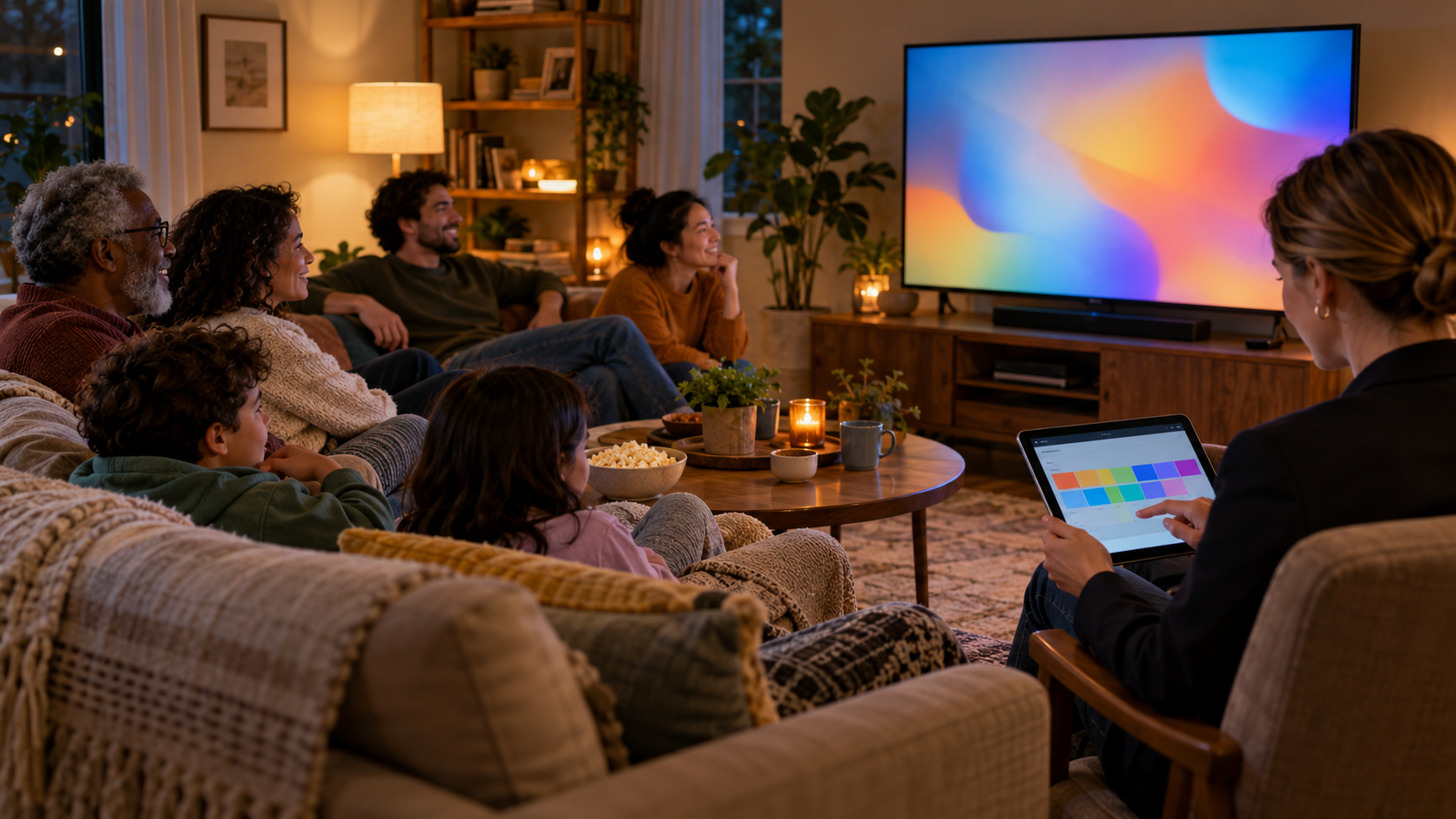
Co-viewing occurs when two or more people watch the same screen at the same time. It matters because a television or connected device usually reports one stream or tuning event even when several viewers are present. Advertising, programming, and audience research often need estimates of people rather than active devices. Co-viewing measurement connects household-level signals with information about who is actually in the room, turning a single technical event into a more realistic estimate of shared attention.
Traditional people-meter panels ask household members to identify themselves when they begin or stop watching. That known-person data can reveal how co-viewing varies by program, time, age, household composition, and device. Large datasets from smart televisions, set-top boxes, or applications add scale but may not identify every person. Measurement systems can use representative panels to model the number and characteristics of viewers associated with device-level activity.
The estimate changes the meaning of an audience figure. One million active screens do not necessarily equal one million viewers, and a family program may have a different people-per-device pattern from solitary late-night viewing. Co-viewing also affects demographic estimates because the account holder or household purchaser may not be the only viewer. Researchers therefore distinguish household reach, device exposure, and person-level audience rather than treating them as synonyms.
Every method has limits. Panel members can forget to identify themselves, guest viewing may be harder to capture, and models depend on the representativeness of the data used to train them. A screen can be on while attention is divided, and the same household may watch across several devices. Out-of-home locations, mobile screens, dorms, hotels, and shared public spaces may require different approaches or remain outside a stated product's coverage. Co-viewing is a reminder that media metrics are interpretations of behavior, not direct readings of the mind. Before comparing figures, ask whether the unit is accounts, devices, households, or people and whether co-viewers are observed, declared, or modeled. Also check which screens, territories, and age groups are covered. Transparent methodology does not remove uncertainty, but it shows how a measurement company moved from a technical signal to an estimate of human audiences. A practical way to read or discuss Co-Viewing Measurement is to begin with the basic definition and then identify the choices made in a particular example. Co-viewing means multiple people watch one screen, so one stream, device, or tuning event may represent several viewers. Next, ask who sets the relevant rules, who performs the work, and which results follow from creative judgment, law, contracts, technology, budget, or production limits. Similar-looking examples can operate differently because their audience, market, format, timing, and agreements are different. Programs, times, household composition, age, and screen type can influence the number of viewers associated with a device. It also helps to distinguish a formal industry category from an informal critical label or one organization's current practice. That separation keeps a memorable anecdote from becoming a false universal rule. Dates and territories matter: tools, distribution systems, audience behavior, and standard agreements change, while older examples can preserve assumptions that no longer apply everywhere. When a claim sounds absolute, compare it with a second kind of source and look for the conditions under which the claim is true. Then trace the process from the visible result back through the less visible decisions, handoffs, and quality checks that produced it. A responsible audience claim states whether co-viewing is measured directly, reported by panelists, modeled, or excluded. Finally, compare the example with a contrasting case and note which part of the definition still holds. This method keeps the explanation grounded, highlights the people and systems behind the outcome, and leaves room for reasonable disagreement about hybrid or borderline cases.
Co-viewing means multiple people watch one screen, so one stream, device, or tuning event may represent several viewers.
People-meter panels collect person-level behavior that can be combined with larger device datasets to estimate shared viewing.
Household reach, active devices, accounts, and individual viewers are different units and should not be compared as equivalents.
Programs, times, household composition, age, and screen type can influence the number of viewers associated with a device.
Panel compliance, guests, divided attention, mobile use, and out-of-home settings introduce uncertainty or coverage gaps.
A responsible audience claim states whether co-viewing is measured directly, reported by panelists, modeled, or excluded.
Explore more "Explainers"
Discover additional explainers across politics, science, business, technology, and other fields. Each explainer breaks down a complex idea into clear, everyday language—helping you better understand how major concepts, systems, and debates shape the world around us.