

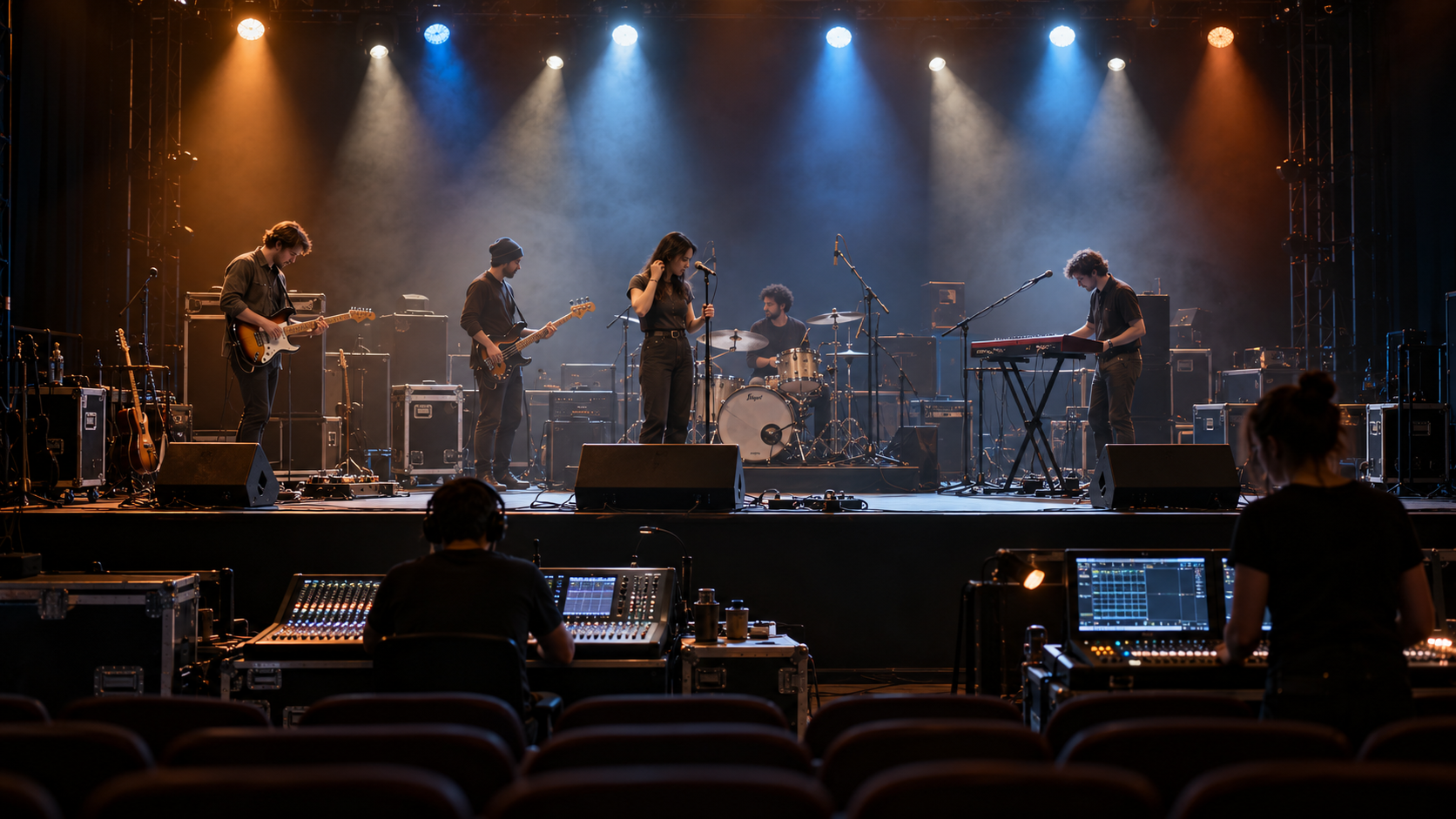
Concert Rehearsals Explainer
Concert rehearsals prepare musicians and production teams to deliver a coordinated live performance. The work can range from private musical practice to full production runs with sound, lighting, video, staging, choreography, wardrobe, and special effects. Rehearsal is not one undifferentiated activity. Arrangement rehearsals decide musical structure, band rehearsals establish ensemble performance, technical rehearsals test systems and cues, and dress rehearsals combine the elements under conditions close to the show.
Musicians confirm tempos, keys, transitions, endings, solos, count-ins, backing tracks, and alternate arrangements. Musical directors may revise parts to fit a venue, guest, broadcast slot, or time limit. Setlist order affects instrument changes, vocal demand, energy, and tuning. Repeating difficult transitions can be more valuable than running every song from beginning to end, while a full run reveals cumulative timing and stamina issues that isolated practice cannot show.
Production rehearsals synchronize departments. Lighting and video operators program cues; monitor engineers build performers' mixes; front-of-house engineers balance the room; stage managers coordinate entrances and changes; backline crews prepare instruments; and automation or effects teams test safety procedures. Cue sheets and talkback communication create shared reference points. The goal is repeatability, including a clear response when a cue, instrument, microphone, playback system, or entrance fails.
Rehearsal time is labor and may be governed by contracts, compensation rules, breaks, venue access, noise limits, and travel schedules. Touring personnel can arrive with different responsibilities and local crews may receive only a short load-in. Soundcheck is not always a substitute for rehearsal: it primarily verifies the venue system and onstage monitoring, though artists may use it to review selected material. Festivals and television appearances often allow especially limited setup and line-check time. A polished concert can still contain improvisation. Rehearsal provides a stable framework within which performers can respond to the room, audience, or one another. Over-rehearsal may flatten spontaneity, while under-rehearsal can shift avoidable risk onto crew and musicians. The useful question is whether the team has practiced the decisions that must be reliable and identified the moments that may remain flexible. Preparation and live energy are partners rather than opposites. A practical way to read or discuss Concert Rehearsals is to begin with the basic definition and then identify the choices made in a particular example. Concert rehearsals align musical arrangements, performers, equipment, staging, cues, timing, safety, and contingency plans. Next, ask who sets the relevant rules, who performs the work, and which results follow from creative judgment, law, contracts, technology, budget, or production limits. Similar-looking examples can operate differently because their audience, market, format, timing, and agreements are different. Soundcheck verifies venue audio and monitoring but may not provide enough time to rehearse the complete musical and visual show. It also helps to distinguish a formal industry category from an informal critical label or one organization's current practice. That separation keeps a memorable anecdote from becoming a false universal rule. Dates and territories matter: tools, distribution systems, audience behavior, and standard agreements change, while older examples can preserve assumptions that no longer apply everywhere. When a claim sounds absolute, compare it with a second kind of source and look for the conditions under which the claim is true. Then trace the process from the visible result back through the less visible decisions, handoffs, and quality checks that produced it. The strongest preparation makes critical moments repeatable while preserving deliberate space for safe improvisation and audience response. Finally, compare the example with a contrasting case and note which part of the definition still holds. This method keeps the explanation grounded, highlights the people and systems behind the outcome, and leaves room for reasonable disagreement about hybrid or borderline cases.
Concert rehearsals align musical arrangements, performers, equipment, staging, cues, timing, safety, and contingency plans.
Arrangement, band, technical, spacing, dress, and full-run rehearsals answer different questions and may occur at different times.
Setlists shape keys, transitions, instrument changes, vocal load, show duration, energy, and the order of production cues.
Soundcheck verifies venue audio and monitoring but may not provide enough time to rehearse the complete musical and visual show.
Contracts, pay, breaks, access, travel, local labor, curfews, and noise limits constrain how rehearsal time can be used.
The strongest preparation makes critical moments repeatable while preserving deliberate space for safe improvisation and audience response.
Explore more "Explainers"
Discover additional explainers across politics, science, business, technology, and other fields. Each explainer breaks down a complex idea into clear, everyday language—helping you better understand how major concepts, systems, and debates shape the world around us.