

Video Game Level Design Explainer
Video game level design is the creation of playable spaces and the experiences that unfold within them. A level designer arranges routes, obstacles, encounters, resources, goals, landmarks, sightlines, and pacing so players can understand possibilities and make meaningful choices. The work is not identical to environment art. A beautiful location may be difficult to navigate, while a simple blockout can already contain strong flow, challenge, and teaching. Level design begins with play before surfaces receive final detail.
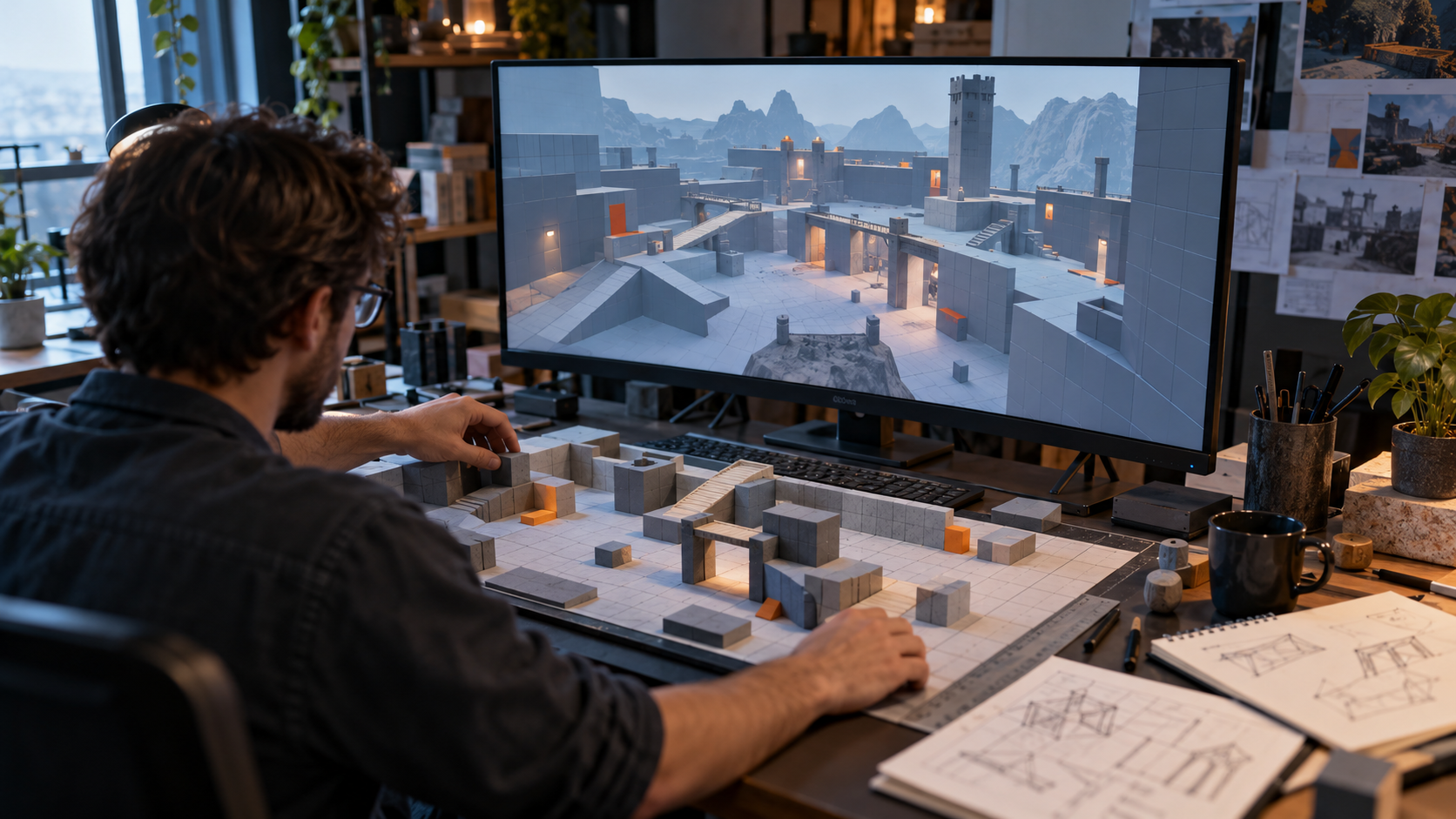
Designers often build rough prototypes from basic shapes. These blockouts test scale, movement, jump distances, cover, enemy placement, puzzle logic, checkpoints, camera behavior, and the time needed to move through an area. Landmarks and composition guide attention without requiring constant arrows. The level can introduce a mechanic safely, ask the player to combine it with earlier knowledge, then vary the challenge. Good teaching is embedded in action and feedback rather than depending entirely on instructions.
Different genres demand different structures. A competitive map must consider spawn positions, routes, visibility, balance, and repeated play. A narrative space may control reveals and environmental storytelling. A platformer emphasizes rhythm and readable movement; a stealth level balances concealment, patrols, and alternatives; an open world connects local activities with large-scale orientation. These principles interact with character abilities, camera, interface, artificial intelligence, and save systems.
Playtesting turns assumptions into evidence. Designers watch where players hesitate, become lost, discover exploits, avoid intended tools, or succeed for unexpected reasons. Metrics can show deaths or paths, but observation and interviews explain experience. Iteration may change geometry, lighting, encounter timing, rewards, or mechanics. Testers need clear goals because optimizing for shortest completion, dramatic tension, accessibility, exploration, or competitive mastery can lead to different revisions. Level design is collaborative and constrained by performance budgets, art schedules, audio, animation, narrative, networking, platform requirements, and production scope. Designers communicate intent through maps, blockouts, scripts, and reviews, then refine with specialists. The final space is not simply the work of one builder. It is an interactive system whose quality appears only when rules, environment, players, and technology meet under real conditions. A practical way to read or discuss Video Game Level Design is to begin with the basic definition and then identify the choices made in a particular example. Level design arranges playable space, routes, obstacles, encounters, resources, goals, landmarks, and pacing around a game's rules. Next, ask who sets the relevant rules, who performs the work, and which results follow from creative judgment, law, contracts, technology, budget, or production limits. Similar-looking examples can operate differently because their audience, market, format, timing, and agreements are different. Competitive, narrative, platform, stealth, puzzle, and open-world spaces require different flows and measures of success. It also helps to distinguish a formal industry category from an informal critical label or one organization's current practice. That separation keeps a memorable anecdote from becoming a false universal rule. Dates and territories matter: tools, distribution systems, audience behavior, and standard agreements change, while older examples can preserve assumptions that no longer apply everywhere. When a claim sounds absolute, compare it with a second kind of source and look for the conditions under which the claim is true. Then trace the process from the visible result back through the less visible decisions, handoffs, and quality checks that produced it. Designers iterate with art, code, audio, narrative, animation, testing, and production teams under technical and schedule constraints. Finally, compare the example with a contrasting case and note which part of the definition still holds. This method keeps the explanation grounded, highlights the people and systems behind the outcome, and leaves room for reasonable disagreement about hybrid or borderline cases.
Level design arranges playable space, routes, obstacles, encounters, resources, goals, landmarks, and pacing around a game's rules.
Blockouts use simple geometry to test movement, scale, sightlines, challenge, navigation, and interaction before final art is built.
Levels can teach mechanics through safe introduction, feedback, repetition, combination, variation, and escalating consequences.
Competitive, narrative, platform, stealth, puzzle, and open-world spaces require different flows and measures of success.
Playtesting reveals confusion, exploits, unexpected paths, difficulty spikes, accessibility barriers, and gaps between intent and behavior.
Designers iterate with art, code, audio, narrative, animation, testing, and production teams under technical and schedule constraints.
Explore more "Explainers"
Discover additional explainers across politics, science, business, technology, and other fields. Each explainer breaks down a complex idea into clear, everyday language—helping you better understand how major concepts, systems, and debates shape the world around us.