

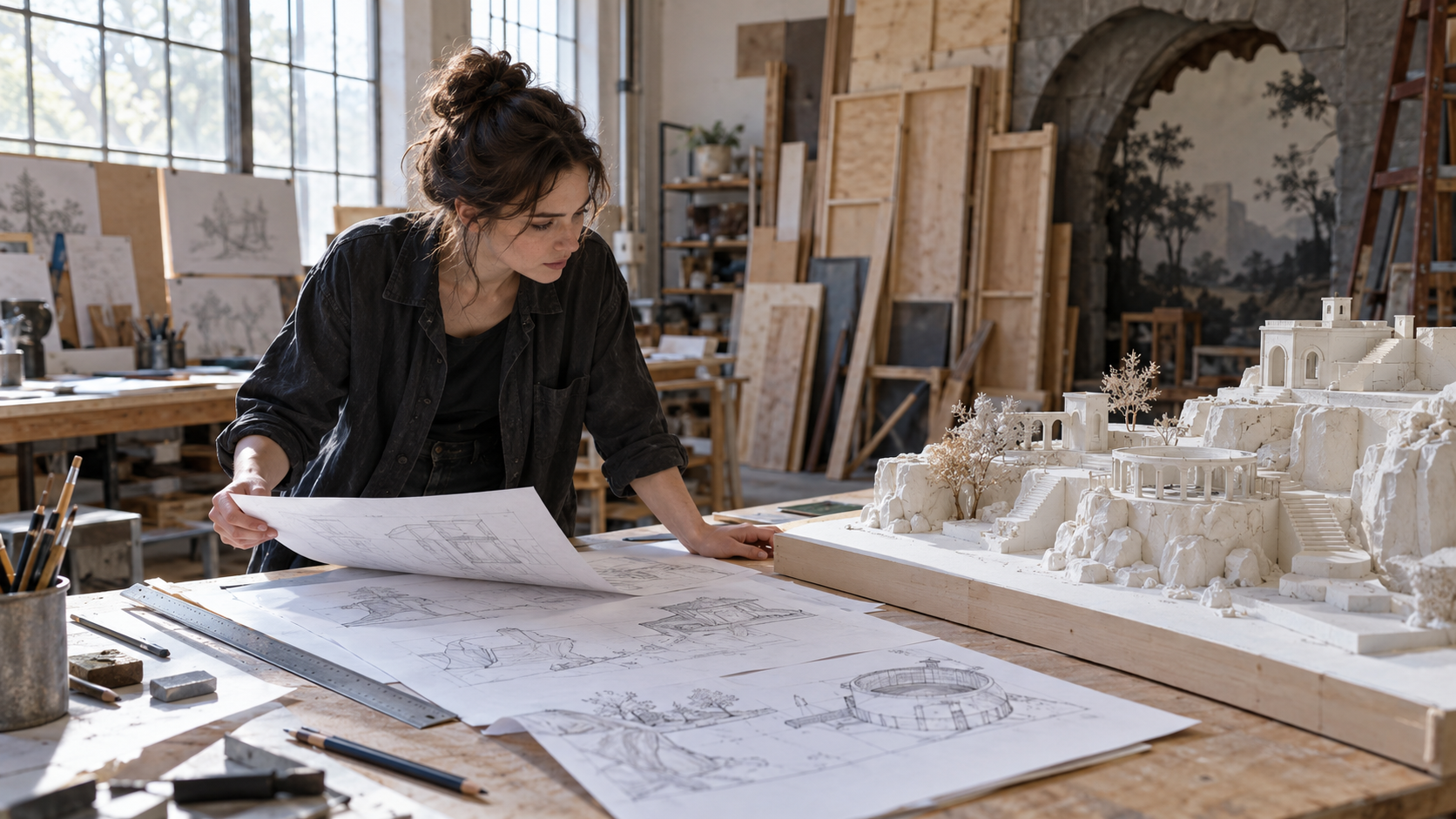
Art Direction Explainer
In film and television, art direction is the management and technical realization of the production designer's visual plan. An art director helps turn concepts into drawings, construction packages, location adaptations, schedules, and coordinated work across the art department. The production designer ordinarily establishes the overall look; art directors organize substantial parts of making that look physically possible. Hierarchies expand on large productions and compress on smaller ones.
The process begins with a close reading of the script and design research. Art directors may survey locations, estimate builds, supervise drafting and models, plan graphics and scenic elements, and work with construction, set decoration, props, effects, and locations. They must reconcile visual ambition with stage dimensions, camera access, fire routes, material lead times, labor, reuse, and striking. A beautiful drawing that cannot be built or photographed is not a complete solution.
Technical drawings translate creative language into dimensions and interfaces. Walls may need to fly out for cameras, ceilings may require removable sections, and windows must align with lighting plans. Effects, stunts, vehicles, or water can change structural requirements. The art director coordinates revisions so different vendors and departments work from the same information. Version control matters because a late design change can propagate through construction, dressing, lighting, and the shooting schedule.
Several art-director roles can coexist. A supervising art director may coordinate multiple units or sets; assistant art directors can own particular builds or drafting tasks; a standby art director addresses immediate set problems during filming. Names and responsibilities vary by market. Art direction is also different from the broader use of the term in advertising or publishing, where it can refer to directing graphic style rather than constructing screen environments. Successful art direction protects the design while solving constraints that viewers never see. It ensures that a fictional space can be entered, lit, dressed, moved through, damaged, reset, and removed on schedule. That combination of aesthetic interpretation and production systems explains why the credit is managerial as well as creative. The art director makes the visual world legible not only to an audience, but also to every craft that must build it. A practical way to read or discuss Art Direction is to begin with the basic definition and then identify the choices made in a particular example. Art directors manage the technical realization of a production designer's overall visual concept. Next, ask who sets the relevant rules, who performs the work, and which results follow from creative judgment, law, contracts, technology, budget, or production limits. Similar-looking examples can operate differently because their audience, market, format, timing, and agreements are different. Accurate revisions and version control keep builders, decorators, props, graphics, and production teams aligned. It also helps to distinguish a formal industry category from an informal critical label or one organization's current practice. That separation keeps a memorable anecdote from becoming a false universal rule. Dates and territories matter: tools, distribution systems, audience behavior, and standard agreements change, while older examples can preserve assumptions that no longer apply everywhere. Because the concept sits inside a larger workflow, examine what comes before and after it, which records move between stages, and where responsibility changes hands. This broader view prevents one visible task from being mistaken for the entire system. When a claim sounds absolute, compare it with a second kind of source and look for the conditions under which the claim is true. Then trace the process from the visible result back through the less visible decisions, handoffs, and quality checks that produced it. Screen art direction differs from the term's use in advertising or publishing, where the medium and workflow change. Finally, compare the example with a contrasting case and note which part of the definition still holds. This method keeps the explanation grounded, highlights the people and systems behind the outcome, and leaves room for reasonable disagreement about hybrid or borderline cases.
Art directors manage the technical realization of a production designer's overall visual concept.
They connect research and concept art to surveys, drawings, construction, locations, schedules, and budgets.
Sets must accommodate cameras, lighting, sound, performers, access routes, effects, resets, and eventual removal.
Accurate revisions and version control keep builders, decorators, props, graphics, and production teams aligned.
Supervising, assistant, and standby art directors may divide responsibility differently on large productions.
Screen art direction differs from the term's use in advertising or publishing, where the medium and workflow change.
Explore more "Explainers"
Discover additional explainers across politics, science, business, technology, and other fields. Each explainer breaks down a complex idea into clear, everyday language—helping you better understand how major concepts, systems, and debates shape the world around us.