

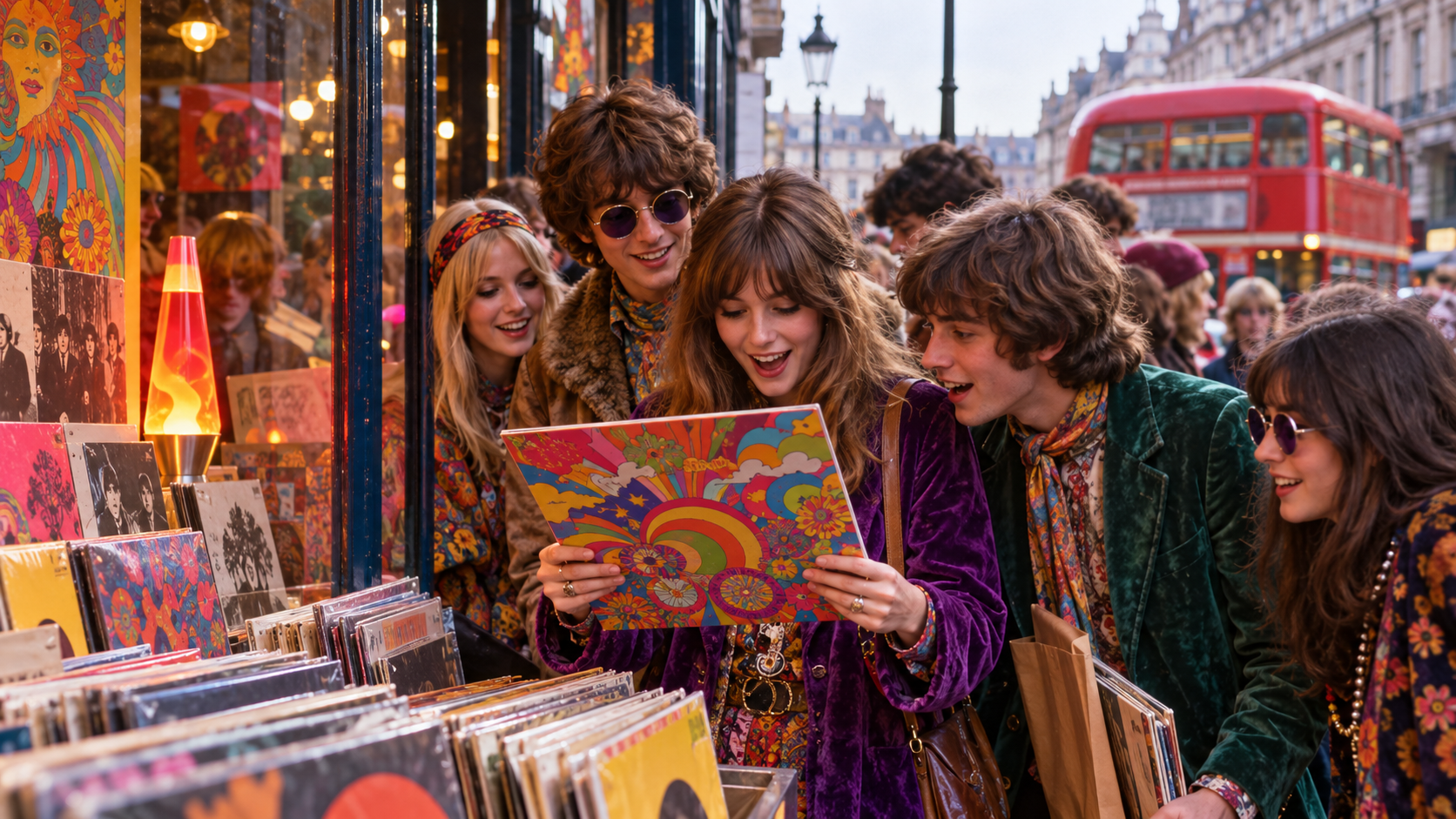
On This Day in Pop: June 1, 1967
On June 1, 1967, the Beatles officially released Sgt. Pepper’s Lonely Hearts Club Band, an album designed to sound less like a collection of singles than a complete encounter with a newly imagined group. The band had stopped touring the previous summer, freeing John Lennon, Paul McCartney, George Harrison and Ringo Starr to spend months at EMI’s Abbey Road studios with producer George Martin and engineer Geoff Emerick. Recording on four-track equipment, the team layered instruments, tape loops, orchestral passages, studio effects and performances that could not have been reproduced by the Beatles onstage. The title track introduced the fictional ensemble, the songs flowed into one another, and the closing chord of A Day in the Life seemed to suspend time. Peter Blake and Jann Haworth’s crowded cover completed the invitation: listeners were not simply buying music, but entering a brightly constructed world.
The date mattered because Sgt. Pepper arrived when the long-playing record was becoming pop music’s most ambitious form. Rock albums had already grown more sophisticated, but this release made studio craft, packaging and sequencing central to a mass-cultural event. Its sound moved freely among music hall, Indian classical music, psychedelia, chamber arrangement and hard electric rock without presenting those turns as novelties. The album also reflected the counterculture’s appetite for transformation while remaining accessible enough to dominate record charts. It spent 27 weeks at number one in Britain and 15 weeks atop the U.S. album chart during its first run, then won four Grammy Awards, including Album of the Year. That combination of experiment and enormous popularity widened the space in which record companies, musicians and audiences believed pop could operate.
What followed was not a single style but a new expectation. Artists across rock, soul and pop treated the album as a canvas whose songs, artwork and public image could support one another. Studios became instruments in their own right, producers gained cultural visibility, and the idea of an album as a statement rather than a delivery system for hits became harder to dismiss. The Beatles continued rapidly into Magical Mystery Tour and the White Album, while later generations repeatedly returned to Sgt. Pepper to debate both its innovations and its excesses. The Library of Congress placed it in the National Recording Registry in 2003, recognizing its cultural and historical importance. Its greatest legacy may be the permission it gave: a popular record could be playful, difficult, theatrical, meticulously engineered and still address the widest possible audience.
The Beatles officially released Sgt. Pepper's Lonely Hearts Club Band on June 1, 1967 after more than 400 hours of studio work.
The moment reached audiences through the media and distribution systems of 1967, influencing how the initial response developed.
The record used the fictional Sgt. Pepper band as a loose frame and ended with A Day in the Life.
Its early impact was substantial but not universal, and later retellings sometimes compressed a more complicated contemporary response.
It won four Grammy Awards, including Album of the Year, and later entered the National Recording Registry.
Anniversary coverage continues to place Sgt. Pepper Arrives within the broader history of popular culture while distinguishing documented evidence from later legend.
Explore more of "On This Day ..."
Discover more events from the same date across news, politics, technology, sports, and other fields. Each link highlights significant moments that shaped history on different fronts.