

On This Day in Pop: June 28, 1928
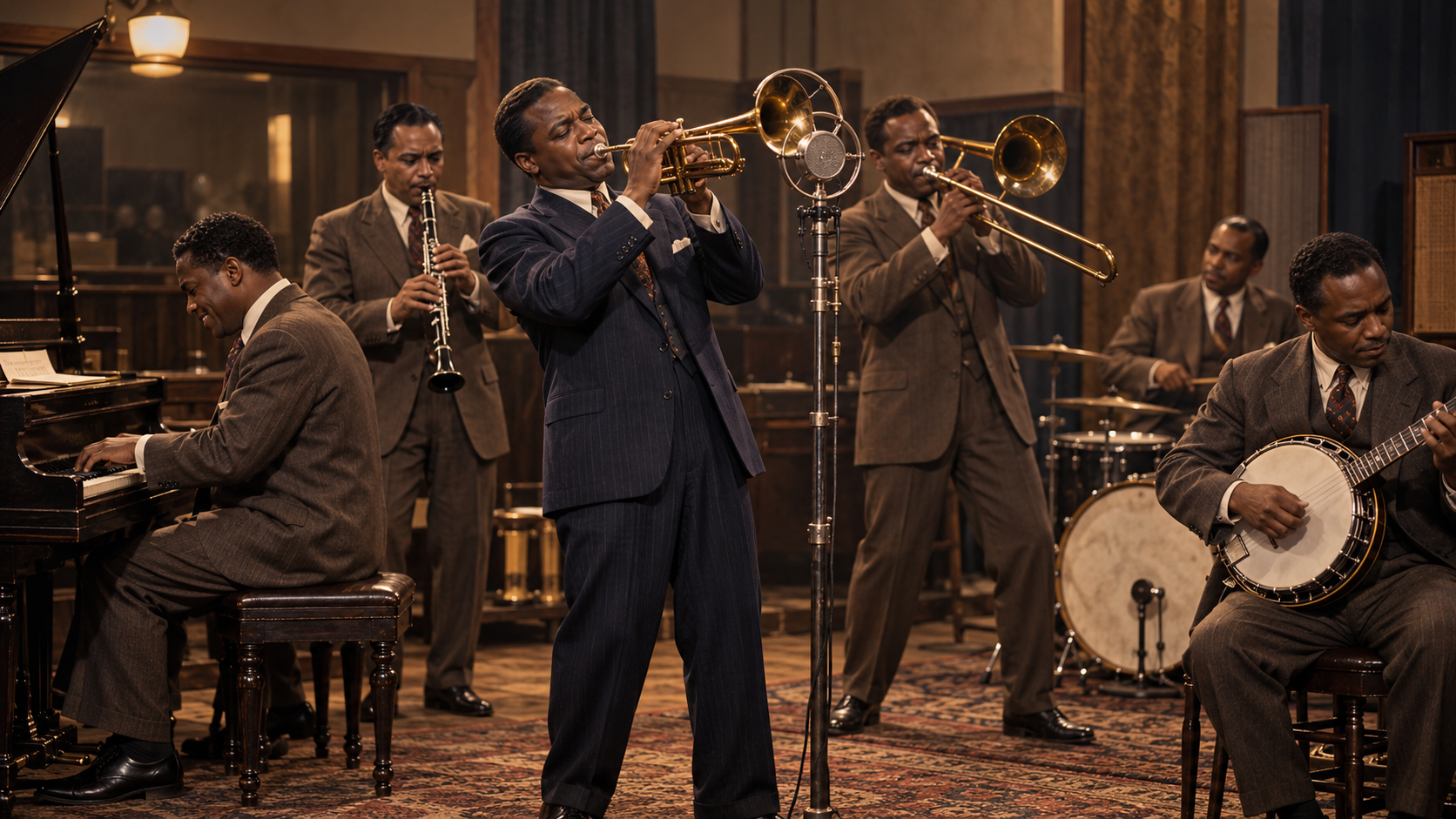
On June 28, 1928, Louis Armstrong and his Hot Five recorded West End Blues for Okeh Records in Chicago. The composition was by Armstrong’s mentor Joe Oliver, but the new performance announced a different level of rhythmic and expressive freedom. Armstrong opened alone with a trumpet cadenza whose balanced phrases seemed both composed and spontaneously discovered. The ensemble—Fred Robinson on trombone, Jimmy Strong on clarinet, Earl Hines on piano, Mancy Carr on banjo and Zutty Singleton on drums—then entered a compact arrangement that made space for individual voices. Armstrong’s vocal passage used scat and flexible timing, and his later high note floated over the band with a control that transformed virtuosity into emotional narrative.
The session mattered because West End Blues helped establish the improvised soloist as the organizing force of jazz. Earlier New Orleans styles often emphasized collective interplay, and that remains present, but Armstrong’s performance showed how a single musician could shape time, melody and dramatic structure across an entire recording. The opening cadenza became a lesson studied by trumpeters and scholars, yet its influence cannot be reduced to technical difficulty. Armstrong made phrases speak: attacks, pauses, bends and accents carried personality. Hines’s piano offered an equally modern conversation, suggesting new relationships between soloist and accompaniment. Within the strict duration of a 78 rpm side, the group created an arc that felt spacious and complete.
West End Blues became one of the essential recordings in jazz history and was included with Armstrong’s Hot Five and Hot Seven work in the National Recording Registry. Musicians across genres learned from its combination of precision, swing and individual sound. The performance also complicates simplistic accounts of innovation because it emerged from Black musical networks, mentorship and commercial recording conditions that often gave limited control to artists. Armstrong would become an international celebrity whose public image sometimes obscured the radical force of his early records. Returning to June 28 restores that force. In a Chicago studio, six musicians used three minutes of shellac to demonstrate that a popular recording could hold architecture, risk and an unmistakable personal voice—and jazz would never again define possibility in quite the same way.
Remembering louis armstrong records west end blues on June 28 is valuable because anniversaries turn a familiar cultural object back into a specific decision, release or broadcast. The surrounding technology, business and audience conditions explain why the moment could happen then, while its later uses show that meaning never stops changing. Seen at that scale, the date is not trivia. It is a checkpoint between creation and memory: a place to separate what occurred from the legend accumulated around it and to ask why the work still attracts attention.
Louis Armstrong and his Hot Five recorded West End Blues in Chicago on June 28, 1928.
The moment reached audiences through the media and distribution systems of 1928, influencing how the initial response developed.
Armstrong's unaccompanied opening cadenza and the ensemble's solo interplay became landmarks of jazz performance.
Its early impact was substantial but not universal, and later retellings sometimes compressed a more complicated contemporary response.
The recording helped center the expressive improvising soloist in jazz and later entered the National Recording Registry.
Anniversary coverage continues to place West End Blues Recorded within the broader history of popular culture while distinguishing documented evidence from later legend.
Explore more of "On This Day ..."
Discover more events from the same date across news, politics, technology, sports, and other fields. Each link highlights significant moments that shaped history on different fronts.