

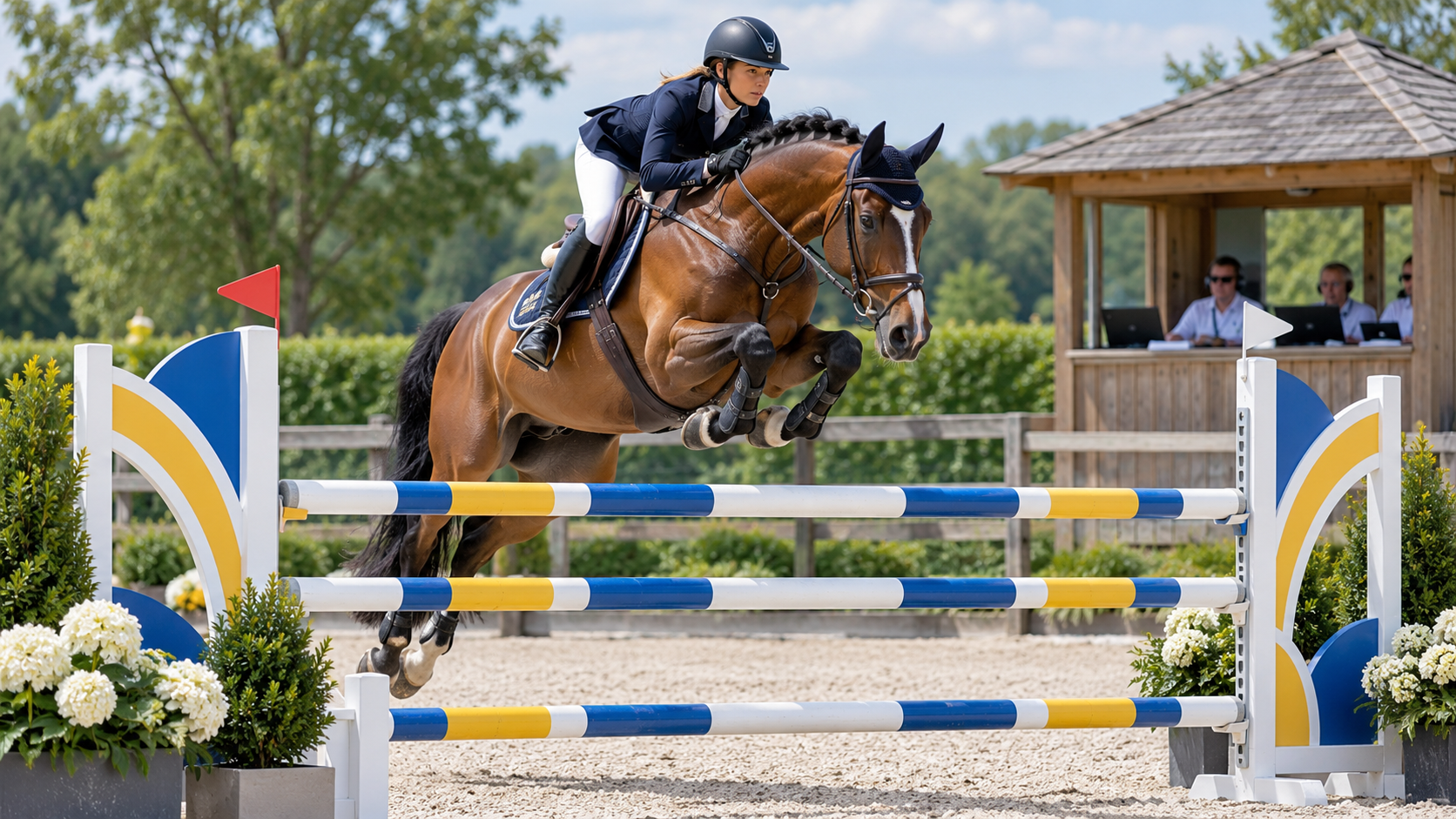
How Time Faults Work in Show Jumping Explainer
Show jumping gives each course a time allowed based on its measured length and prescribed speed. The clock begins when the horse crosses the start line after the signal and stops at the finish, subject to adjustments for interruptions, corrections, and other rule-defined events.
In competitions judged under Table A, exceeding the time allowed produces time penalties, commonly one penalty for every commenced second over the limit. The exact scale depends on the class and phase, so a fraction or partial interval can matter even after every fence stays standing.
A separate time limit is longer than the time allowed. Exceeding that maximum causes elimination rather than merely adding penalties. Refusals, route corrections, and rebuilding an obstacle consume time or trigger clock procedures, making recovery costly even when horse and rider eventually clear the fence.
Placings combine jumping penalties, time penalties, and sometimes speed in a jump-off. Riders therefore choose lines that are efficient without asking for unsafe turns or flat, careless jumps. Officials measure the course, publish its timing standard, and use electronic timing backed by manual systems.
Officials use the measured course length and the speed prescribed for the class.
Time penalties are added under the table used for that competition.
No. The time limit is a larger maximum whose breach normally causes elimination.
Explore more "Explainers"
Discover additional explainers across politics, science, business, technology, and other fields. Each explainer breaks down a complex idea into clear, everyday language—helping you better understand how major concepts, systems, and debates shape the world around us.