

On This Day in AI: January 13, 2023
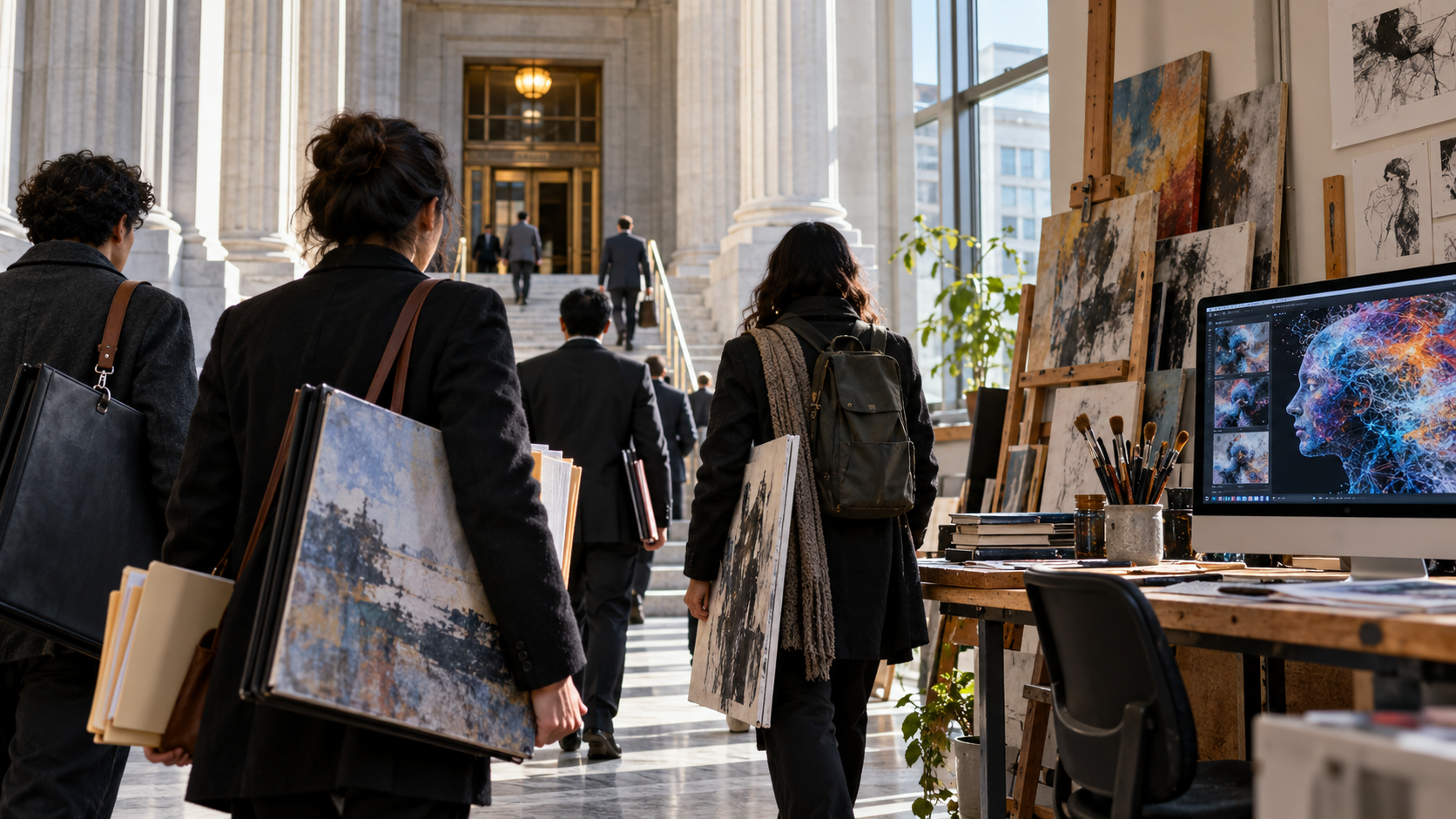
On January 13, 2023, artists Sarah Andersen, Kelly McKernan, and Karla Ortiz filed a proposed class-action lawsuit in federal court in San Francisco against Stability AI, Midjourney, and DeviantArt. The complaint argued that image generators had been trained on vast collections of copyrighted pictures without permission and could produce images associated with artists’ names and styles. It challenged Stability AI’s Stable Diffusion model as well as services that incorporated or relied on related technology. The filing arrived just as text-to-image tools were moving from research demonstrations into widely used creative products, making the case one of the first major attempts by working artists to apply existing copyright and publicity law to generative AI.
The plaintiffs described online portfolios and art-sharing sites as sources from which training images had been gathered. Their case raised several distinct questions: whether copying images for training was infringement, whether a trained model stored protected expression, whether generated outputs were unlawfully similar to particular works, and whether the use of an artist’s name could mislead customers. The companies disputed the legal theories, and the technical process complicated familiar copyright categories. A model does not ordinarily retrieve one intact image when asked to create a new picture, yet its behavior depends on patterns learned from large datasets. Artists also faced the practical problem of tracing which works were included and linking a particular output to a particular original.
The January 13 filing began litigation rather than resolving those issues. In October 2023, a judge dismissed several claims while allowing the plaintiffs to amend their complaint, and later proceedings continued with a larger group of artists and more detailed allegations. The case therefore should not be treated as a final ruling that all AI training is either lawful or unlawful. Its immediate importance was to force questions about consent, attribution, market harm, and dataset transparency into a formal court record. It also encouraged model developers, image platforms, and creative organizations to examine opt-out systems, licensing programs, provenance tools, and disclosures. The dispute became part of a wider group of lawsuits involving authors, photographers, news organizations, and software developers. Whatever the final legal outcomes, the artists’ complaint marked a turning point: generative AI was no longer only a technical achievement or product trend. It had become a direct labor and rights issue for people whose work helped form the cultural data on which the systems were trained. The litigation also made dataset documentation a business concern rather than an internal research detail. Companies, creators, and customers increasingly wanted to know what material supported a model, which permissions applied, and who would answer when an output caused harm.
The complaint alleged that copyrighted online artwork had been copied into training datasets without permission and that commercial generators benefited from those works.
It also argued that prompts using artists' names could associate creators with outputs they did not make or endorse, raising publicity and consumer-confusion concerns.
Copyright law traditionally compares identifiable works and copies, while generative models learn statistical patterns from enormous datasets. That made technical facts central to the legal arguments.
The filing did not establish liability. Some early claims were dismissed with permission to amend, and the litigation continued rather than producing an immediate final answer.
The case helped move dataset consent, attribution, licensing, and compensation from informal criticism into courts and company policy discussions.
Similar disputes later involved books, photographs, news reporting, music, and software, making the artists' action an early landmark in the governance of generative AI.
Explore more of "On This Day ..."
Discover more events from the same date across news, politics, technology, sports, and other fields. Each link highlights significant moments that shaped history on different fronts.