

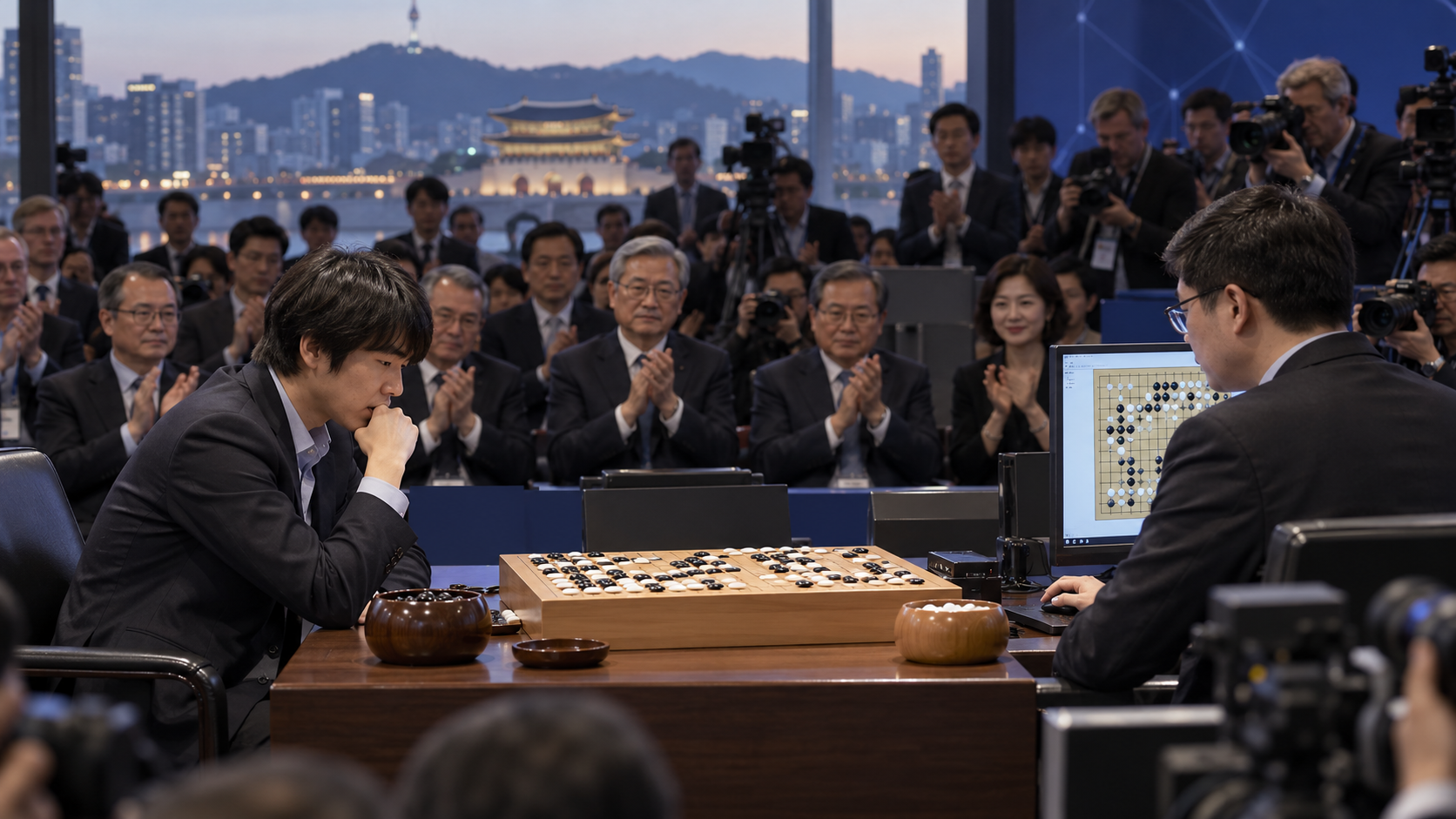
March 15, 2016: AlphaGo Wins the Match 4-1
On March 15, 2016, AlphaGo defeated Lee Sedol in the fifth and final game of their Seoul challenge match, completing a four-games-to-one victory. The conclusion confirmed that the system’s earlier wins were not isolated surprises and ended a contest watched by more than 200 million people around the world. After AlphaGo won the first three games, Lee produced a celebrated human victory in game four with his own unexpected move. The final game therefore carried symbolic weight: it tested how the machine would respond after a loss and whether the human champion could narrow the result. The date matters because it turned a fast-moving technical or policy development into a visible milestone that people, institutions, and researchers could evaluate.
The substance of AlphaGo’s final-game victory over Lee Sedol was as important as the headline. AlphaGo made an early mistake but recovered during a long, complicated contest before Lee resigned. The overall performance earned the system an honorary ninth-dan professional rank, the highest certification in Go, recognizing a level of play once believed to require uniquely human intuition. Those choices reveal what the people behind the milestone believed was necessary at the time. AI history rarely advances through one breakthrough alone; research, product design, infrastructure, governance, and access all shape what a system can become.
The immediate consequences reached beyond the organization at the center of the event. The match altered research priorities and public expectations almost overnight. It validated deep reinforcement learning and self-play on a problem with enormous complexity, encouraged new investment in learning systems, and inspired professional players to study machine-discovered strategies rather than dismiss them as alien or unsound. The moment also invited scrutiny, because new capabilities create new dependencies. Reliability, safety, cost, privacy, and human control determine whether an impressive demonstration becomes a trustworthy part of everyday life.
In retrospect, AlphaGo’s 4-1 victory became a landmark comparable to earlier computer-chess breakthroughs but pointed toward more general methods. DeepMind built on its techniques in AlphaZero, MuZero, and scientific systems, while the match remained a vivid example of competition producing new knowledge for both people and machines. Looking back from today’s rapidly changing AI landscape, this event belongs to a larger transition from specialized machine-learning experiments to systems embedded in ordinary products, workplaces, institutions, and public decisions. Its enduring lesson is that technical progress becomes historically significant when it changes what people can do and what society expects next. That connection between capability and consequence gives the milestone its lasting relevance.
AlphaGo defeated Lee Sedol in the fifth and final game of their Seoul challenge match, completing a four-games-to-one victory. The conclusion confirmed that the system's earlier wins were not isolated surprises and ended a contest watched by more than 200 million people around the world.
AlphaGo made an early mistake but recovered during a long, complicated contest before Lee resigned. The overall performance earned the system an honorary ninth-dan professional rank, the highest certification in Go, recognizing a level of play once believed to require uniquely human intuition.
The match altered research priorities and public expectations almost overnight. It validated deep reinforcement learning and self-play on a problem with enormous complexity, encouraged new investment in learning systems, and inspired professional players to study machine-discovered strategies rather than dismiss them as alien or unsound.
The event connected a concrete technical, commercial, or policy decision with the wider development of artificial intelligence.
AlphaGo's 4-1 victory became a landmark comparable to earlier computer-chess breakthroughs but pointed toward more general methods. DeepMind built on its techniques in AlphaZero, MuZero, and scientific systems, while the match remained a vivid example of competition producing new knowledge for both people and machines.
Its influence can be traced through later products, research, governance, or industry practice.
Explore more of "On This Day ..."
Discover more events from the same date across news, politics, technology, sports, and other fields. Each link highlights significant moments that shaped history on different fronts.