

On This Day in AI: April 11, 2024
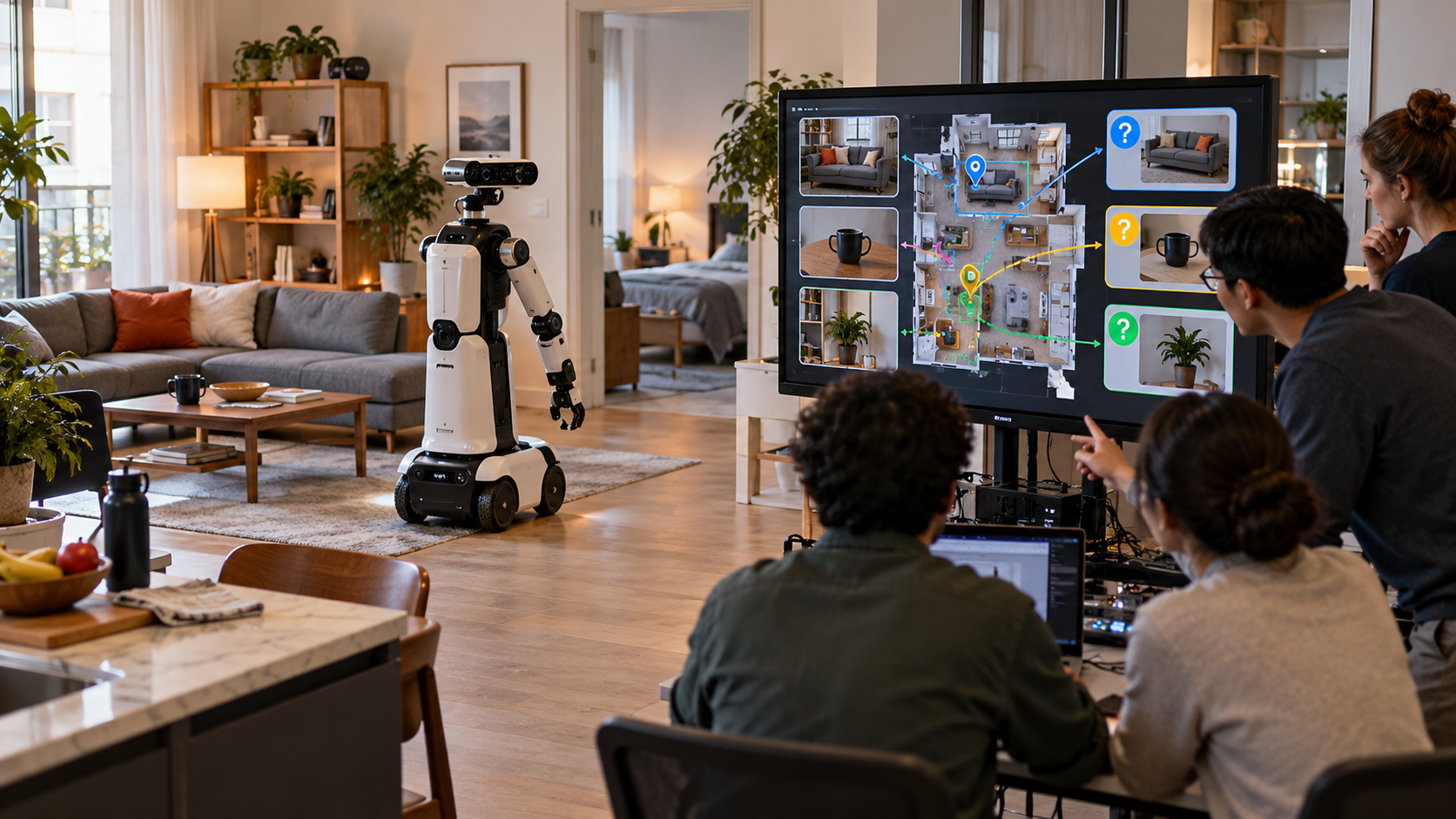
On April 11, 2024, Meta introduced Open-Vocabulary Embodied Question Answering, or OpenEQA, to test whether an AI agent could understand a physical environment well enough to answer questions about it. The benchmark covered remembered experiences and active exploration in homes and other indoor spaces. Language models could answer questions about text and images, but useful robots and smart glasses need a persistent model of three-dimensional surroundings. They must connect what a camera sees with location, time, memory, and action instead of treating each frame as an isolated picture. The date matters because it turned a fast-moving technical or policy development into a visible milestone that people, institutions, and researchers could evaluate.
The substance of Meta’s release of the OpenEQA benchmark was as important as the headline. OpenEQA asked questions such as where an object had been left or what was located near another item. Meta compared leading vision-language models with human performance and found a large gap, especially on spatial questions where added visual input sometimes produced little benefit. Those choices reveal what the people behind the milestone believed was necessary at the time. AI history rarely advances through one breakthrough alone; research, product design, infrastructure, governance, and access all shape what a system can become.
The immediate consequences reached beyond the organization at the center of the event. The benchmark exposed how far fluent multimodal systems remained from grounded understanding. By releasing data and evaluation tools, the project gave researchers a common way to measure progress in episodic memory, scene reasoning, embodied exploration, and communication. The moment also invited scrutiny, because new capabilities create new dependencies. Reliability, safety, cost, privacy, and human control determine whether an impressive demonstration becomes a trustworthy part of everyday life. Those practical limits are essential to understanding both the achievement and the response it received.
In retrospect, OpenEQA helped shift attention from models that describe images toward agents that build and use world models over time. Its importance lies in defining practical questions that future home robots, wearables, and assistive systems must answer reliably before they can act safely. Looking back from today’s rapidly changing AI landscape, this event belongs to a larger transition from specialized machine-learning experiments to systems embedded in ordinary products, workplaces, institutions, and public decisions. Its enduring lesson is that technical progress becomes historically significant when it changes what people can do and what society expects next. That connection between capability and consequence gives the milestone its lasting relevance. The anniversary therefore records a turning point, not simply an announcement.
Meta introduced Open-Vocabulary Embodied Question Answering, or OpenEQA, to test whether an AI agent could understand a physical environment well enough to answer questions about it. The benchmark covered remembered experiences and active exploration in homes and other indoor spaces.
OpenEQA asked questions such as where an object had been left or what was located near another item. Meta compared leading vision-language models with human performance and found a large gap, especially on spatial questions where added visual input sometimes produced little benefit.
The benchmark exposed how far fluent multimodal systems remained from grounded understanding. By releasing data and evaluation tools, the project gave researchers a common way to measure progress in episodic memory, scene reasoning, embodied exploration, and communication.
The event connected a concrete technical, commercial, or policy decision with the wider development of artificial intelligence.
OpenEQA helped shift attention from models that describe images toward agents that build and use world models over time. Its importance lies in defining practical questions that future home robots, wearables, and assistive systems must answer reliably before they can act safely.
Its influence can be traced through later products, research, governance, or industry practice.
Explore more of "On This Day ..."
Discover more events from the same date across news, politics, technology, sports, and other fields. Each link highlights significant moments that shaped history on different fronts.