

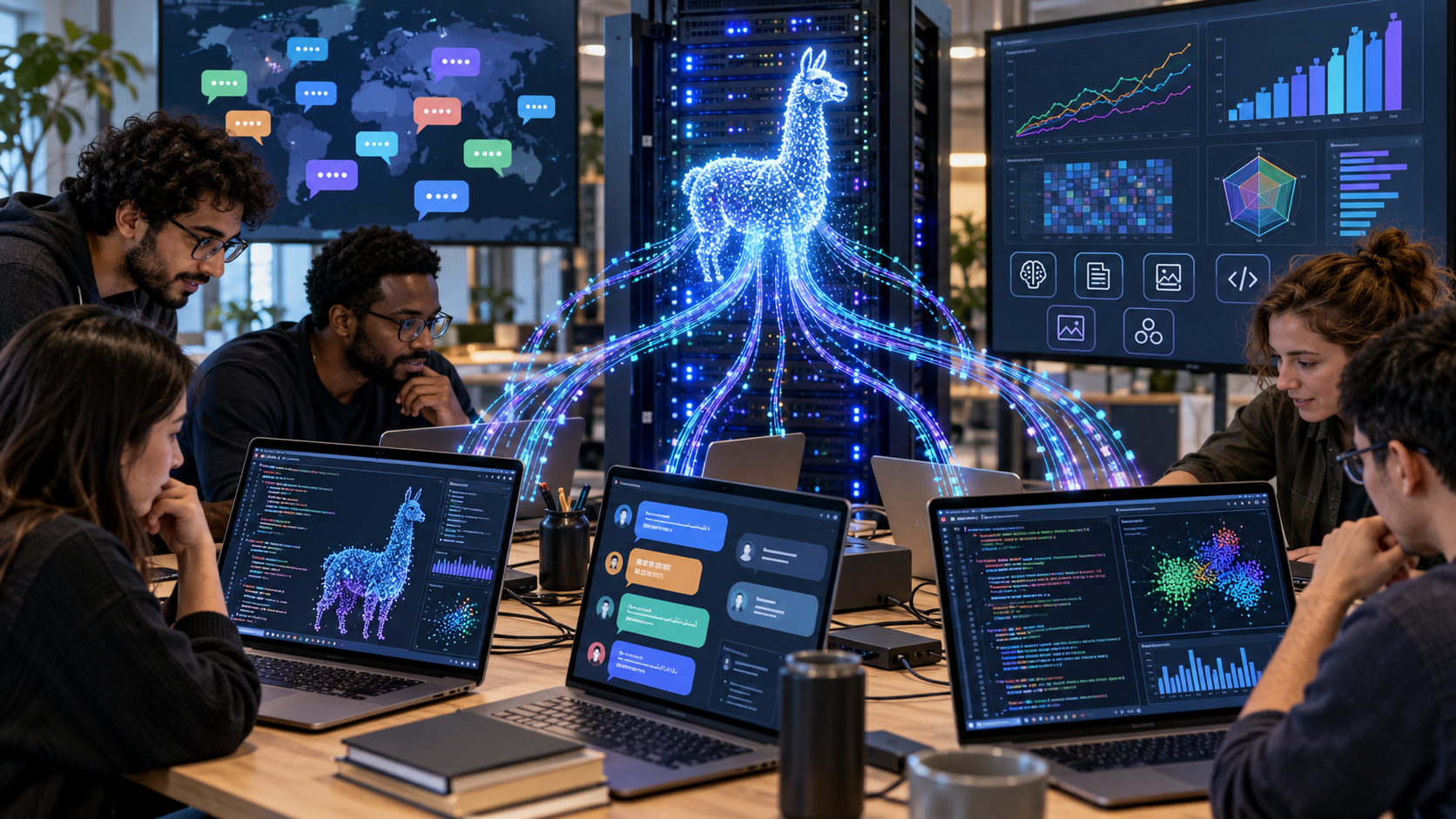
On This Day in AI: April 18, 2024
On April 18, 2024, Meta released the first Llama 3 models in eight-billion- and seventy-billion-parameter sizes and placed them across major cloud, hardware, and model-hosting platforms. The company also began using the new generation to power Meta AI in its consumer applications. The Llama family had become a foundation for open model research and commercial experimentation, but competition was accelerating. Developers expected stronger reasoning, coding, instruction following, and safety without losing the ability to download and adapt model weights. The date matters because it turned a fast-moving technical or policy development into a visible milestone that people, institutions, and researchers could evaluate.
The substance of Meta’s launch of the first Llama 3 models was as important as the headline. Meta trained Llama 3 on more than fifteen trillion tokens with a larger tokenizer and improved data filtering. It released pretrained and instruction-tuned variants together with Llama Guard 2, CyberSec Eval 2, and Code Shield resources intended to support safer deployment. Those choices reveal what the people behind the milestone believed was necessary at the time. AI history rarely advances through one breakthrough alone; research, product design, infrastructure, governance, and access all shape what a system can become.
The immediate consequences reached beyond the organization at the center of the event. The models raised the quality available to the open ecosystem and triggered a new wave of fine-tunes, local tools, and enterprise deployments. Distribution through WhatsApp, Instagram, Facebook, and the web also brought the technology to a mass consumer audience. The moment also invited scrutiny, because new capabilities create new dependencies. Reliability, safety, cost, privacy, and human control determine whether an impressive demonstration becomes a trustworthy part of everyday life. Those practical limits are essential to understanding both the achievement and the response it received.
In retrospect, Llama 3 strengthened the role of downloadable weights in frontier competition and set the stage for larger context and parameter variants. The release showed how model capability, safety tooling, licensing, hardware support, and product distribution could move together as one platform strategy. Looking back from today’s rapidly changing AI landscape, this event belongs to a larger transition from specialized machine-learning experiments to systems embedded in ordinary products, workplaces, institutions, and public decisions. Its enduring lesson is that technical progress becomes historically significant when it changes what people can do and what society expects next. That connection between capability and consequence gives the milestone its lasting relevance. The anniversary therefore records a turning point, not simply an announcement.
Meta released the first Llama 3 models in eight-billion- and seventy-billion-parameter sizes and placed them across major cloud, hardware, and model-hosting platforms. The company also began using the new generation to power Meta AI in its consumer applications.
Meta trained Llama 3 on more than fifteen trillion tokens with a larger tokenizer and improved data filtering. It released pretrained and instruction-tuned variants together with Llama Guard 2, CyberSec Eval 2, and Code Shield resources intended to support safer deployment.
The models raised the quality available to the open ecosystem and triggered a new wave of fine-tunes, local tools, and enterprise deployments. Distribution through WhatsApp, Instagram, Facebook, and the web also brought the technology to a mass consumer audience.
The event connected a concrete technical, commercial, or policy decision with the wider development of artificial intelligence.
Llama 3 strengthened the role of downloadable weights in frontier competition and set the stage for larger context and parameter variants. The release showed how model capability, safety tooling, licensing, hardware support, and product distribution could move together as one platform strategy.
Its influence can be traced through later products, research, governance, or industry practice.
Explore more of "On This Day ..."
Discover more events from the same date across news, politics, technology, sports, and other fields. Each link highlights significant moments that shaped history on different fronts.