

On This Day in AI: April 24, 2025
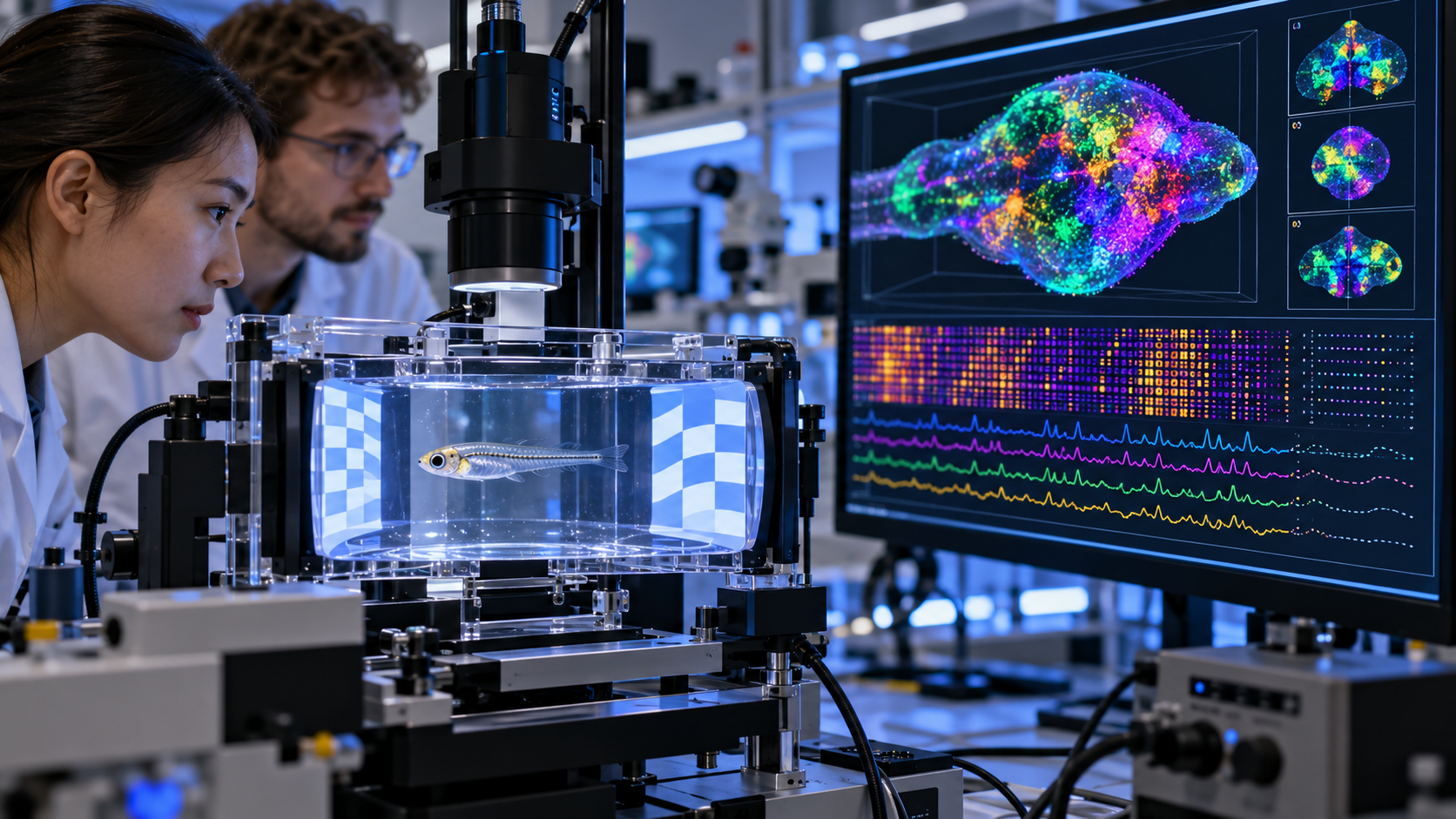
On April 24, 2025, Google Research, Harvard, and HHMI Janelia introduced ZAPBench, a dataset and benchmark for predicting activity across the brain of larval zebrafish. The project used large-scale four-dimensional recordings to connect neural activity with visual and water-flow stimuli. Language models learn by predicting the next token, inspiring neuroscientists to ask whether related predictive systems could help reveal how biological brains respond over time. Progress required shared datasets large enough to compare models across thousands of neurons and changing sensory conditions. The date matters because it turned a fast-moving technical or policy development into a visible milestone that people, institutions, and researchers could evaluate.
The substance of Google’s introduction of the Zebrafish Activity Prediction Benchmark was as important as the headline. The underlying recordings captured activity from about seventy thousand neurons while fish experienced controlled virtual-reality stimuli. ZAPBench organized that information into forecasting tasks so researchers could test whether a model generalized across time, individuals, and unfamiliar experimental conditions. Those choices reveal what the people behind the milestone believed was necessary at the time. AI history rarely advances through one breakthrough alone; research, product design, infrastructure, governance, and access all shape what a system can become.
The immediate consequences reached beyond the organization at the center of the event. The benchmark created common ground between machine learning and systems neuroscience. Better predictions could help scientists identify principles of neural computation, design experiments more efficiently, and eventually understand how distributed activity relates to behavior and disease. The moment also invited scrutiny, because new capabilities create new dependencies. Reliability, safety, cost, privacy, and human control determine whether an impressive demonstration becomes a trustworthy part of everyday life. Those practical limits are essential to understanding both the achievement and the response it received.
In retrospect, ZAPBench exemplified AI’s expanding role as a scientific instrument rather than only a consumer product. Its enduring importance lies in making a complex biological prediction problem reproducible and measurable for researchers across institutions. Looking back from today’s rapidly changing AI landscape, this event belongs to a larger transition from specialized machine-learning experiments to systems embedded in ordinary products, workplaces, institutions, and public decisions. Its enduring lesson is that technical progress becomes historically significant when it changes what people can do and what society expects next. That connection between capability and consequence gives the milestone its lasting relevance. The anniversary therefore records a turning point, not simply an announcement.
Google Research, Harvard, and HHMI Janelia introduced ZAPBench, a dataset and benchmark for predicting activity across the brain of larval zebrafish. The project used large-scale four-dimensional recordings to connect neural activity with visual and water-flow stimuli.
The underlying recordings captured activity from about seventy thousand neurons while fish experienced controlled virtual-reality stimuli. ZAPBench organized that information into forecasting tasks so researchers could test whether a model generalized across time, individuals, and unfamiliar experimental conditions.
The benchmark created common ground between machine learning and systems neuroscience. Better predictions could help scientists identify principles of neural computation, design experiments more efficiently, and eventually understand how distributed activity relates to behavior and disease.
The event connected a concrete technical, commercial, or policy decision with the wider development of artificial intelligence.
ZAPBench exemplified AI's expanding role as a scientific instrument rather than only a consumer product. Its enduring importance lies in making a complex biological prediction problem reproducible and measurable for researchers across institutions.
Its influence can be traced through later products, research, governance, or industry practice.
Explore more of "On This Day ..."
Discover more events from the same date across news, politics, technology, sports, and other fields. Each link highlights significant moments that shaped history on different fronts.