

On This Day in Business: January 1, 1995
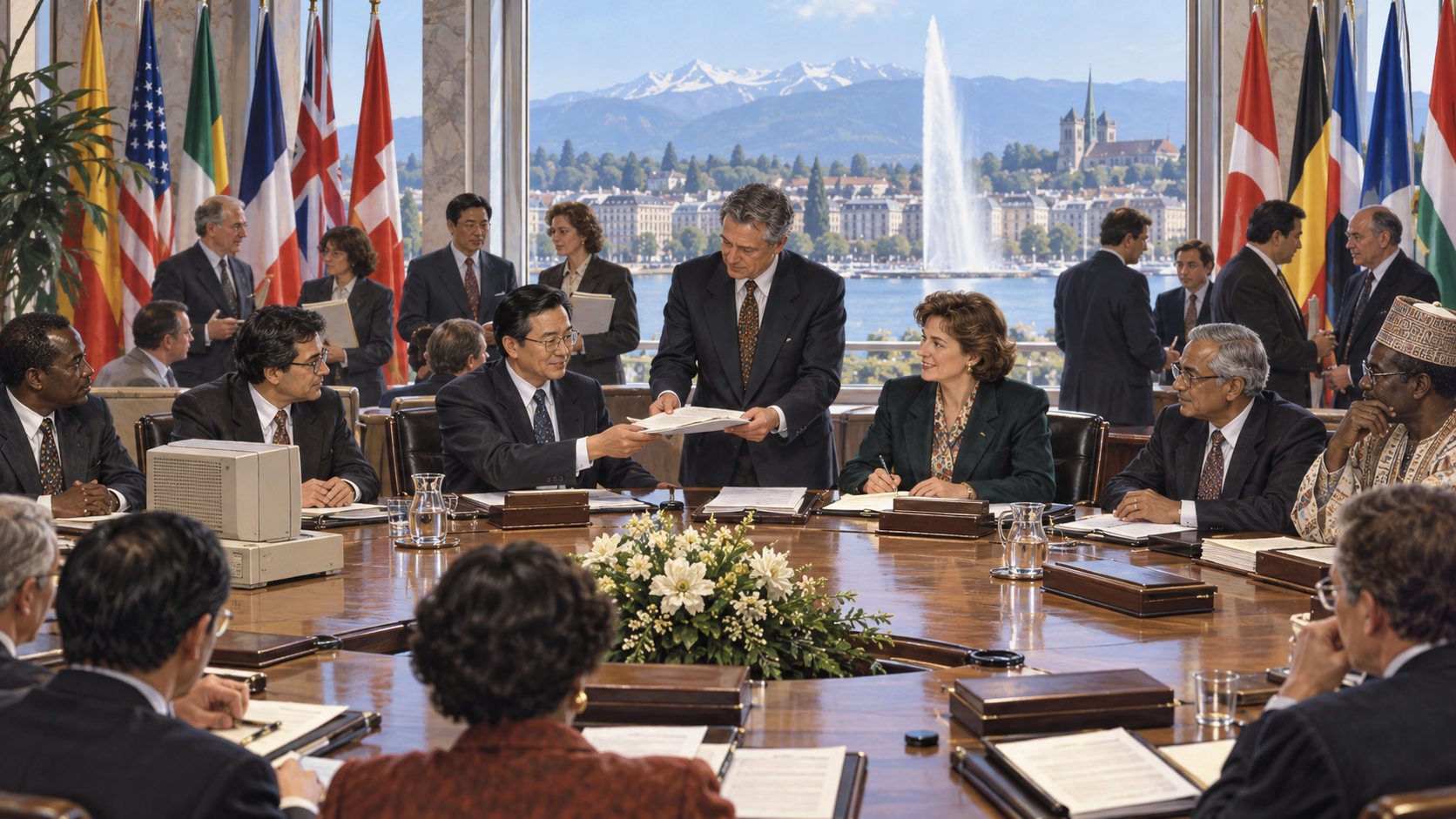
On January 1, 1995, the World Trade Organization began operating from Geneva as the new institutional center of the global trading system. Its launch completed a transformation negotiated during the Uruguay Round, an eight-year effort involving more than 120 economies. The WTO replaced the looser framework built around the General Agreement on Tariffs and Trade, or GATT, which had guided trade in goods since 1948. The change was larger than a new name. Governments had agreed to create a permanent organization with a broader rulebook, a formal structure for negotiations, and a stronger process for resolving disputes. The Marrakesh Agreement, signed in April 1994, supplied the legal foundation, while the first day of 1995 marked the moment those commitments took effect.
The organization brought several areas under one roof. Alongside updated rules for merchandise trade, its agreements covered services and trade-related intellectual property, subjects that had not been governed comprehensively by the old GATT system. Member governments also accepted regular reviews of their trade policies and a dispute process with defined stages for consultations, panels, appeals, and authorized responses. That structure was meant to make outcomes less dependent on the political weight of any single country. Decisions still rested largely on consensus, and national governments retained the power to set policy within the commitments they had negotiated. The WTO therefore became a forum and rule administrator, not a world government or a body that could independently write domestic law.
The immediate effect was continuity mixed with expansion. Existing tariff commitments remained in force, but businesses and governments now faced common obligations reaching into banking, telecommunications, patents, agriculture, textiles, and other sectors. Countries used the new dispute system quickly, testing whether the institution could turn negotiated language into practical restraint. Developing economies gained a formal place in the same system, although differences in legal capacity and bargaining power did not disappear. Nor did the launch produce instant free trade: tariffs, quotas, subsidies, exceptions, and transition periods remained. The WTO opened with an ambitious mandate, but its first day was the start of implementation rather than the completion of economic integration.
Over time, the WTO became one of the most consequential and contested institutions in international business. Its rules helped companies plan across borders and gave governments a venue for challenging discriminatory treatment, while its ministerial meetings became focal points for arguments over labor, the environment, public health, agriculture, and sovereignty. China’s entry in 2001 expanded the system’s reach, and later deadlock in broad negotiating rounds exposed the limits of consensus among a larger, more diverse membership. Strains in the appellate process have further tested enforcement. Even so, the organization’s January 1995 debut remains a dividing line: it established the basic legal architecture through which much of modern global commerce is negotiated, monitored, and disputed.
The WTO grew out of the Uruguay Round, which began in 1986 and concluded with the Marrakesh Agreement in 1994. That package converted decades of provisional trade cooperation into a standing organization.
Postwar trade rules had concentrated mainly on goods and tariffs. By the early 1990s, cross-border services, technology licensing, and complex supply chains had made the narrower GATT framework increasingly incomplete.
Existing trade commitments did not vanish on launch day. They were carried into a broader system with regular councils, policy reviews, and a more structured method for hearing complaints between governments.
The new institution did not abolish protection or require identical policies everywhere. Members retained negotiated exceptions and transition periods, and poorer countries often had fewer resources for litigation and bargaining.
The WTO helped make trade rules more predictable for companies operating across borders. Its agreements also made once-domestic questions, including patent protection and services regulation, part of international commercial diplomacy.
Debates over subsidies, national security, development, climate policy, and the stalled appeals system show that the 1995 framework is still under pressure. Its core agreements nevertheless continue to organize a large share of world trade.
Explore more of "On This Day ..."
Discover more events from the same date across news, politics, technology, sports, and other fields. Each link highlights significant moments that shaped history on different fronts.