

On This Day in Business: January 29, 1886
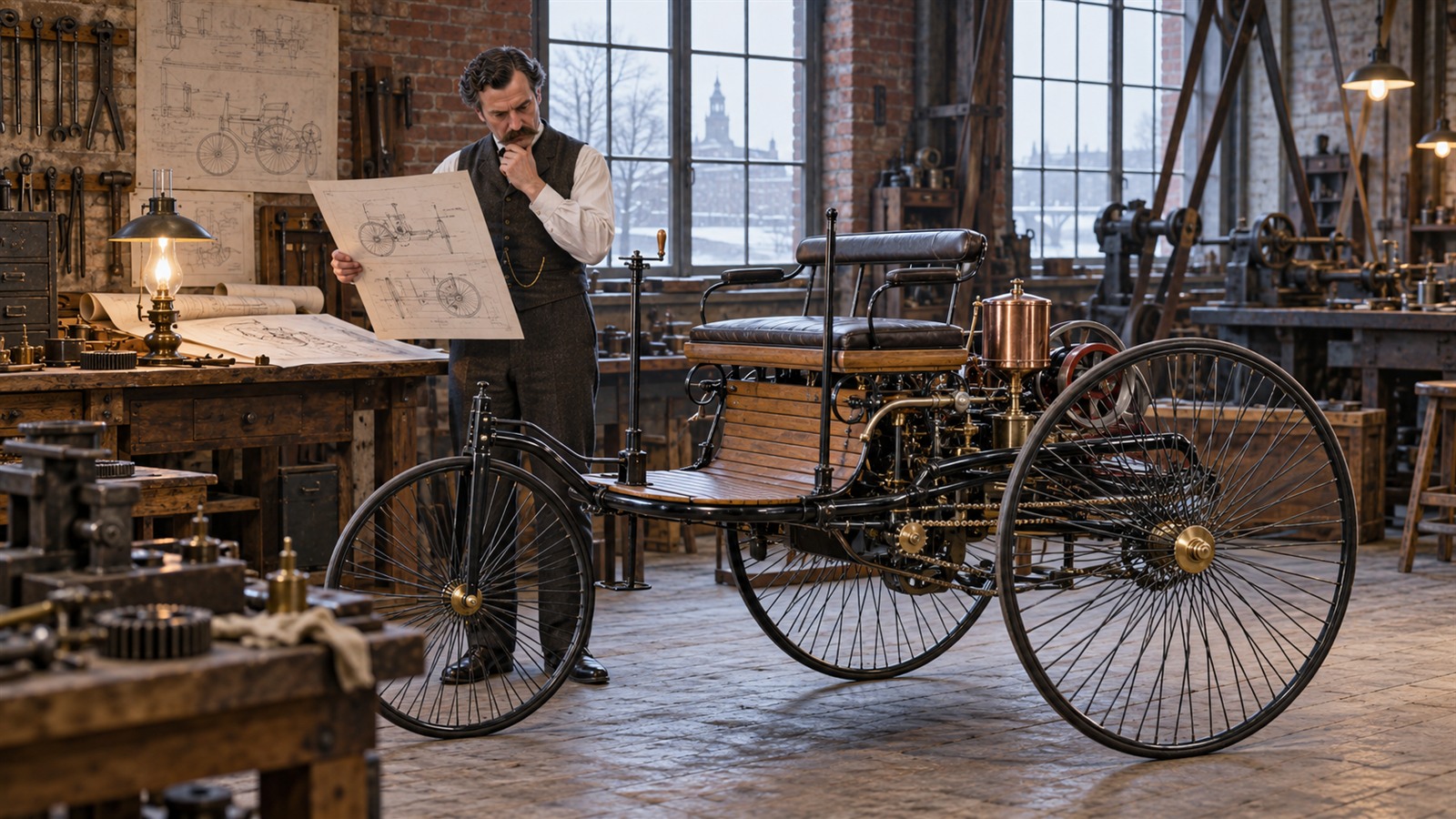
On January 29, 1886, Mannheim engineer Carl Benz applied for a German patent covering a vehicle powered by a gas engine. Patent DRP 37435, later granted by the Imperial Patent Office, described a purpose-built three-wheeled machine rather than a carriage with an engine added afterward. Benz placed a compact single-cylinder four-stroke engine horizontally at the rear and used a tubular steel frame, wire-spoked wheels and a tiller for steering. The engine produced roughly three-quarters of a horsepower. Although modest by later standards, the design integrated propulsion, chassis, control and transmission into a complete road vehicle and is widely regarded as the birth certificate of the automobile.
Benz's company already built stationary engines, providing technical skill and revenue while he pursued personal transportation. A three-wheel layout simplified steering because the front wheel did not have to coordinate with a second wheel through a complex mechanism. Power passed to the rear axle through belts and chains, and an evaporative system cooled the engine. The first public outing took place in Mannheim in July 1886, where the strange machine attracted attention but did not immediately reveal a mass market. Roads, fuel supply, maintenance expertise, driving rules and consumer confidence all lagged behind the invention.
Commercial proof came gradually. Benz built improved versions, and in August 1888 his wife and business partner Bertha Benz drove a Patent-Motorwagen from Mannheim to Pforzheim with their sons. The approximately 100-kilometer journey demonstrated useful range, exposed repair needs and generated publicity. She obtained fuel from a pharmacy, improvised maintenance and suggested practical improvements such as an additional gear for hills. The trip converted a laboratory product into visible transportation. Sales began to follow, and Benz & Cie. developed more practical four-wheeled models, becoming one of the largest automobile producers of the 1890s.
The patent did not single-handedly create the modern car; inventors and manufacturers in several countries contributed engines, controls, tires, production methods and roads. Its importance lies in the integrated business seed it protected. Benz combined a novel machine with an operating company, successive product improvements and public demonstrations that reduced buyer uncertainty. January 29 marks the legal claim around that system at the start of an industry that would reorganize manufacturing, cities, energy and labor. The Patent-Motorwagen shows how transformative markets often require much more than a technical breakthrough: entrepreneurs must make the invention reliable, prove it in real use and help build the surrounding infrastructure customers need before the product becomes ordinary.
Carl Benz used revenue and experience from stationary engines while developing a road vehicle designed around internal combustion from the beginning.
A three-wheel layout simplified steering, while a rear horizontal single-cylinder engine drove the lightweight tubular frame through belts and chains.
On January 29, 1886, Benz applied for German patent DRP 37435, later described as the automobile's birth certificate.
The first public drive in July showed that the machine worked, but roads, fuel, repair services and consumer confidence remained undeveloped.
Bertha Benz's 1888 long-distance journey supplied practical feedback and publicity, proving that the vehicle could serve transportation rather than demonstration alone.
Benz & Cie. improved and sold later models, illustrating how patents, field testing and complementary infrastructure turn an invention into an industry.
Explore more of "On This Day ..."
Discover more events from the same date across news, politics, technology, sports, and other fields. Each link highlights significant moments that shaped history on different fronts.