

On This Day in Business: January 31, 1990
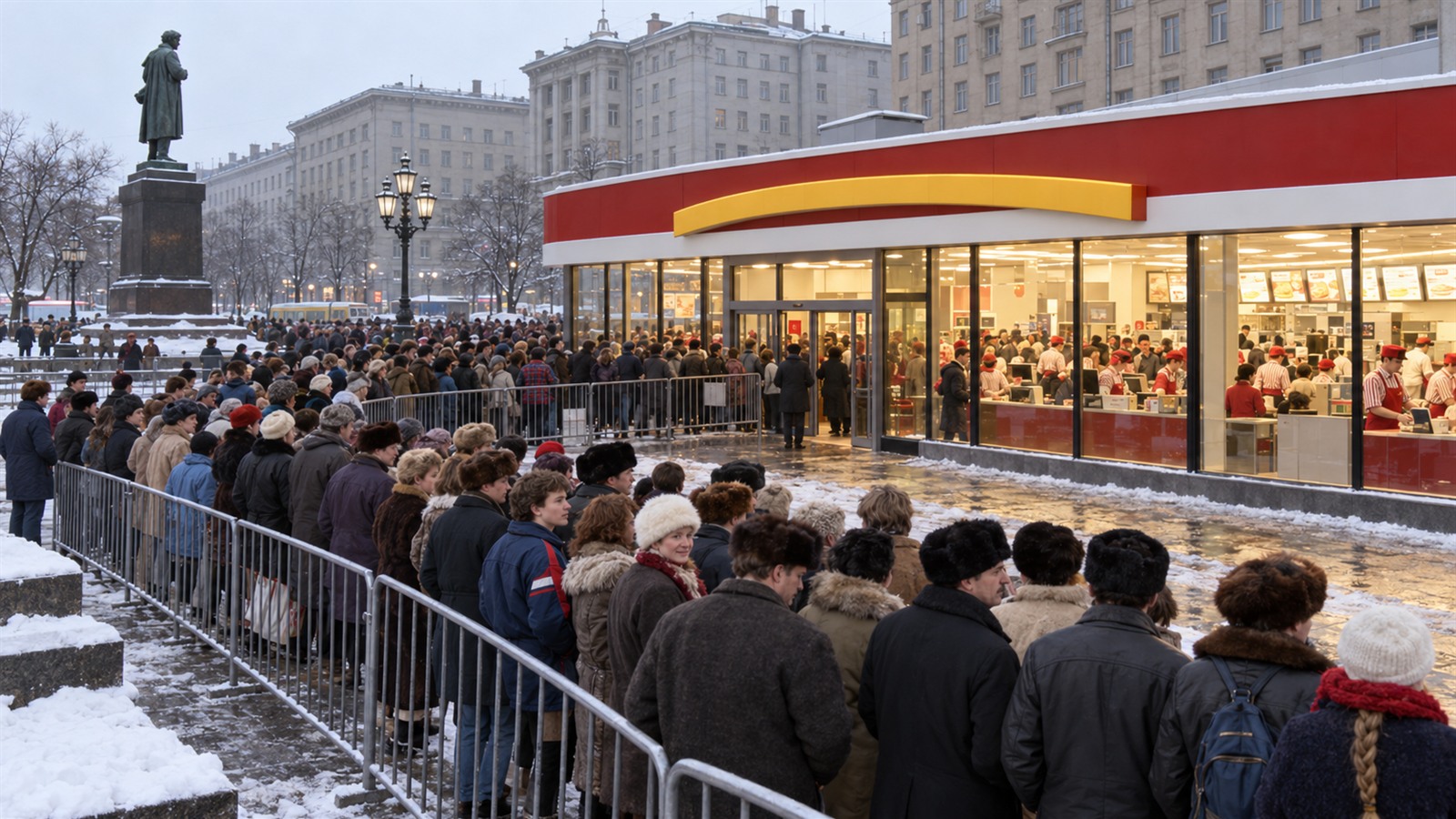
On January 31, 1990, the first McDonald's in Moscow opened in Pushkin Square. More than 30,000 people reportedly passed through the restaurant that day, forming a long winter queue outside the large, busy dining room. The opening followed 14 years of negotiation led by George Cohon of McDonald's Canada, beginning after he met Soviet officials during the 1976 Montreal Olympics. It arrived during perestroika, when Soviet policy was cautiously permitting new forms of foreign investment and consumer exchange. For many visitors, the restaurant offered not only a hamburger but a highly visible encounter with Western service, standardized production and corporate presentation.
The venture could not simply import a normal franchise kit. McDonald's formed a joint venture with the Moscow city government and invested in a supply network able to meet its specifications. A processing complex produced buns, meat patties, dairy products and other ingredients because local suppliers could not reliably provide the required volume and consistency. The company trained hundreds of employees in food preparation, cleaning, speed and customer interaction. Even the unfamiliar practice of smiling at customers required instruction. This vertical integration made the restaurant possible, but it also raised the capital and organizational commitment far beyond that of opening an ordinary location in an established market.
Price and payment reflected the unusual setting. Meals were expensive relative to average wages, yet demand on opening day exceeded expectations. The company initially accepted rubles even though the currency was not freely convertible, showing that market entry served long-term positioning as much as immediate profit repatriation. The restaurant's scale—hundreds of seats and dozens of cash registers—turned operations into spectacle. Customers watched a repeatable process, uniformed staff and a menu delivered with a consistency associated with the chain elsewhere. That experience made service design itself part of the product, alongside food and recognizable packaging.
The Moscow opening became one of the most memorable corporate entries of the late Cold War, although later political and economic change would repeatedly test the business. Its significance on January 31 lies in the preparation behind the famous queue. McDonald's spent years building government relationships, adapting ownership, constructing supply capacity and training a workforce before serving its first customer. The result demonstrates that international expansion is not merely exporting a brand. Companies entering structurally different markets may have to recreate the institutions they normally take for granted—suppliers, quality systems, logistics, payment arrangements and service culture. A dramatic launch can attract attention, but durable market entry begins much earlier in the patient construction of an operating ecosystem.
George Cohon of McDonald's Canada began discussions with Soviet officials in 1976, starting a 14-year negotiation over ownership and operations.
A joint venture with the Moscow city government gave the company a legal route into a market that lacked a normal Western franchise structure.
On January 31, 1990, the Pushkin Square restaurant opened and served more than 30,000 customers despite winter weather and high relative prices.
McDonald's built a dedicated processing and distribution system for meat, buns and dairy products because existing suppliers could not meet its standards.
Hundreds of employees were trained in standardized preparation, cleanliness, speed and a customer-service style unfamiliar in many Soviet businesses.
The opening became a symbol of economic change and a case study in how foreign brands must sometimes construct an entire local ecosystem before expansion.
Explore more of "On This Day ..."
Discover more events from the same date across news, politics, technology, sports, and other fields. Each link highlights significant moments that shaped history on different fronts.