

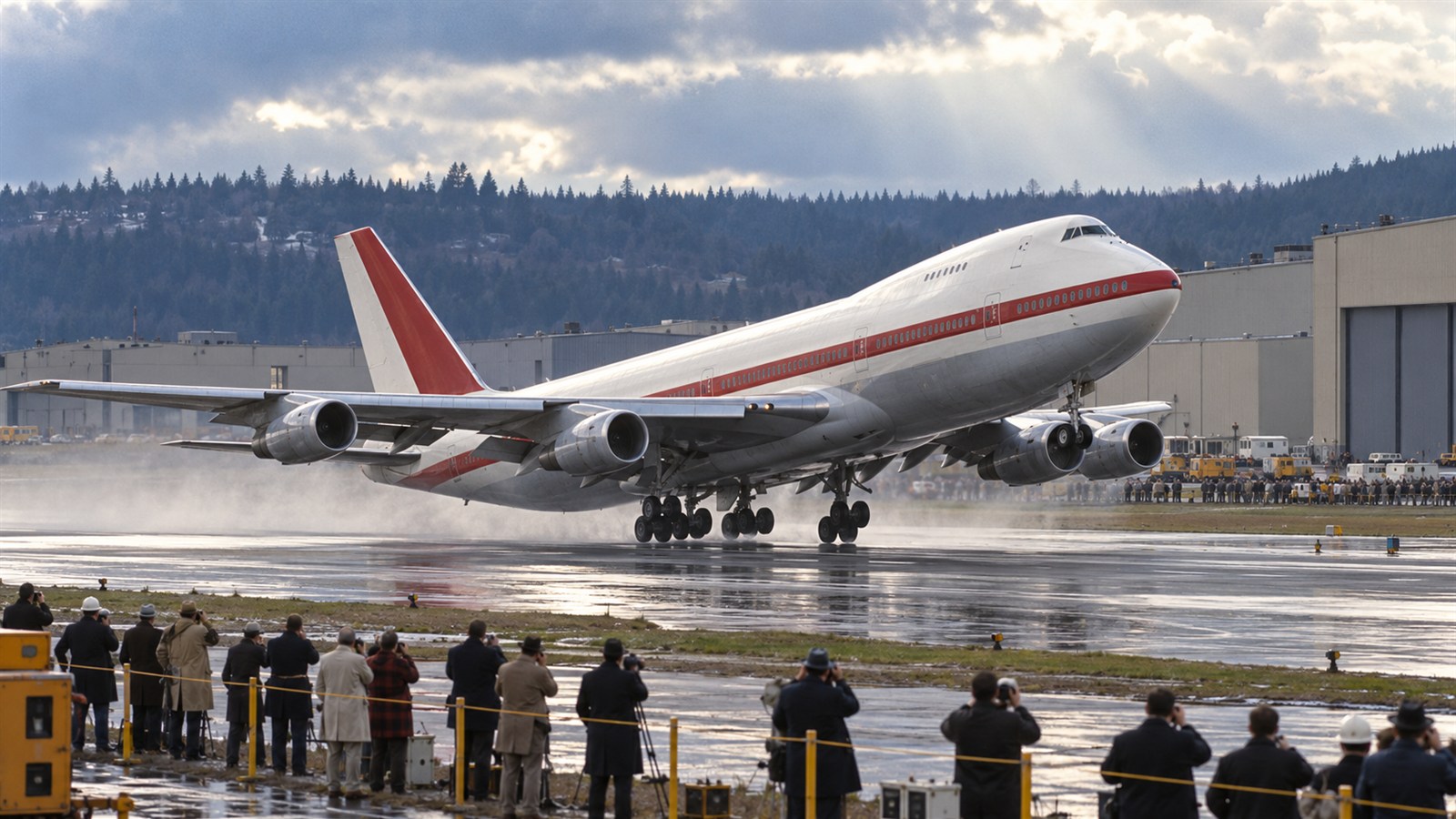
On This Day in Business: February 9, 1969
On February 9, 1969, the first Boeing 747 lifted off from Paine Field near Everett, Washington. Test pilots Jack Waddell and Brien Wygle, with flight engineer Jess Wallick, took the enormous prototype through a flight lasting a little more than an hour. The aircraft's distinctive upper-deck hump, wide fuselage and four engines made it unlike any passenger jet already in service. Its successful return did not end the test program, but it proved that a machine created on an extraordinary schedule could fly and handle as its designers intended.
The project began with a market wager. Pan American World Airways wanted an airliner far larger than the Boeing 707, believing that lower seat-mile costs could make long-distance flying accessible to many more people. Boeing committed to the design before it possessed a factory large enough to build it. The company constructed the Everett plant while engineers led by Joe Sutter developed the aircraft and suppliers created new engines, systems and tooling. The program required billions of dollars in contemporary investment and placed intense pressure on Boeing's finances; a major delay or technical failure could have threatened the company.
The 747's scale changed airline operations. Two aisles accelerated boarding and allowed flexible passenger or cargo layouts. The upper cockpit made it possible for the nose to swing open on freighter versions, reflecting expectations that supersonic aircraft might eventually take over premium passenger service. Airports lengthened gates and adapted baggage, catering and maintenance systems. Airlines could move far more travelers on dense routes, spreading fixed crew and fuel costs across hundreds of seats. When Pan Am introduced service in January 1970, the jet became a symbol of mass international travel.
February 9 marks the moment when a high-risk industrial ecosystem became airborne. Boeing's achievement depended on an anchor customer, a new factory, a global supplier base, certification work and airlines willing to redesign ground operations. The aircraft later carried presidents, freight, satellites and millions of ordinary travelers, while its cargo capacity remained valuable even as newer twin-engine jets replaced it on many passenger routes. The 747 demonstrates how a breakthrough product can force complementary industries to invest around it. Its commercial power came not just from size but from reducing the unit economics of distance and giving operators a platform that could serve several markets for more than half a century. Its launch also illustrates the danger of irreversible commitments. The factory, tooling and supplier contracts had to be funded before sales were certain, so the same scale that promised low unit costs magnified the consequences of weak demand or technical delay.
Pan Am pressed for a much larger airliner that could lower seat-mile costs and expand the economics of intercontinental passenger service.
Boeing built its Everett factory while Joe Sutter's engineering team and a wide supplier network developed the aircraft under severe time and financial pressure.
On February 9, 1969, the first 747 completed a successful maiden flight from Paine Field with a three-person test crew.
The wide body, two aisles and elevated cockpit supported high passenger capacity while preserving a practical path to nose-loading freighter versions.
Airlines and airports invested in gates, maintenance, baggage and catering systems designed for a jet carrying far more people than earlier aircraft.
Passenger service began in 1970, and the 747 went on to reshape long-distance travel, heavy cargo operations and Boeing's global industrial position.
Explore more of "On This Day ..."
Discover more events from the same date across news, politics, technology, sports, and other fields. Each link highlights significant moments that shaped history on different fronts.