

On This Day in Business: March 12, 1901
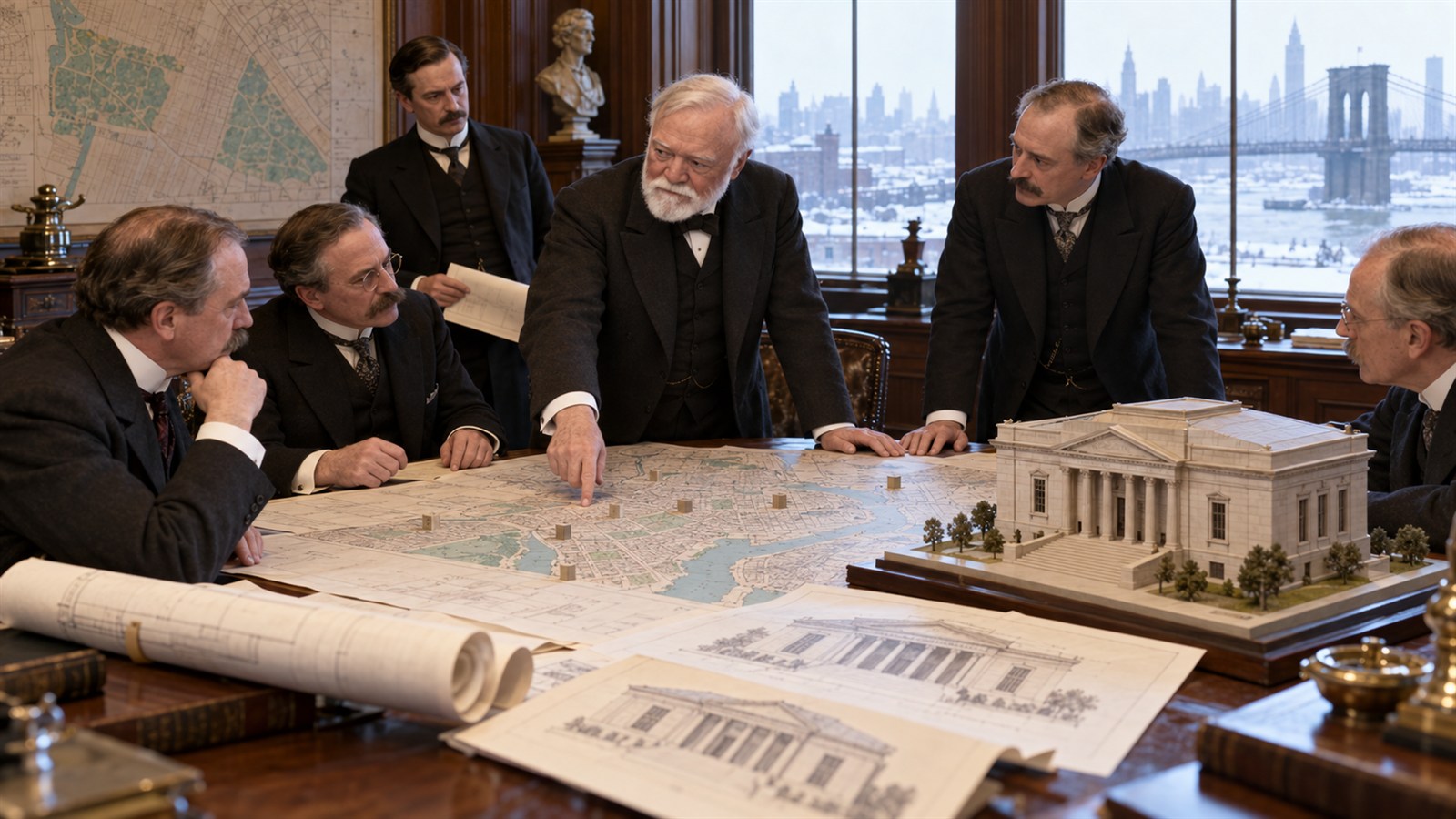
On March 12, 1901, Andrew Carnegie offered New York City $5.2 million to build sixty-five branch libraries. The gift was extraordinary in scale, but it came with an operating condition: the city had to provide sites, maintain the buildings, and support them with public funds. Carnegie believed libraries offered motivated people tools for self-education, reflecting his own experience as a young worker with access to books. The arrangement joined private capital to long-term municipal responsibility rather than treating philanthropy as a one-time construction project.
The offer arrived as New York's population and neighborhoods were expanding. The recently consolidated city needed local institutions that residents could reach without traveling to a grand central library. Standardized but individually designed branches created visible civic anchors across Manhattan, the Bronx, and Staten Island, while separate arrangements supported Brooklyn and Queens. Architects, librarians, officials, and community leaders had to select sites and adapt buildings to dense urban conditions. The program therefore became a large public-private development effort as well as a cultural investment.
Carnegie's model imposed discipline on both donor and recipient. Funding buildings without books, staff, heat, and maintenance would have produced impressive but fragile monuments. Requiring annual public support encouraged cities to calculate their continuing commitment before accepting a grant. Critics could still question the influence of a wealthy industrialist or the sources of his fortune, particularly his record in labor conflict. Yet the operating compact helped many libraries survive beyond the ceremony of opening day and embedded them in municipal budgets.
The New York offer demonstrates that infrastructure philanthropy works best when capital and operations are designed together. Carnegie funded a network of useful assets, while the city assumed responsibility for service delivery and continuity. Branch libraries supported literacy, job seeking, education, civic participation, and access to information for generations of residents. In business terms, the grant converted private wealth into distributed public capacity, with governance rules intended to preserve the investment. March 12 marks a deal whose enduring value came not just from generous construction money but from a plan for keeping every door open. The branches also produced option value that no donor could specify in advance. As neighborhoods changed, buildings supported children's programs, language learning, research, public computing, and help navigating new forms of information. A durable local institution could adapt because staff and communities, not the original grant agreement, selected the services. The gift's best feature was therefore not architectural uniformity but a funding structure that allowed public purpose to continue after the founder's priorities and technology had changed.
Rapid population growth left many New York neighborhoods far from convenient library service at the start of the twentieth century.
Carnegie favored free libraries as instruments of self-improvement and used grants to encourage cities to make lasting public commitments.
His March 12 offer provided $5.2 million for sixty-five branches if New York supplied sites and continuing operating support.
The city still had to coordinate land, architects, librarians, construction, collections, staffing, and separate borough library systems.
Dozens of Carnegie branches became neighborhood institutions and part of the physical identity of public library service in New York.
The agreement remains a model for pairing philanthropic capital with accountable public funding for long-term operations.
Explore more of "On This Day ..."
Discover more events from the same date across news, politics, technology, sports, and other fields. Each link highlights significant moments that shaped history on different fronts.