

On This Day in Business: March 19, 1799
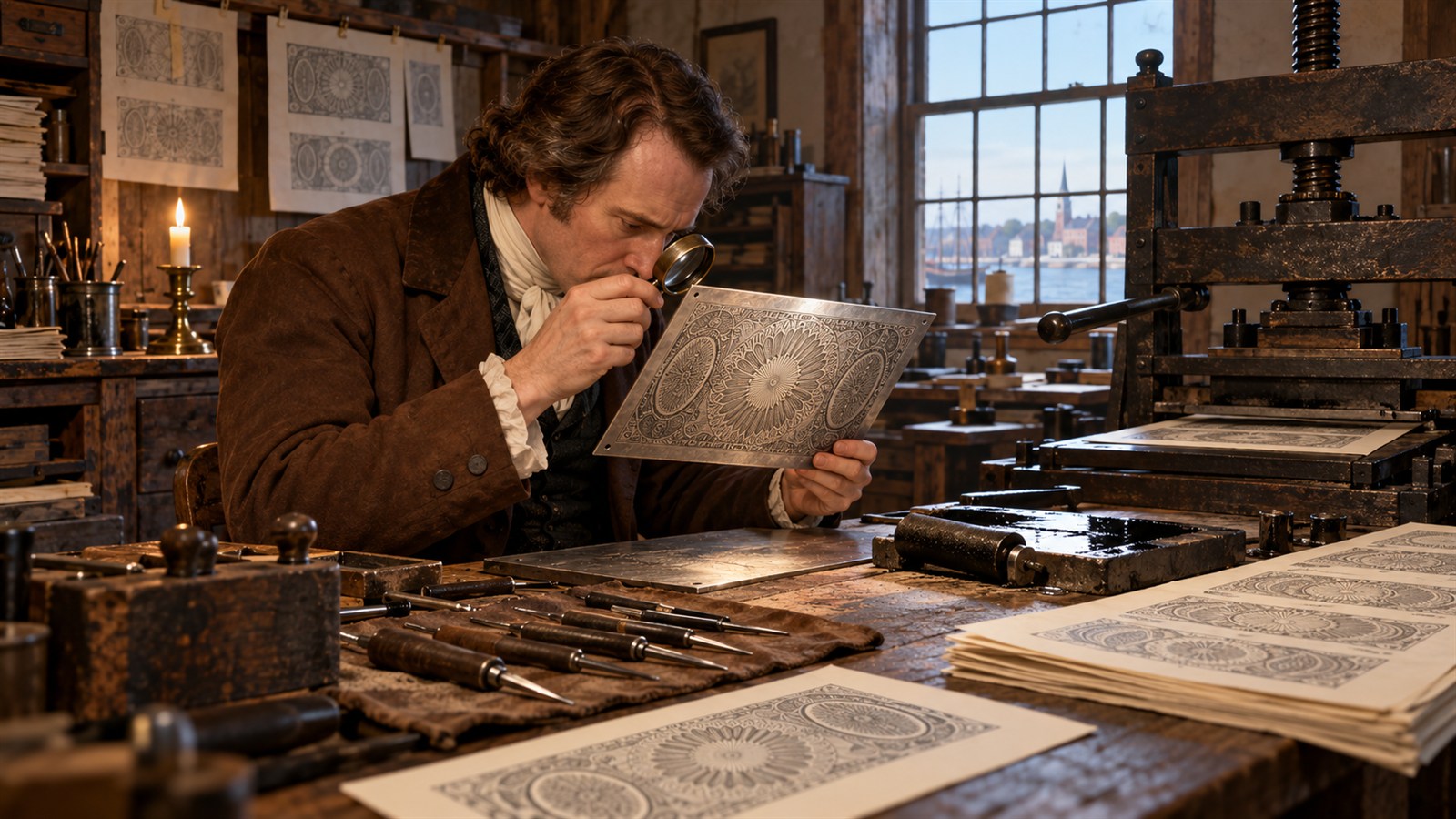
On March 19, 1799, Jacob Perkins received a United States patent for an invention to detect counterfeit notes. It is commonly identified as the country's first financial patent. The Massachusetts inventor and engraver developed methods that made bank-note designs more difficult to imitate, including the use of hardened steel plates and intricate repeated patterns. In an era when many banks issued their own paper currency and notes traveled far from the institution named on them, forgery threatened confidence in everyday exchange.
Counterfeiting was an information problem as much as a printing crime. Merchants and consumers had to judge whether a piece of paper represented real value, often without rapid access to the issuing bank. Detailed engravings, consistent production, and recognizable security features raised the skill and equipment required for imitation. Perkins turned that need into a specialized business capability. His work linked mechanical invention, art, metallurgy, and printing, demonstrating that financial infrastructure depends on physical technologies as well as laws and institutions.
The patent system offered a way to disclose and protect the technique, but adoption still required customers and credibility. Banks needed to believe that improved plates would reduce losses enough to justify their cost, and note users had to recognize trustworthy designs. Security was never final because counterfeiters adapted. That continuing contest encouraged better engraving, paper, inks, serial controls, and eventually centralized currency production. The basic commercial relationship remained: institutions invested in authentication to preserve the value of the promises printed on their notes.
Perkins's patent marks an early intersection of finance and technology in the United States. Modern payments may rely on chips, cryptography, networks, and fraud models rather than engraved steel, yet the economic task is similar. A payment instrument must be easy for legitimate users to accept and costly for attackers to reproduce. Effective security also needs standards, distribution, and public familiarity. The March 1799 grant shows that financial innovation is not limited to new forms of credit; it also includes tools that make existing value claims safer to create, verify, and circulate. Security design also changes behavior. Features must be difficult for criminals to reproduce yet simple enough for cashiers and customers to use under time pressure. Excess complexity can cause legitimate notes to be rejected or make training expensive. Perkins's approach embedded authentication in the object itself, allowing visual inspection to travel with the note. Modern payment systems continue that balance, combining invisible technical controls with recognizable signals that help ordinary users decide whether to trust a transaction.
Early American commerce used many locally issued bank notes, making authenticity difficult to judge when money circulated far from its issuer.
Jacob Perkins applied engraving, hardened steel, and complex repeated designs to make fraudulent reproduction more difficult and expensive.
His anti-counterfeiting invention received a U.S. patent on March 19, 1799, the first American patent commonly classified as financial.
The method could not eliminate fraud; banks still needed consistent printing and users needed enough familiarity to recognize legitimate features.
Security printing continued to develop through specialized firms, standardized currency, improved materials, and increasingly sophisticated authentication.
The patent established a lasting fintech principle: confidence depends on making legitimate transactions convenient and successful attacks costly.
Explore more of "On This Day ..."
Discover more events from the same date across news, politics, technology, sports, and other fields. Each link highlights significant moments that shaped history on different fronts.